
By Maj Gen Harvijay Singh, SM
A power that seeks unlimited objectives in an unlimited battlespace eventually collides with the limits of its own endurance.
Before taking Netanyahu’s bait, America failed to analyse that Venezuela was a backyard limited objective, while Iran was a regional system- an unlimited objective.
The Concept of Limited vs Unlimited Objectives
– Keep the objective modest and the means overwhelming. That is the mathematics of victory and not the burden of a political stalemate.
– Success demands a pause. Reorganise first, do not rush to the next objective – victory may just convert into vulnerability.
– Do not seek grand victories; choose limited objectives and reject those which cannot be realistically achieved.
– Bottom Line: Only limited objectives are achievable; the rest are illusions.
Soldiers chase objectives, Politicians Pursue Optics.
The most typical illustration of expanding objectives is the mistake which MacArthur made in the Korean War. MacArthur initially fought a limited defensive war to repel North Korea’s invasion. After the Inchon landing succeeded, he shifted toward a maximalist objective: the total unification of Korea and the destruction of the North Korean regime. A shift from ‘repel aggression’ to ‘unify Korea’ to ‘defeat China’, from limited to unlimited.
Afghanistan followed a similar fatal trajectory: a shift from “destroy al-Qaeda and deny safe havens” to “remove Taliban” to “build a democratic state, reform society, create a national army, reshape governance”, a shift from limited to unlimited.
Understanding the Key Domains of Modern Conflict
Modern conflicts are no longer confined to traditional domains. War can be waged through any means, financial, cyber, media, legal, diplomatic, economic, psychological, blurring the line between war and peace, battlefield and non-battlefield, soldier and civilian.
In the very first superior technology aerial attack against Iran, around 170 primary school girls were tragically killed. All these domains were visible in the West Asia War:
– Financial Warfare: Currency attacks, sanctions, market disruption, blockade of sea routes.
– Lawfare: Using courts, treaties (NPT), and regulations to constrain or delegitimize an adversary.
– Media Warfare: Narrative control, disinformation, perception shaping.
– Cyber Warfare: Attacks on networks, grids, data, and communications.
– Economic Warfare: Trade pressure, supply-chain disruption, resource denial.
– Psychological Warfare: Fear, confusion, morale erosion.
These non-kinetic tools, drawn from the concepts outlined in Unrestricted Warfare, were employed extensively alongside kinetic operations.
The Future of Conflicts Seen Through the Lens of Unrestricted Warfare
Future conflicts will be multi domain, continuous, and systemic, fought across every layer of national power. AI, quantum computing, biotechnology, and global networks will open new fronts and expose new vulnerabilities. States will compete through economic coercion, information dominance, and technological control. The battlefield will be everywhere: in markets, minds, and machines, all contested at once.
Victory will hinge on adaptability, creativity, and the seamless integration of every domain.
Lessons Learnt: Iran’s Resilience in the 40-Day War
Iran, an asymmetric opponent, demonstrated the capacity to absorb sustained pressure from a militarily superior adversary for 40 days and continue striking back. The lessons are structural, rooted in resilience, redundancy, and national preparedness:
– Cyber resilience and redundancy: Uninterrupted operation of Iran’s missile and drone control networks demonstrated the strength of a resilient digital infrastructure. Redundancies keep systems alive even under intense attack.
– Diversified supply chains: Iran’s ability to function despite sanctions and wartime disruptions highlights the value of multi-source procurement, protected weapons manufacturing, underground stockpiling, and terrain-exploited parallel logistics channels. Nations that rely on single supply lines receive a rude shock when they face blockades or war, even one broken artery can collapse the entire system.
– Stronger financial regulation: Despite years of sanctions, Iran maintained alternate trade and financial channels. During the conflict, it even imposed a ‘toll’ on ships transiting the Strait of Hormuz. Financial resilience is national-security resilience.
– Counter-narratives: Iran’s ability to maintain internal cohesion under extensive bombardment and sustain effective leadership despite the loss of multiple commanders reflects high organisational resilience. Its tight control of social media and rapid counter-narratives reinforced internal stability. Iran’s internal cohesion under stress highlighted the power of shared national identity, something many modern democracies find difficult to maintain.
– Whole-of-nation security planning: Iran’s response involved multiple layers, Military, Paramilitary, Civil Defence, Energy sector, Diplomatic, and Information networks. Modern conflict is multi-domain; resilience requires every sector to be mobilised.
Strength is not about matching firepower. It is about standing together as one nation.
Strategic Geography and the Cost of the Conflict
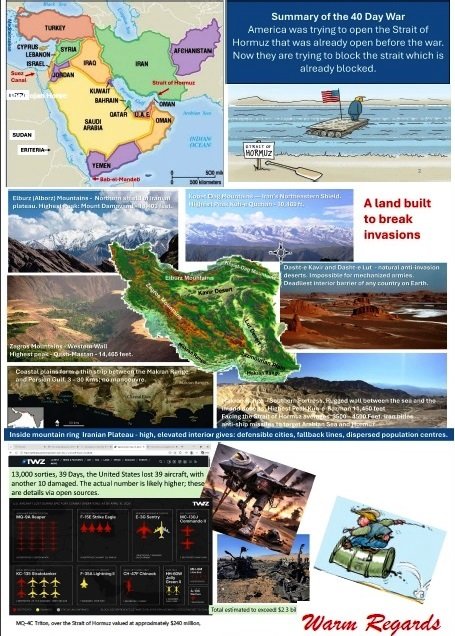
Iran’s geography played a decisive role. The country is a natural fortress, ringed by the Zagros and Elburz mountains, with vast deserts (Dasht-e Kavir and Dasht-e Lut) forming an almost impenetrable interior barrier. Its coastal plains are narrow, and the elevated Iranian Plateau provides depth for defensive cities, fallback lines, and dispersed population centres.
The attempt to open the Strait of Hormuz, which America had kept ready to open before the war, ended with the strait effectively blocked. The financial cost to the United States was staggering, over 13,000 sorties in 39 days, with dozens of high-value aircraft lost or damaged, and the total estimated cost exceeding $2.3 billion. One MQ-4C Triton drone alone was valued at approximately $240 million.
Conclusion
The 40-day war in West Asia has become the first major example of Unrestricted Warfare in practice. A militarily superior coalition collided with an opponent that refused to play by the old rules of symmetric confrontation. Iran did not need to match American firepower; it simply needed to endure, adapt, and strike back across multiple domains while leveraging its geography and whole-of-nation resilience.
For India and other nations watching this conflict closely, the message is clear. In an era of unrestricted warfare, victory belongs not to the side with the most advanced platforms, but to the side that builds systemic resilience, maintains strategic restraint on objectives, and mobilises the entire nation.
Limited objectives, overwhelming means in chosen domains, and ironclad national cohesion, these remain the timeless principles of victory, even in the age of multi-domain operations.

contact: drrajeshjauhri@gmail.com
Dr Rajesh Jauhri is a Journalist with an experience of over 25 years in Indian and foreign media, a Social Scientist, an Ac-complished Author, a Political & Strategic Analyst, a Marksman (Rifle & Pistol), an Orator, a Thinker and an Educationist. He holds a Ph.D. degree on “Impact of colonial heritage on Indian police”. He runs an NGO dedicated to the social and eco-nomic uplift of tribal communities in MP and two decades back, he established a school in a village of Indore district, providing education and moral values to children belonging to underprivileged and minority families. Has received multiple awards in various fields.