

Rewa, Madhya Pradesh: In a poignant display of humility and institutional pride, Gen Upendra Dwivedi, Chief of the Army Staff (COAS), visited his alma mater, Sainik School Rewa, on Tuesday. The visit, marked by deep nostalgia and forward-looking inspiration, underscored the enduring role of India’s Sainik Schools in nurturing the nation’s military leadership.
Gen Dwivedi, who joined Sainik School Rewa in July 1973 and passed out in 1981, walked the same corridors and grounds that shaped his early years of discipline and character formation. Accompanied by the weight of his current responsibility as the 30th Chief of the Indian Army, the four-star general paid heartfelt tribute to the institution that laid the foundation for his distinguished career.
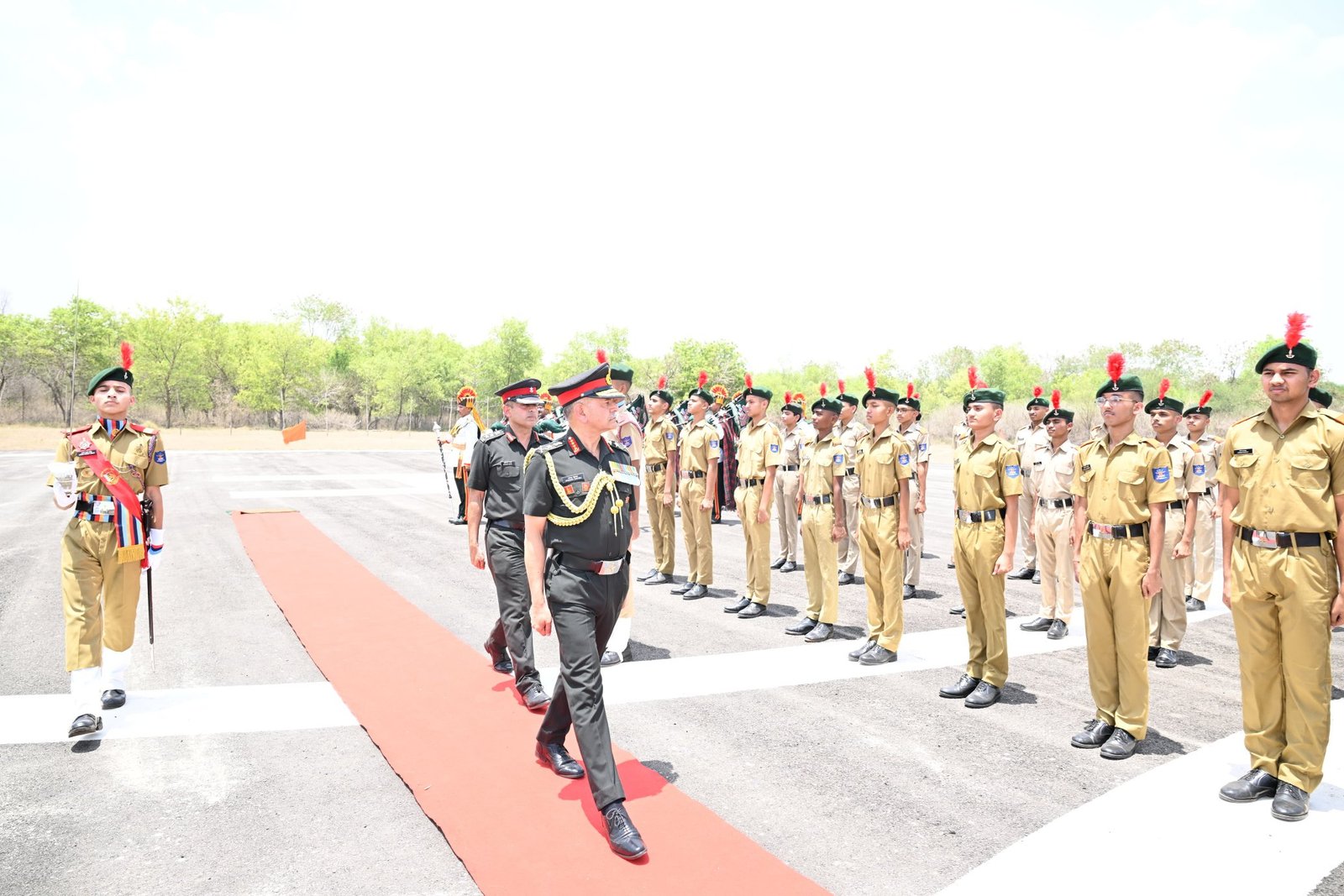
Upon arrival, the COAS laid a wreath at the school memorial, honouring the sacrifices of alumni and instilling a solemn reminder of the profession of arms. He then reviewed a smart Guard of Honour presented by the cadets, their crisp drill and bearing reflecting the high standards the school continues to uphold. General Dwivedi interacted warmly with faculty members and students, commending them for preserving the finest traditions of excellence, integrity, and selfless service.
Sainik School Rewa, established on July 20, 1962 at the historic Yuvraj Bhawan estate generously provided by the former princely state of Rewa, stands as one of India’s pioneering institutions dedicated to preparing young boys for careers in the armed forces. Over six decades, the fully residential, English-medium school, affiliated to the Central Board of Secondary Education, has produced nearly 950 officers for the Indian military. Its motto, “Knowledge is Power,” continues to guide generations of cadets who learn not just academics but also the values of leadership, physical endurance, and national commitment under a rigorous regimen that blends education with military-style discipline.
For Gen Dwivedi, the return carried special resonance. Born on July 1, 1964, he was commissioned into the 18 Jammu and Kashmir Rifles on December 15, 1984 after training at the National Defence Academy and Indian Military Academy. His career trajectory, from infantry officer to Army Commander and finally COAS, exemplifies the transformative impact of early foundational training received at institutions like Sainik School Rewa. Notably, his classmate from the 1970s, Admiral Dinesh Kumar Tripathi, currently serves as Chief of the Naval Staff, making theirs a rare and historic instance of two alumni from the same school batch leading India’s Army and Navy simultaneously.
In his address to the young cadets, Gen Dwivedi drew from personal memories of his school days, urging them to lead with unwavering integrity, serve with dedication, and remain committed to the nation above all else. He emphasised that true leadership is forged not in moments of glory but through consistent discipline, ethical decision-making, and resilience in adversity, qualities the Sainik School system deliberately cultivates.
The visit also served as a powerful reaffirmation of the Sainik Schools’ strategic importance in India’s nation-building architecture. With over 30 such institutions across the country, they function as vital feeders to the National Defence Academy and other officer training academies. In an era of rapid technological change, hybrid warfare threats, and the need for agile, tech-savvy leaders, the emphasis on character-building alongside modern education remains more relevant than ever.
Defence analysts often point out that the success stories emerging from Sainik Schools highlight a uniquely Indian model: democratic access to high-quality military-oriented education that transcends regional, linguistic, and socio-economic barriers. General Dwivedi’s journey from the grounds of Rewa to South Block in New Delhi stands as living testimony to this model’s efficacy.
As he departed the campus, the COAS left behind not just fond reminiscences but a renewed sense of purpose among the current generation of cadets. Many who watched him review the Guard of Honour or listened to his words will likely carry the image of their Chief—once a cadet like them—returning as the head of the world’s second-largest army.
In today’s complex security landscape, where the Indian Armed Forces are modernising rapidly under initiatives focused on Atmanirbharta, indigenous technology integration, and theatre commands, the human capital developed in places like Sainik School Rewa assumes even greater significance. General Dwivedi’s homecoming was more than a personal milestone; it was a public acknowledgement that the foundations of India’s military strength are laid early, in institutions that instil timeless values while preparing youth for contemporary challenges.
The Indian Army, through such gestures, continues to reinforce the bond between its leadership and the training ecosystem that sustains it. For Sainik School Rewa, this visit by its illustrious alumnus will undoubtedly serve as a lasting source of motivation, reminding every cadet that the path from these grounds can indeed lead to the highest echelons of national service.
contact: drrajeshjauhri@gmail.com
Dr Rajesh Jauhri is a Journalist with an experience of over 25 years in Indian and foreign media, a Social Scientist, an Ac-complished Author, a Political & Strategic Analyst, a Marksman (Rifle & Pistol), an Orator, a Thinker and an Educationist. He holds a Ph.D. degree on “Impact of colonial heritage on Indian police”. He runs an NGO dedicated to the social and eco-nomic uplift of tribal communities in MP and two decades back, he established a school in a village of Indore district, providing education and moral values to children belonging to underprivileged and minority families. Has received multiple awards in various fields.