

Jaipur: As senior Indian military commanders convene in Jaipur for a high-level conference marking the first anniversary of Operation Sindoor, the message from New Delhi is unequivocal: precision, resolve, and a transformed deterrence posture now define India’s approach to cross-border terrorism. The operation, launched in response to the horrific April 22, 2025, Pahalgam terrorist attack that claimed 26 innocent lives, tourists belonging to a particular ethnic group were targeted in a communal massacre, represented a calibrated yet decisive strike against the infrastructure of terror operating with impunity from Pakistani soil and Pakistan-occupied Kashmir (PoK).
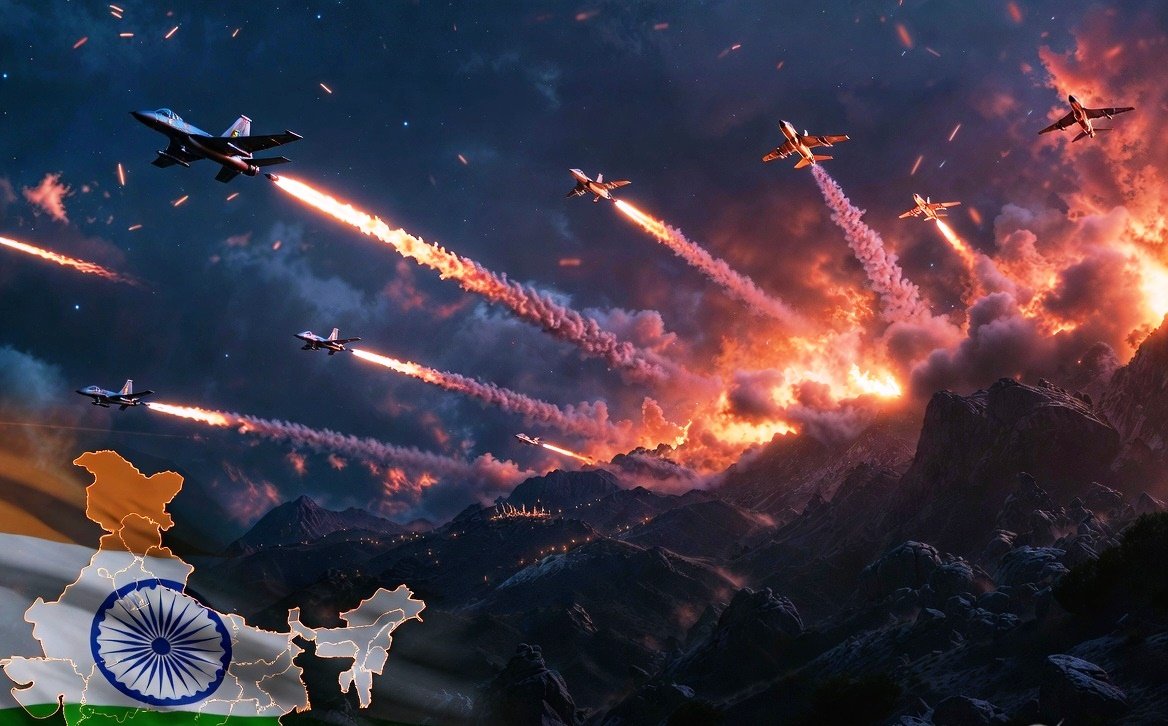
Indian forces executed airstrikes and precision missile attacks on nine terror camps linked to groups such as Lashkar-e-Taiba (LeT) and Jaish-e-Mohammed (JeM) between May 7 and 10, 2025. These facilities, including sites in Punjab province and PoK, had long served as launch pads for attacks inside India. Official accounts describe the strikes as surgical, focused on terrorist infrastructure while deliberately avoiding broader civilian or Pakistani military targets in the initial phase. The operation underscored India’s growing capability in network-centric warfare, real-time intelligence fusion, and standoff munitions.
Pakistan’s response, packaged under names like ‘Marka-e-Haq’ (Battle for Justice) and ‘Bunyan-un-Marsoos’, framed the episode as an assault on its sovereignty. Islamabad predictably denied any involvement in the Pahalgam outrage, despite well-documented links between these terror outfits and elements within its establishment, and retaliated with drone and missile exchanges. Yet, the pattern remains familiar: a major terror attack on Indian soil, followed by Pakistani denials, rhetorical escalation, and attempts to internationalize the Kashmir dispute while shielding perpetrators.
The four-day crisis, which included intense aerial engagements and cross-border fire, ended in a ceasefire facilitated through direct hotline communications. Both sides claimed successes, but independent assessments and post-strike imagery released by India highlighted the degradation of key terror-related sites and demonstrated a marked asymmetry in precision strike capabilities and air dominance. India suffered minor losses but achieved its core objectives of imposing costs on terror networks.
Today’s Joint Commanders’ Conference in Jaipur, attended by top leadership including Defence Minister Rajnath Singh, celebrates not only the operational success but also lessons in multi-domain integration, cyber, space, and cognitive warfare, under the theme of bolstering military capabilities in emerging domains. It reflects a broader doctrinal shift: zero tolerance for terrorism and a willingness to strike at its sources regardless of nuclear posturing.
In contrast, Pakistani commemorations emphasize national unity and defensive triumphs, a narrative that conveniently sidesteps its longstanding role as a breeding ground and exporter of Jihadist Militancy. Decades of evidence, from UN designations of LeT and JeM to repeated FATF scrutiny, paint a troubling picture of a state that has weaponized terror as an instrument of asymmetric warfare while seeking international sympathy when held accountable.
The Pahalgam attack and Operation Sindoor have further crystallized the shifted deterrence landscape in South Asia. India has signalled that the era of strategic restraint in the face of repeated provocations is over. Kashmir remains a flashpoint, but the onus now lies heavily on Pakistan to dismantle terror ecosystems operating from its territory. Until Islamabad chooses credible action over denial and patronage, cycles of violence will persist, threatening regional stability.
For the international community, particularly defence establishments monitoring nuclear-armed rivals, the events of May 2025 offer a stark reminder. State sponsorship of terrorism carries tangible military and diplomatic costs. India’s measured response has not only defended its sovereignty but also exposed the fragility of Pakistan’s dual policy, projecting victimhood abroad while nurturing proxies at home.

contact: drrajeshjauhri@gmail.com
Dr Rajesh Jauhri is a Journalist with an experience of over 25 years in Indian and foreign media, a Social Scientist, an Ac-complished Author, a Political & Strategic Analyst, a Marksman (Rifle & Pistol), an Orator, a Thinker and an Educationist. He holds a Ph.D. degree on “Impact of colonial heritage on Indian police”. He runs an NGO dedicated to the social and eco-nomic uplift of tribal communities in MP and two decades back, he established a school in a village of Indore district, providing education and moral values to children belonging to underprivileged and minority families. Has received multiple awards in various fields.