


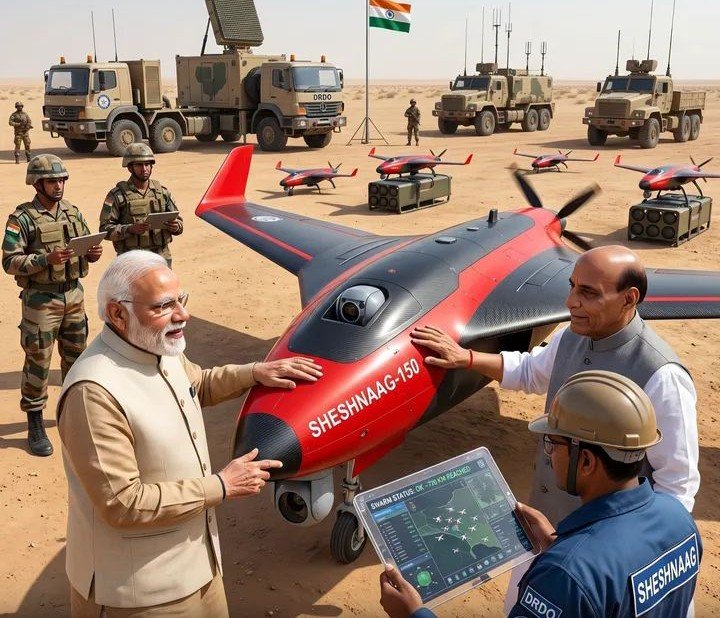
In a significant stride for India’s indigenous defence capabilities, the Sheshnaag-150 swarming attack drone has successfully completed a long-range flight test at the Pokhran Field Firing Range on April 15, 2026. Developed by Bengaluru-based NewSpace Research and Technologies, the unmanned system demonstrated advanced precision-strike and autonomous coordination capabilities that could reshape the country’s tactical warfare doctrine.
According to details from the trial, the drone navigated an approximately 720-kilometre flight path over five hours, accurately engaging its designated target. While the test validated its operational reliability, developers indicate that the platform is engineered for a maximum strike range exceeding 1,000 kilometres—placing it firmly in the category of long-range tactical systems.The Sheshnaag-150 is designed to carry a payload of 25 to 40 kilograms, enabling it to effectively target critical infrastructure, military vehicles, and fortified positions. However, its most notable feature lies in its resilience to electronic warfare. The system can operate in GPS-denied environments using visual navigation and onboard sensor fusion, reducing vulnerability to signal jamming, a growing concern in modern conflicts.
Equally transformative is its integration of artificial intelligence-driven swarm technology. Multiple drones can coordinate in real time, executing simultaneous saturation attacks aimed at overwhelming adversary air defence systems. This capability mirrors evolving global trends in autonomous warfare, where coordinated drone swarms are increasingly seen as force multipliers.Strategically, the successful test underscores progress under India’s Aatmanirbhar Bharat initiative, which seeks to reduce dependence on foreign defence imports. Defence analysts suggest that platforms like the Sheshnaag-150 could offer a cost-effective alternative to conventional cruise missiles for deep-strike missions, particularly along sensitive frontiers such as the Line of Actual Control and the Line of Control.Notably, the system’s rapid evolution, from its initial flight trials in 2025 to a successful extended-range demonstration within a year, indicates that it may be approaching operational induction. If deployed, the Sheshnaag-150 could mark a pivotal shift in India’s offensive and deterrence capabilities, reflecting a broader transition toward autonomous, network-centric warfare systems.

contact: drrajeshjauhri@gmail.com
Dr Rajesh Jauhri is a Journalist with an experience of over 25 years in Indian and foreign media, a Social Scientist, an Ac-complished Author, a Political & Strategic Analyst, a Marksman (Rifle & Pistol), an Orator, a Thinker and an Educationist. He holds a Ph.D. degree on “Impact of colonial heritage on Indian police”. He runs an NGO dedicated to the social and eco-nomic uplift of tribal communities in MP and two decades back, he established a school in a village of Indore district, providing education and moral values to children belonging to underprivileged and minority families. Has received multiple awards in various fields.