
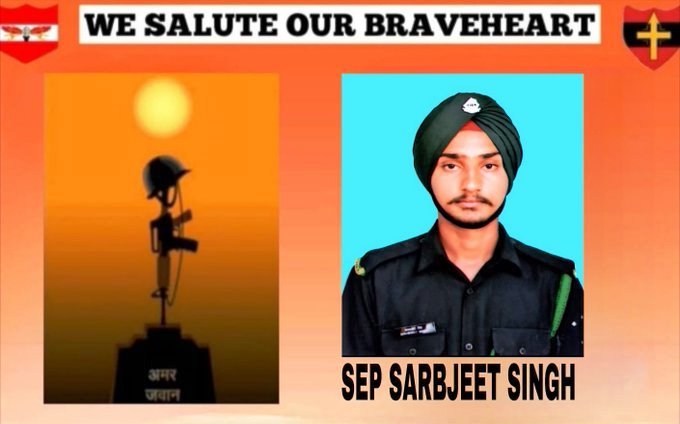
The Fire & Fury Corps (XIV Corps) of the Indian Army has paid tribute to Sepoy Sarbjeet Singh, who made the supreme sacrifice while serving in the line of duty on the Siachen Glacier on June 16, 2026. In a statement, the Corps Commander and all ranks saluted the brave soldier’s “unwavering devotion to duty, courage, and selfless service to the nation.” The Army expressed solidarity with the bereaved family, offering deepest condolences in their hour of grief.
Siachen, often described as the world’s highest and harshest battlefield, continues to exact a heavy toll. Located in the Karakoram Range at altitudes exceeding 5,400 metres (average) and stretching approximately 76 km, the glacier presents extreme environmental challenges. Temperatures routinely plummet to minus 50°C or lower, accompanied by blizzards with winds exceeding 300 km/h, frequent avalanches, and critically low oxygen levels. Frostbite, high-altitude pulmonary oedema, and other altitude-related ailments remain constant threats. Despite advances in high-altitude warfare gear, logistics, and medical support, the terrain claims more lives than direct combat.
A Legacy of Strategic Resolve
The Indian Army’s presence on Siachen dates back to Operation Meghdoot, launched on April 13, 1984. Pre-empting Pakistani moves (Operation Ababeel), Indian forces secured the dominating heights along the Saltoro Ridge, including key passes such as Sia La, Bilafond La, and Gyong La. This audacious high-altitude operation, executed with close Army-Air Force coordination, established Indian control over the entire glacier and its tributaries.
The origins of the dispute trace to ambiguities in the 1949 Karachi Agreement and 1972 Shimla Agreement, which left the area north of NJ 9842 undemarcated. Pakistani cartographic assertions extending the Line of Control to the Karakoram Pass prompted India’s decisive action. Since 1984, India has maintained positions along the Actual Ground Position Line (AGPL), with the vast majority of casualties resulting from the unforgiving environment rather than enemy action.
Why India Holds Siachen
Strategically, Siachen remains vital. Control of the Saltoro Ridge provides a commanding overlook, preventing potential linkages between Pakistani and Chinese forces in the region and safeguarding approaches to Ladakh. It acts as a buffer against threats from Gilgit-Baltistan and denies adversaries tactical advantages in the tri-junction area near Aksai Chin. In an era of growing China-Pakistan infrastructure collaboration via CPEC, these heights offer enduring strategic depth and leverage in any future boundary negotiations.
Sepoy Sarbjeet Singh’s sacrifice underscores the quiet heroism of thousands of Indian soldiers who endure these extremes year-round. As the Army continues its vigil on the glacier, the nation remains indebted to these sentinels. Their resolve ensures that even in the most inhospitable corners of the frontier, India’s territorial integrity stands firm.
The tragedy also highlights the need for sustained investment in high-altitude technologies, better acclimatisation protocols, and environmental monitoring as climate change accelerates glacial melt and avalanche risks.
In the annals of military history, Siachen symbolises not just territorial defence, but an unparalleled testament to human endurance and national commitment.

contact: drrajeshjauhri@gmail.com
Dr Rajesh Jauhri is a Journalist with an experience of over 25 years in Indian and foreign media, a Social Scientist, an Ac-complished Author, a Political & Strategic Analyst, a Marksman (Rifle & Pistol), an Orator, a Thinker and an Educationist. He holds a Ph.D. degree on “Impact of colonial heritage on Indian police”. He runs an NGO dedicated to the social and eco-nomic uplift of tribal communities in MP and two decades back, he established a school in a village of Indore district, providing education and moral values to children belonging to underprivileged and minority families. Has received multiple awards in various fields.