

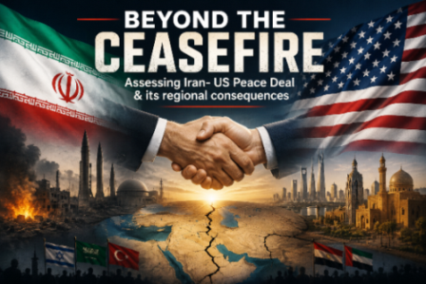
More than fifteen weeks after the outbreak of hostilities in end February 2026, US and Iran have declared a diplomatic breakthrough that may formally end the US blockade of Iranian ports and reopen Strait of Hormuz. The crisis has again demonstrated how regional conflicts in West Asia can quickly create global economic consequences. The agreement, slated to be signed in Geneva, Switzerland, on 19 June 2026, was first reported by Iran’s state-affiliated Mehr News Agency and subsequently, Reuters[i], citing senior Iranian officials and diplomatic sources, reported it on 12 June 2026
Though both governments have confirmed that a broad framework agreement has been finalised, the full text remains unclear. The declaration has nevertheless been welcomed by governments across Europe, Middle East and Asia, even as oil prices have fallen to their lowest levels in three months amid expectations of restored energy flows through the Gulf[ii]. However, uncertainties persist. Contradicting Iranian claims that the agreement includes cessation of hostilities on the Lebanese front, Israeli Defence Minister Israel Katz stated on 15 June 2026 that Israeli forces will not withdraw from southern Lebanon[iii]. Israel continued with strikes on Beirut, hours before the agreement was announced. The public expression of frustration from US President Donald Trump towards Prime Minister Benjamin Netanyahu, highlighted differences between Washington and Tel Aviv. As President Trump travels to Évian-les-Bains, France, for the G7 Summit beginning on 19 June, the agreement is expected to dominate discussions amongst world leaders[iv].
Against this backdrop, the key question on the outcome of the war persists. Though no official details are yet available, the proposed framework suggests an immediate ceasefire, reopening of the Strait of Hormuz, suspension of certain sanctions, phased release of frozen Iranian assets and a sixty-day negotiating period intended to produce a comprehensive agreement on Iran’s nuclear activities and sanctions relief. Reuters reported that the draft envisages the release of approximately US$25 billion in frozen Iranian funds[v]. Various international estimates place the value of Iranian assets immobilised by sanctions and financial restrictions at between US$100 billion and US$120 billion worldwide. These funds are reportedly spread across multiple jurisdictions, including China, Iraq, Japan, South Korea, Europe, Qatar and other nations. With Iran’s GDP estimated at roughly US$400 billion, the frozen assets represent a significant proportion of the country’s economic resources. Consequently, access to these funds has become almost as important to Tehran as sanctions relief itself.
From Iran’s perspective, the most important outcome is regime survival. States facing overwhelming military power often define victory as evading total collapse and preserving political sovereignty. Despite months of economic disruption, military strikes, and international pressure, the Islamic Republic remains intact[vi]. Iran’s demand for the release of frozen assets is rooted in years of economic isolation. Since reimposition of sanctions following the US withdrawal from JCPOA in 2018, Tehran has grappled to access its overseas earnings[vii]. If the reported agreement rolls out in its present form, Iran will be assured of sanctions relief, access to billions of dollars in frozen assets, and eventual reintegration into global economy[viii].
Yet it would be misleading to portray Iran having emerged unscathed. The conflict imposed considerable economic costs, disrupted oil exports, damaged infrastructure, and substantially weakened its military capabilities. Tehran’s ostensible commitment to freeze aspects of its nuclear programme and negotiate future restrictions indicates that it has accepted compromises.
On the other hand, critics of US’s approach contend that the reported terms suggest a significant scaling back of American objectives. If the original aims included regime change, a rollback of Iranian influence, or the dismantling of Tehran’s regional networks, the agreement in present form falls short. Iran’s political system remains intact, its regional partnerships endure, and its leadership retains control. However, the United States may define success differently[ix].
From Trump administration’s perspective, avoiding a prolonged military involvement while restricting Iran’s nuclear ambitions is being presented as a credible achievement rather than a retreat. US is claiming that its main concern was preventing Iran from securing nuclear weapons. The draft MoU reportedly includes an Iranian commitment not to develop nuclear weapons and establishes a framework for detailed negotiations on nuclear activities over the next sixty days. Domestic political considerations have shaped Washington’s approach. Rising energy prices, inflationary pressures, and concerns over voter sentiment ahead of future elections created strong motivations to stabilise the situation quickly.
Among the other principal actors, Israel faces the most challenging strategic reassessment. For years, its security policy focused on degrading Iran’s military capabilities, constraining Hezbollah’s influence, and thwarting Iranian nuclear weapon. While Israel inflicted significant damage on Iranian assets, there has been no decisive shift in the regional power balance. Critics argue that the MoU prioritises reopening trade routes, easing restrictions, and creating space for negotiations without asking major concessions from Iran on its nuclear programme or regional influence. Consequently, some Israeli officials fear that Iran could emerge economically and politically stronger, benefiting from sanctions relief and renewed economic activity while retaining much of its strategic leverage[x]. Israel can however claim that its unrelenting military pressure helped bring Iran back to the negotiating table and may have deterred Tehran’s strategic programmes[xi].
The most immediate beneficiary of de-escalation is perhaps the global economy. The Strait of Hormuz remains world’s most important energy chokepoint. During the crisis, disruptions triggered sharp increases in energy prices and heightened concerns about inflation, supply chains, and economic growth[xii]. Iran itself exports more than two million barrels of oil and petroleum products daily through Hormuz. The strait also is the primary route for energy exports from Saudi Arabia, Kuwait, Iraq, Qatar and the United Arab Emirates. The market reaction to reports of a ceasefire led to brent crude prices declining sharply as shipping companies anticipated reduced geopolitical risks and the restoration of normal shipping through Gulf. Global equity markets similarly responded positively to the prospect of de-escalation.
Another notable feature of the reported agreement is the role played by regional mediators. While much attention was focused on major powers, smaller states appear to have exercised considerable diplomatic influence. Qatar has reinforced its reputation as a trusted intermediary capable of maintaining communication channels with actors that often refuse direct engagement. Several Gulf states also reportedly encouraged de-escalation behind the scenes. The episode highlights the growing importance of middle powers in contemporary diplomacy and the increasingly multipolar nature of regional politics.
For India, the immediate consequence is relief as the reopening of Hormuz reduces immediate risks to India’s energy security and maritime commerce. The bigger strategic lessons are however more important. India imports more than eighty per cent of its crude oil requirements, making stability in the Gulf an economic and strategic necessity. Any prolonged disruption in Hormuz directly affects inflation, fiscal balances, shipping costs and economic growth[xiii]. The crisis underlines the need for diversified energy sourcing and resilient supply chains, while also highlighting the continuing centrality of West Asia to India’s economic interests despite growing attention to the Indo-Pacific[xiv]. It reinforces the importance of maintaining balanced relations with regional actors, the United States, Iran, Israel and the Gulf monarchies, and validates India’s long-standing emphasis on strategic autonomy[xv]. In an increasingly fragmented international system, excessive dependence on any single power or geopolitical bloc creates vulnerabilities that can quickly become apparent during periods of crisis.
The peace deal should not be viewed through the one-dimensional lens of winners and losers. Rather than representing a decisive victory for any party, the agreement appears to exemplify a negotiated settlement shaped by mutual constraints and converging interests. Iran endured and may obtain substantial economic relief. The United States may secure renewed constraints on Iran’s nuclear ambitions while avoiding a costly long-term conflict. Israel achieved military gains but faces continuing strategic uncertainty. Regional mediators enhanced their diplomatic standing, and the global economy gained breathing space through the reopening of a critical energy corridor.
In international relations, such outcomes are often more durable than outright battlefield victories because they indicate that compromise serves interests better than continued confrontation. The true significance of the memorandum lies in the MoU’s ability to transform a fragile ceasefire into a sustainable framework for regional stability. Success of the agreement would depend not on claims of victory, but on the willingness of all sides to uphold the arrangements and translate short-term de-escalation into a more stable regional order.
While a ceasefire may have reduced immediate tensions, the underlying risks have not disappeared[xvi]. The oil market has responded positively, but it is too early to assume a lasting stability. Key uncertainties including Iran’s nuclear programme, security of shipping through the Strait of Hormuz, and adherence to agreement remain.
[i] https://www.reuters.com/world/middle-east/us-iran-deal-promises-end-war-how-it-will-work-remains-unclear-2026-06-16/
[ii] Oil Prices Fall to 3-Mth Low, Brent at $83. The Times of India, June 16, 2026.
[iii] Pact Fails to Resolve Lebanon Question. The Times of India, June 16, 2026.
[iv] https://edition.cnn.com/2026/06/14/world/live-news/iran-war-trump-israel
[v]Rouzbeh Parsi, “Trump’s Big Small Iran Deal,” The Times of India, June 16, 2026.
[vi] ibid
[vii] https://www.reuters.com/world/middle-east/trump-vance-irans-parliament-speaker-signed-mou-2026-06-15
[viii] US, Iran Agree on Peace MoU; June 19 Signing in Switzerland. The Times of India, June 16, 2026.
[ix]Israel Worries Iran Could Emerge Economically Strengthened, The Times of India, June 16, 2026.
[x] ibid
[xi]Israel Worries Iran Could Emerge Economically Strengthened, The Times of India, June 16, 2026.
[xii]Oil Quiet? Not Quite, The Times of India, June 16, 2026.
[xiii] Oil Prices Fall to 3-Mth Low, Brent at $83. The Times of India, June 16, 2026.
[xiv]West Asia Crisis Alters India’s Trade Map, The Times of India, June 16, 2026.
[xv]Rouzbeh Parsi, “Trump’s Big Small Iran Deal,” The Times of India, June 16, 2026.
[xvi]Israel Worries Iran Could Emerge Economically Strengthened, The Times of India, June 16, 2026.

Brigadier (Retd) Preet Pal Singh, AVSM, VSM is an Army veteran with over 35 years of distinguished service. After retirement, he served as a Senior Research Fellow at a leading national think tank focused on defence and strategic affairs. He currently holds a senior corporate leadership role overseeing security architecture and risk management, while also contributing regularly to defence discourse as a speaker and writer.