

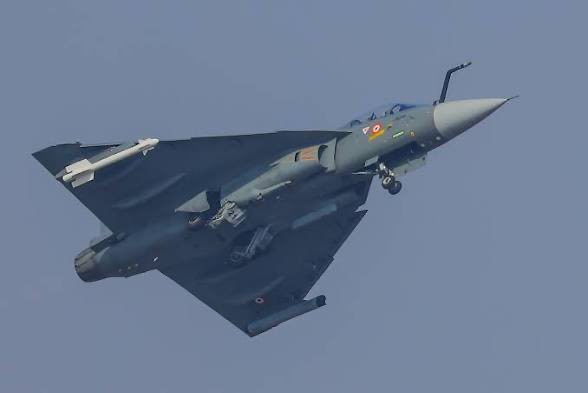
Hindustan Aeronautics Limited (HAL) will hand over final two Tejas Mk-1 Final Operational Clearance (FOC) twin-seater trainers to the Indian Air Force (IAF) today, formally completing the original 40-aircraft order placed under contracts signed in 2006 and 2010. The same ceremony will mark the delivery of the first batch of indigenous HTT-40 basic trainer aircraft to the IAF and four Dhruv Next Generation (NG) helicopters to Pawan Hans Limited.
Keywords: Tejas Mk-1, HAL Bengaluru, HTT-40 trainer, Dhruv NG helicopter, Tejas Mk-1A delay, Atmanirbhar Bharat aerospace, Indian Air Force induction
The event will be held at HAL’s Bengaluru facility, will be attended by Defence Minister Rajnath Singh, Civil Aviation Minister K. Rammohan Naidu, Chief of the Air Staff Air Chief Marshal A.P. Singh, HAL Chairman and Managing Director Ravi K, and senior officials from the Ministries of Defence and Civil Aviation. Officials describe the occasion as a significant milestone in India’s Atmanirbhar Bharat journey in aerospace, underscoring the growing capability of domestic industry to design, develop and manufacture platforms for both military training and civil roles such as offshore operations and air ambulance services.
The last two Tejas trainers, built to the FOC standard with enhanced radar, avionics and secure communications, close a long-delayed chapter. Of the original 40 aircraft, comprising single-seat fighters in IOC and FOC configurations plus eight twin-seat trainers, 38 are giving service to the IAF. The HTT-40 deliveries, long held up by engine supply issues, will strengthen basic pilot training pipelines critical for future fighter conversion. The Dhruv NG helicopters, ordered by Pawan Hans earlier this year, expand HAL’s civil aviation footprint with multi-role capabilities.
Yet the celebration comes against a backdrop of persistent challenges on the more advanced Tejas Mk-1A programme. The IAF ordered 83 Mk-1A jets in February 2021 under a Rs 46,898-crore contract, with deliveries originally scheduled to begin in 2024. More than five years and seven months later, not a single aircraft has entered squadron service. HAL has assembled 27 airframes and received 10 GE F404-IN20 engines, but residual integration issues involving the AESA radar and missile systems continue to delay formal handover. HAL leadership has indicated that the first aircraft could still be delivered by the end of 2026 or early 2027, with production capacity now expanded to 24 aircraft per year across three lines.
The prolonged delay raises legitimate questions about project accountability, contractual penalties, and the knock-on impact on the Tejas Mk-2 programme, whose production lines risk remaining occupied longer than planned. While engine availability has improved and airframe production continues, the integration hurdles highlight the complex realities of indigenous fighter development.
Today’s deliveries demonstrate tangible progress in India’s aerospace ecosystem. Sustained momentum on the Mk-1A, however, will determine whether these milestones translate into the operational strength the IAF urgently requires.
contact: drrajeshjauhri@gmail.com
Dr Rajesh Jauhri is a Journalist with an experience of over 25 years in Indian and foreign media, a Social Scientist, an Ac-complished Author, a Political & Strategic Analyst, a Marksman (Rifle & Pistol), an Orator, a Thinker and an Educationist. He holds a Ph.D. degree on “Impact of colonial heritage on Indian police”. He runs an NGO dedicated to the social and eco-nomic uplift of tribal communities in MP and two decades back, he established a school in a village of Indore district, providing education and moral values to children belonging to underprivileged and minority families. Has received multiple awards in various fields.