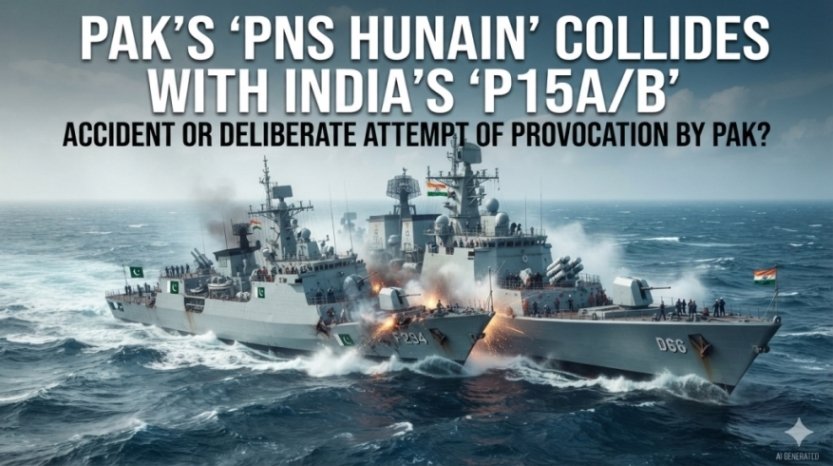
A Pakistan Navy vessel sustained significant damage in a collision with an Indian Navy destroyer in the North Arabian Sea on the evening of September 15, underscoring persistent challenges in maritime confidence-building between the two countries.
Keywords: PNS Hunain collision, Indian Navy P15A/B destroyer, 1991 India-Pakistan naval agreement, Article 10 three nautical miles, North Arabian Sea naval incident
According to Indian defence sources, the Pakistani Yarmook-class offshore patrol vessel PNS Hunain (F-273) approached a frontline Indian Navy P15A/B-class destroyer at high speed while the Indian warship was conducting a routine surveillance mission in international waters, approximately 220 km east of Oman. The Pakistani ship executed close-range, unprofessional manoeuvres, ignoring repeated warnings on VHF Channel 16. The vessels made contact, resulting in a severe dent and possible structural damage to PNS Hunain’s portside and forward section. The Pakistani ship was later attended by a support vessel and returned to harbour. The Indian destroyer sustained no damage and continued its operational patrol.
The incident directly violated Article 10 of the 1991 India-Pakistan Agreement on Advance Notice on Military Exercises, Manoeuvres and Troops Movements. The provision requires naval ships and submarines of both nations to maintain a minimum separation of three nautical miles in international waters to prevent accidents. India’s Ministry of External Affairs summoned Pakistan’s Charge d’Affaires and lodged a strong protest, describing the conduct as “unacceptable and unprofessional.”
Indian naval commanders exercised restraint despite the provocation and the presence of advanced weapon systems on the destroyer. Defence observers note that such disciplined responses prioritise de-escalation, prevent loss of life or wider confrontation and help build an image in the international community, even when the right to self-defence under international maritime law remains intact. Here, formal warnings were issued and recorded, providing a clear evidentiary trail but Pak ship ignored all warnings, so this case reminds us about numerous terror acts by Pak on Indian soil but were ignored by Indian govt, just like what happened in this case.
Retired top officers of ISI had openly claimed several times, “After every terror act in India, the Indian govt used to send a dossier having all details of the terror acts and evidences of involvement of Pak nationals in them. We used to laugh at them and put those dossiers in trash, every time.” None of them could speak same words while speaking about terror attacks on Uri and Pahalgam because Pak was given a reply of very high magnitude, both the times. Whereas summoning Pak high commissioner after this deliberate collision is insufficient, feel the scholars of strategy and defence.
Pakistan has a documented history of aggressive close approaches by its naval units, including previous encounters involving vessels such as PNS Babur. These actions test the professionalism of opposing forces and risk unintended escalation in a sensitive region. While diplomatic démarches are a standard and necessary response, sustained adherence to bilateral agreements remains essential for maritime stability. The episode serves as a reminder that confidence-building measures are only effective when both sides respect their letter and spirit.

contact: drrajeshjauhri@gmail.com
Dr Rajesh Jauhri is a Journalist with an experience of over 25 years in Indian and foreign media, a Social Scientist, an Ac-complished Author, a Political & Strategic Analyst, a Marksman (Rifle & Pistol), an Orator, a Thinker and an Educationist. He holds a Ph.D. degree on “Impact of colonial heritage on Indian police”. He runs an NGO dedicated to the social and eco-nomic uplift of tribal communities in MP and two decades back, he established a school in a village of Indore district, providing education and moral values to children belonging to underprivileged and minority families. Has received multiple awards in various fields.