


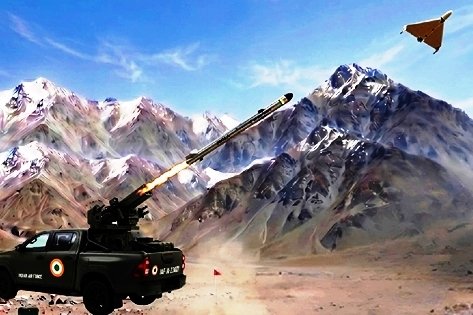
Noida-based defence technology firm IG Defence has successfully test-fired two solid rocket motors for its JWALA micro-missile programme, marking a significant step in the development of India’s first private-sector indigenous hard-kill counter-unmanned aircraft system (C-UAS). The tests, conducted in the early hours of October 3, advance the propulsion subsystem critical to the compact interceptor designed to neutralise hostile drones.
Keywords: JWALA micro-missile, IG Defence, counter-drone system, hard-kill C-UAS, indigenous defence technology, Atmanirbhar Bharat
JWALA MK1 is being developed as a short-range surface-to-air micro-missile optimised for UAV threats. Company specifications indicate an engagement range of 2 to 5 kilometres and an operational altitude envelope stretching from 50 metres to 5000 metres. Powered by a dual-pulse solid rocket motor with fin control, the system is intended to deliver a cost-effective kinetic option against low-cost drone swarms that increasingly challenge conventional air-defence inventories.
Wing Commander Anoop Sharma (Retd), Assistant Vice President at IG Defence, underscored the operational imperative driving the programme. “The drone threat is evolving rapidly, and Counter-UAS systems must evolve with it. There is a growing need for affordable interceptors that can be produced and deployed in meaningful numbers. JWALA is being developed with exactly this requirement in mind. This successful propulsion test is an important milestone towards building an indigenous hard-kill capability for the evolving drone threat,” he stated.
Rather than a standalone weapon, JWALA forms the hard-kill effector within IG Defence’s broader GRID ecosystem, an AI-enabled battle management architecture that integrates sensors, command functions and effectors. The company positions the micro-missile as a complementary layer to existing air-defence networks, providing magazine depth during sustained or saturation attacks by unmanned systems.
The successful motor firings reinforce India’s drive toward self-reliant defence manufacturing under the Atmanirbhar Bharat framework. Further development will focus on system maturity, reliability, manufacturability and scalability as JWALA progresses toward integrated testing and eventual operational readiness. In an era of proliferating unmanned threats, affordable indigenous interceptors such as JWALA represent a pragmatic response to a rapidly changing battlefield.

contact: drrajeshjauhri@gmail.com
Dr Rajesh Jauhri is a Journalist with an experience of over 25 years in Indian and foreign media, a Social Scientist, an Ac-complished Author, a Political & Strategic Analyst, a Marksman (Rifle & Pistol), an Orator, a Thinker and an Educationist. He holds a Ph.D. degree on “Impact of colonial heritage on Indian police”. He runs an NGO dedicated to the social and eco-nomic uplift of tribal communities in MP and two decades back, he established a school in a village of Indore district, providing education and moral values to children belonging to underprivileged and minority families. Has received multiple awards in various fields.