



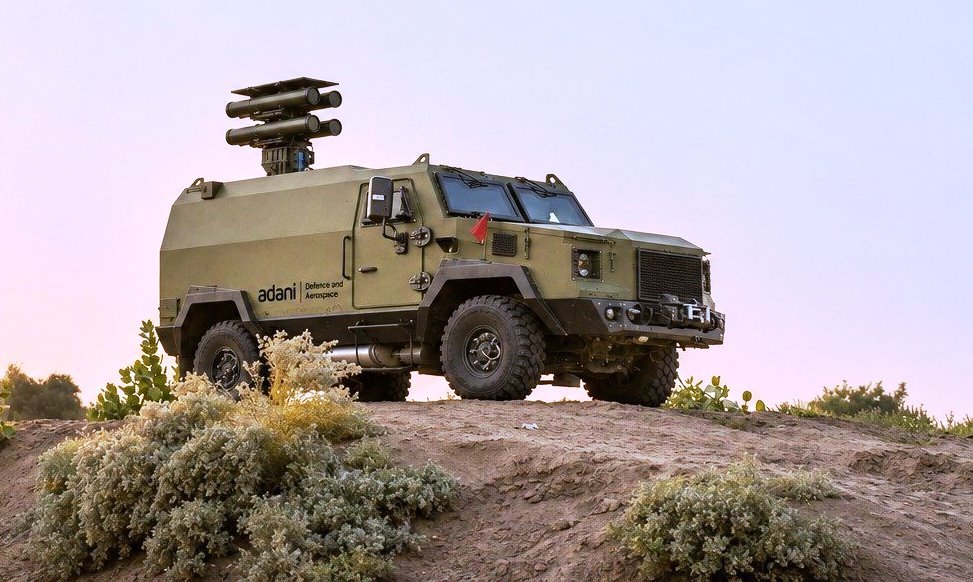
Marking a significant milestone for India’s private defence sector, Noida-based defence technology firm IG Defence has successfully test-fired the JWALA MK-1, billed as the country’s first autonomous Counter-Unmanned Aircraft System (CUAS) micro-missile. Conducted at the Pokhran Field Firing Range in Rajasthan on November 23, 2026, the trial demonstrated a rapid, hard-kill solution designed to counter the proliferating threat of low-cost hostile drones.
Keywords: JWALA MK-1 micro-missile, IG Defence Pokhran test, Autonomous counter-drone system India, Atmanirbhar Bharat defence technology, GRID AI battle management system, Indigenous CUAS India
Engineered for rapid battlefield deployment, the JWALA MK-1 operates from a multi-canister launcher mounted on a standard 4×4 tactical vehicle. According to technical specifications released by IG Defence, the short-range surface-to-air interceptor boasts an engagement envelope of 2 to 5 kilometres and can neutralize aerial targets at altitudes ranging from 50 metres to 5,000 metres. Powered by a dual-pulse solid rocket motor, the interceptor achieves a reaction time of under seven seconds from target detection to launch, delivering a 0.5 TO 1.5 kg pre-fragmented high-explosive warhead fitted with a proximity fuse.
At the core of the platform is GRID, IG Defence’s proprietary artificial intelligence-based Mission Autonomy and Battle Management System. GRID automates the entire engagement sequence—integrating multi-sensor feeds to detect, identify, classify, and intercept incoming unmanned aerial vehicles without requiring continuous human intervention.
“GRID is not just a standalone Mission Autonomy and Battle Management System; it is the intelligence backbone managing the entire kill chain of JWALA MK-1,” said Bodhisattwa Sanghapriya, Founder and CEO of IG Defence. Emphasizing the shift toward intelligent, self-reliant warfare, he noted that domestic manufacturers must build integrated AI capabilities alongside hardware to prepare Indian forces for modern asymmetric threats.
Global conflicts have increasingly underscored the vulnerability of conventional air-defence networks to inexpensive drone swarms, where deploying multi-million-dollar surface-to-air missiles are economically unsustainable. While earlier domestic private-sector initiatives explored comparable micro-missile concepts, JWALA MK-1’s successful Pokhran firing represents a critical step toward operational product maturity under New Delhi’s Atmanirbhar Bharat (Self-Reliant India) initiative.

contact: drrajeshjauhri@gmail.com
Dr Rajesh Jauhri is a Journalist with an experience of over 25 years in Indian and foreign media, a Social Scientist, an Ac-complished Author, a Political & Strategic Analyst, a Marksman (Rifle & Pistol), an Orator, a Thinker and an Educationist. He holds a Ph.D. degree on “Impact of colonial heritage on Indian police”. He runs an NGO dedicated to the social and eco-nomic uplift of tribal communities in MP and two decades back, he established a school in a village of Indore district, providing education and moral values to children belonging to underprivileged and minority families. Has received multiple awards in various fields.