
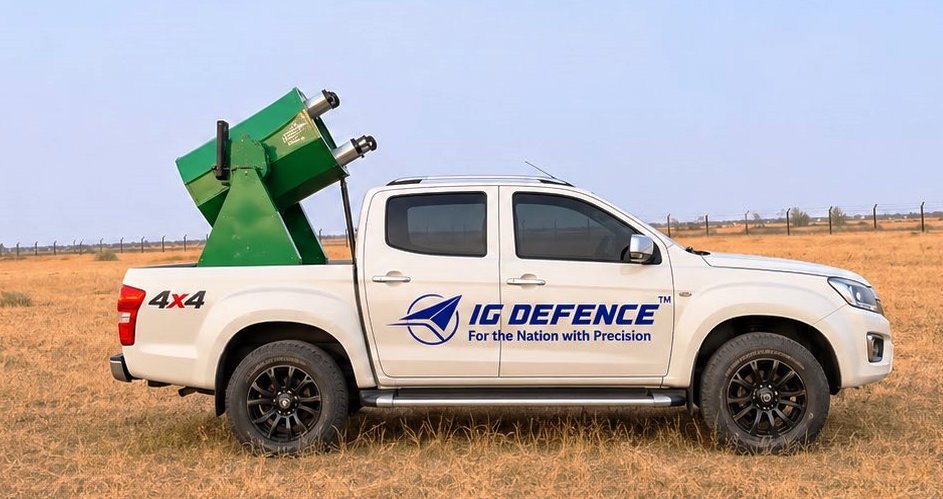


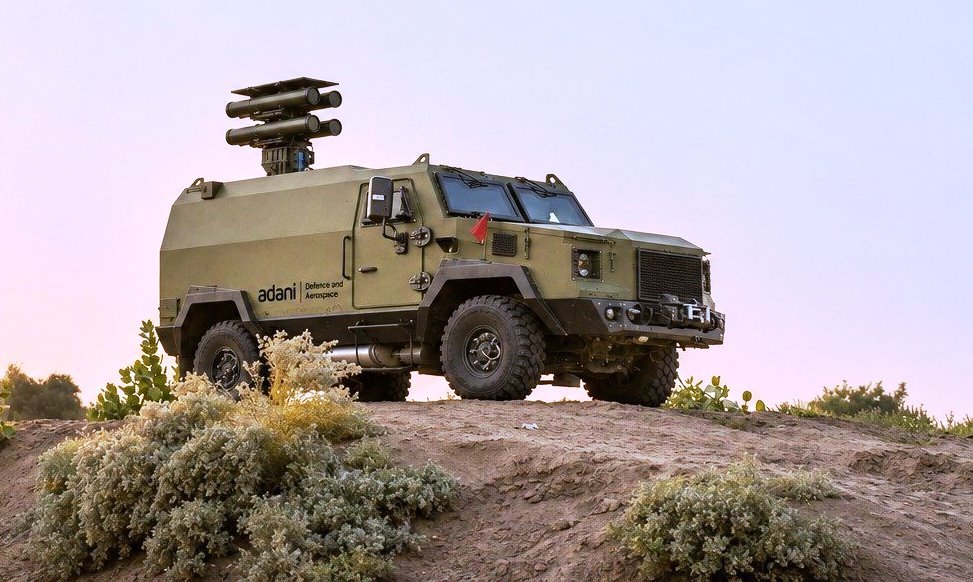
Adani Defence & Aerospace successfully demonstrated its Bagheera AT1 vehicle-mounted anti-tank guided missile system at the Pokhran Field Firing Ranges in Rajasthan on 20 November 2026. The No Cost No Commitment (NCNC) trial was attended by senior representatives from the Indian Army, the Department of Military Affairs and the Ministry of Defence.
Keywords: Bagheera AT1, Adani Defence ATGM, Pokhran missile trial, vehicle-mounted anti-tank missile, NCNC demonstration India, Kornet-EM comparison
Four missiles were fired during the demonstration, validating day and night engagements, a two-missile tandem salvo along a single laser beam against a simulated armoured target, and an aerial engagement at extended range. The tandem-firing mode is designed so that the first missile triggers a tank’s Active Protection System while the second penetrates the armour.
Developed over 18 months and customised for Indian terrain, climate and operational needs, Bagheera AT1 is mounted on an Adani-designed 4×4 high-mobility armoured vehicle. It offers an anti-tank engagement range of up to 8 km, roughly double that of many legacy land-based systems such as the Milan-2T, while its broader architecture can support guided engagements out to 10 km. The system uses jam-resistant laser beam-riding guidance, carries four ready-to-fire missiles on the automated launcher plus eight reloads (total capacity of 12), and features integrated day/night sights with automated target tracking and shoot-and-move capability.
As India seeks to modernise its anti-tank arsenal amid growing private-sector participation, the trials are expected to open the door for formal evaluation by the armed forces. Some observers have noted visual and operational similarities between Bagheera AT1 and Russia’s Kornet-EM, raising questions about the extent of indigenous content. Adani presents the system as a complete combat solution tailored to Indian requirements.
A critical view circulating among defence analysts questions the broader implications of the NCNC route. One expert commented that the process risks allowing companies to “import a Russian system, label it with a Sanskrit name, demo it to the Army and then seek ToT to locally manufacture and call it an Atmanirbhar product,” arguing that such practices could undermine genuine indigenous development.
The demonstration nevertheless marks a tangible step in expanding domestic options for mobile anti-armour firepower. Whether Bagheera AT1 progresses to user trials and induction will depend on rigorous evaluation of its performance, cost, and true indigenous value.

contact: drrajeshjauhri@gmail.com
Dr Rajesh Jauhri is a Journalist with an experience of over 25 years in Indian and foreign media, a Social Scientist, an Ac-complished Author, a Political & Strategic Analyst, a Marksman (Rifle & Pistol), an Orator, a Thinker and an Educationist. He holds a Ph.D. degree on “Impact of colonial heritage on Indian police”. He runs an NGO dedicated to the social and eco-nomic uplift of tribal communities in MP and two decades back, he established a school in a village of Indore district, providing education and moral values to children belonging to underprivileged and minority families. Has received multiple awards in various fields.