



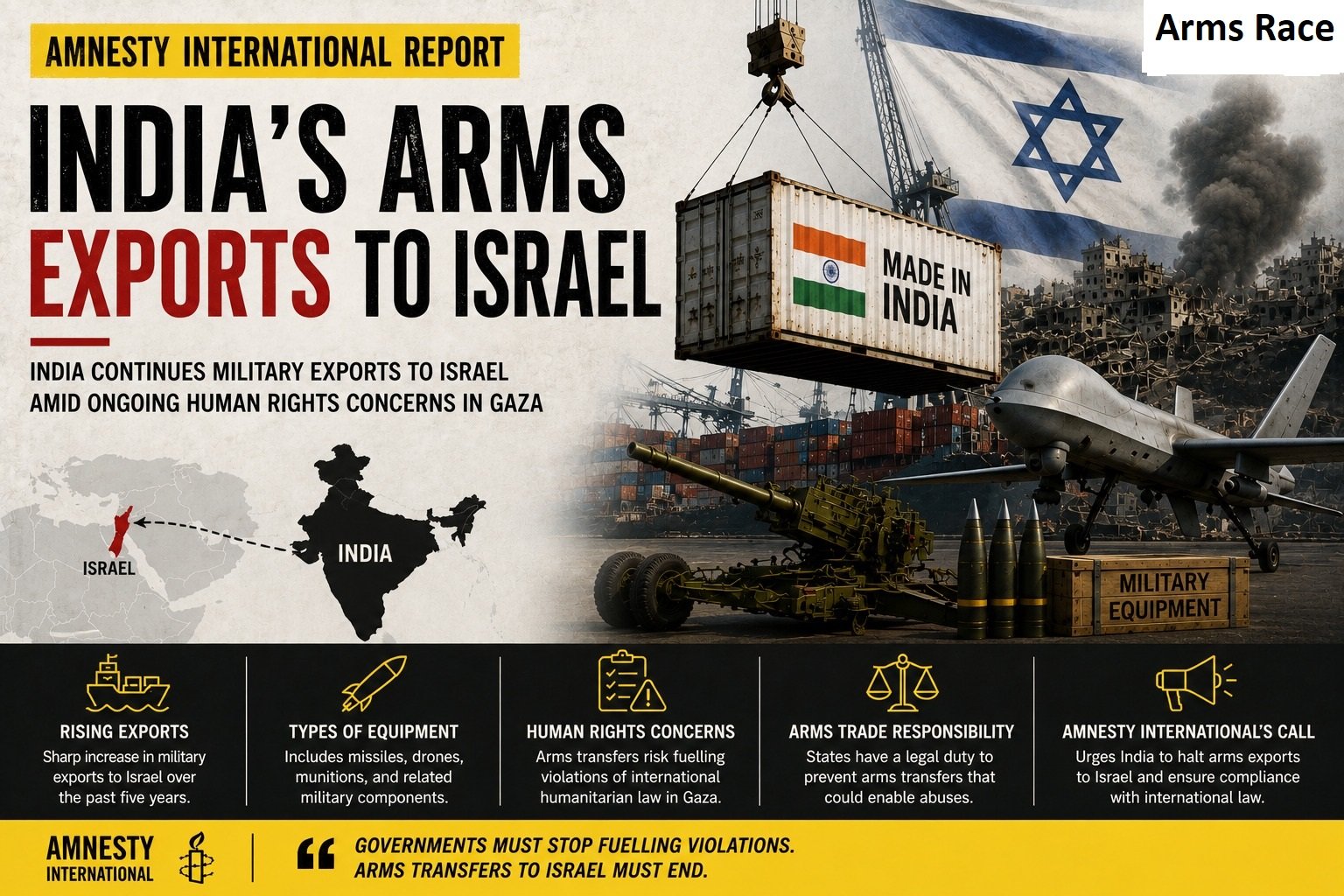
A recent report cited by ‘The Jerusalem Post’, drawing on Amnesty International’s analysis of official Indian trade records, has highlighted a significant shift in the India-Israel defence partnership. Between October 2023 and November 2025, India exported 2,596 shipments of weapons, ammunition, parts and components to Israel. These included 390,516 small-arms parts, 564,970 explosive ammunition components and 298 military vehicle parts.
Keywords: India Israel defence exports, Make in India defence, Amnesty International arms report, India defence manufacturing, India Israel strategic partnership
While the report frames these transfers in a critical light, the data underscore a broader, two-way strategic relationship that has matured over decades. India has long been Israel’s largest defence export customer, accounting for 29 per cent of Israeli defence exports between 2021 and 2025, according to Stockholm International Peace Research Institute (SIPRI) figures. Simultaneously, New Delhi has accelerated its own defence manufacturing under the Make in India initiative, enabling Indian companies, both public sector undertakings and private firms, to integrate into global supply chains and supply critical components.
This dual dynamic reflects India’s evolving role, from a major importer of Israeli systems such as radars, missiles and unmanned platforms to a reliable upstream supplier of specialised parts and munitions. Joint ventures and technology partnerships have expanded domestic production capacity, generating industrial expertise, employment and foreign exchange while strengthening India’s position in the international defence market.
Strategically, the relationship serves mutual interests. Israel benefits from diversified and resilient supply lines for its defence industry. India gains access to proven technologies and the opportunity to build export capabilities in a competitive global environment. Defence cooperation between the two nations has consistently prioritised operational requirements, co-development and industrial collaboration over external political pressures.
Analysts note that trade data alone do not determine policy intent. India’s defence export regime operates within its national legal framework and strategic autonomy doctrine. As New Delhi continues to expand its defence industrial base, the India-Israel partnership is likely to remain a cornerstone of both countries’ security and manufacturing strategies in the years ahead.
Also, if the Amnesty International’s analysis is concerned, there is a very important point, which needs to be seen before that. The institution has never supported Indian causes and have always supported the extremists/ terrorists in Jammu & Kashmir as well as North-Eastern states. They have always worked to serve the interests of the institutions and powers, which want to destabilise India.

contact: drrajeshjauhri@gmail.com
Dr Rajesh Jauhri is a Journalist with an experience of over 25 years in Indian and foreign media, a Social Scientist, an Ac-complished Author, a Political & Strategic Analyst, a Marksman (Rifle & Pistol), an Orator, a Thinker and an Educationist. He holds a Ph.D. degree on “Impact of colonial heritage on Indian police”. He runs an NGO dedicated to the social and eco-nomic uplift of tribal communities in MP and two decades back, he established a school in a village of Indore district, providing education and moral values to children belonging to underprivileged and minority families. Has received multiple awards in various fields.