

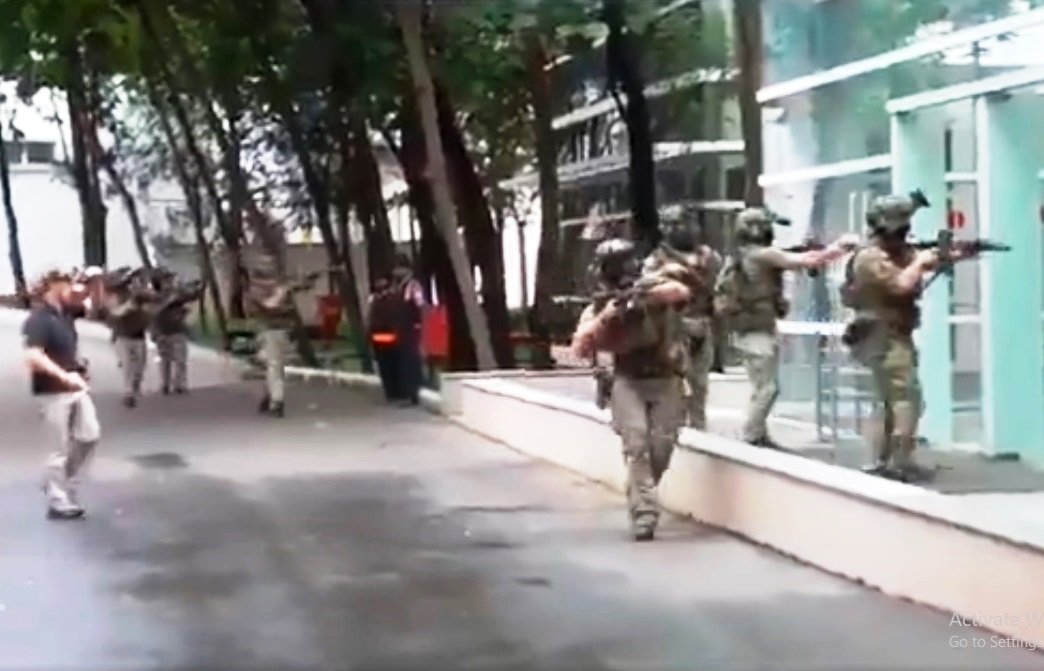
Recently, India’s National Security Guard (NSG) and United States Army Special Forces joined local security agencies for a meticulously planned five-hour joint mock drill at the Infosys Phase II campus in Hinjawadi IT Park. The exercise, which ran from 4 pm to 9 pm, simulated a terrorist attack on a high-value corporate facility and tested multi-agency emergency response and coordination protocols. No actual threat was involved.
Keywords: NSG US joint drill, Hinjawadi anti-terror exercise, India-US special forces cooperation, critical infrastructure security India, Pune Infosys mock drill
More than 100 personnel took part, including commandos from the NSG’s Mumbai-based 26 Special Composite Group, Maharashtra Police’s elite Force One unit, Pimpri-Chinchwad Police’s Anti-Terrorism Branch, Quick Response Team, Riot Control Unit, Bomb Detection and Disposal Squad, and disaster management and fire service teams. Infosys security staff and senior company officials were also involved. In some phases, an Army helicopter supported the insertion of tactical teams onto the campus towers.
The drill examined first-responder roles, establishment of inner and outer cordons, traffic management, bomb detection and disposal, tactical intervention, hostage rescue scenarios, attacker neutralisation, and the company’s internal security procedures. Officials emphasised that the exercise was designed to evaluate readiness to protect critical infrastructure, particularly India’s vital IT and technology hubs that host thousands of employees and sensitive data centres.
Videos of armed tactical teams moving through the campus briefly circulated online, generating a mix of curiosity, humour and speculation. Some social media posts inaccurately referred to “US Marines” and framed the activity as a real operation. Authorities quickly clarified that it was a pre-planned training exercise conducted under controlled conditions, and appealed against the spread of rumours.
The joint drill underscores the deepening operational interoperability between Indian and American special forces, building on ongoing bilateral training programmes focused on urban counter-terrorism and complex crisis response. For India’s security establishment, such exercises reinforce the imperative of seamless inter-agency coordination in safeguarding economic and technological assets against evolving threats.
As India’s IT corridors continue to expand as engines of growth and innovation, regular, realistic multi-force rehearsals of this nature remain essential to ensuring that preparedness matches the scale of the infrastructure they are designed to protect.

contact: drrajeshjauhri@gmail.com
Dr Rajesh Jauhri is a Journalist with an experience of over 25 years in Indian and foreign media, a Social Scientist, an Ac-complished Author, a Political & Strategic Analyst, a Marksman (Rifle & Pistol), an Orator, a Thinker and an Educationist. He holds a Ph.D. degree on “Impact of colonial heritage on Indian police”. He runs an NGO dedicated to the social and eco-nomic uplift of tribal communities in MP and two decades back, he established a school in a village of Indore district, providing education and moral values to children belonging to underprivileged and minority families. Has received multiple awards in various fields.