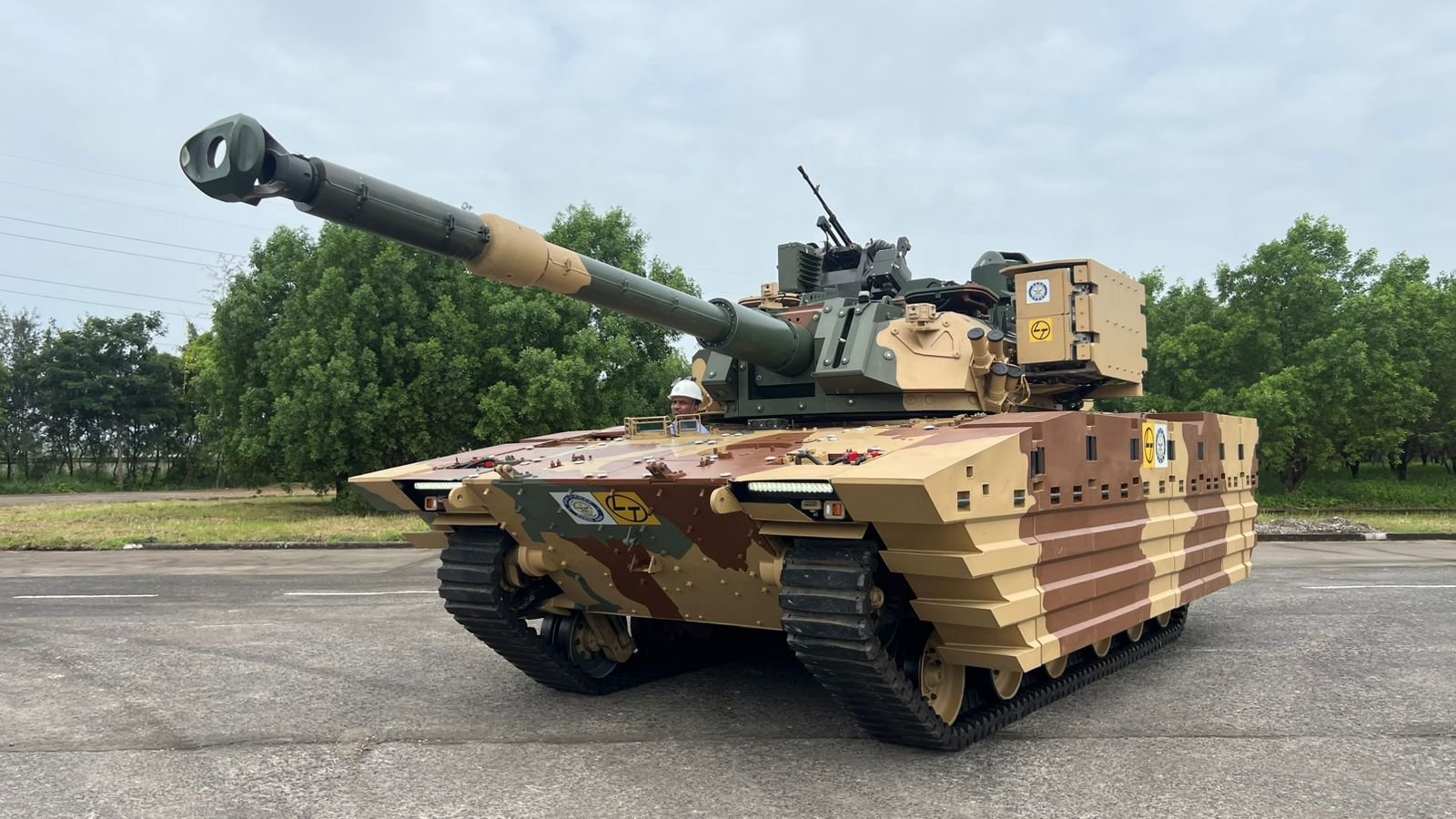
India’s indigenous Zorawar light tank programme faces a significant schedule revision, with induction now projected for 2028-29 rather than the earlier target of 2027. The delay stems from the Indian Army’s requirement for substantially stronger armour protection capable of defeating 30mm armour-piercing rounds.
Keywords: Zorawar light tank, STANAG Level 6 armour, Indian Army high-altitude warfare, DRDO L&T light tank, Type 15 comparison, indigenous defence manufacturing
Developed jointly by the Defence Research and Development Organisation (DRDO) and Larsen & Toubro (L&T), the Zorawar was designed as a specialised platform for high-altitude and mountainous terrain operations, particularly along the northern borders. The current prototype configuration provides frontal protection broadly aligned with STANAG 4569 Level 4 standards and weighs approximately 25 tonnes, powered by a 760 hp Cummins diesel engine that delivers a favourable power-to-weight ratio suited to steep gradients and thin air.
The Army has sought an upgrade toward STANAG Level 6 protection. This higher standard would enable the tank to withstand more potent kinetic threats, including 30mm APFSDS ammunition. Engineers are examining modular and add-on armour solutions, including ceramic packages, to strengthen both frontal and side/rear protection. However, the added mass could increase the combat weight to the 30-32 tonne range. Such an increase would reduce the power-to-weight ratio, potentially necessitating a more powerful engine and triggering fresh rounds of mobility, reliability and ballistic trials.
Indian planners have emphasised that the Zorawar is not intended as a direct counterpart to China’s Type 15 light tank, which weighs 33-36 tonnes and is powered by a 1,000 hp engine. While the Type 15 serves as a useful operational reference following its deployment during the 2020 eastern Ladakh standoff, the Indian design prioritises specific mobility, air-transportability and high-altitude performance requirements unique to the Himalayan environment.
The Army’s overall requirement stands at 354 light tanks. The first batch of 59 is planned under the DRDO-L&T development route. For the remaining 295 units, Tata Advanced Systems has emerged as the lowest bidder in a competitive Make-I process, though a formal production contract has yet to be finalised. Mahindra Defence Systems is also developing a prototype under the same route.
The decision to prioritise enhanced survivability over an accelerated timeline reflects a measured approach to platform design. Yet the prolonged development cycle carries operational costs. With persistent border tensions and the need for modern light armoured capability in high-altitude sectors, compressing the remaining development and testing phases without compromising core mobility characteristics remains essential.

contact: drrajeshjauhri@gmail.com
Dr Rajesh Jauhri is a Journalist with an experience of over 25 years in Indian and foreign media, a Social Scientist, an Ac-complished Author, a Political & Strategic Analyst, a Marksman (Rifle & Pistol), an Orator, a Thinker and an Educationist. He holds a Ph.D. degree on “Impact of colonial heritage on Indian police”. He runs an NGO dedicated to the social and eco-nomic uplift of tribal communities in MP and two decades back, he established a school in a village of Indore district, providing education and moral values to children belonging to underprivileged and minority families. Has received multiple awards in various fields.