As tension remains palpable along the Line of Actual Control (LAC) in Arunachal Pradesh, a complex national security paradox has emerged in India’s North-Eastern frontier. While the Indian Armed Forces maintain strict vigil against aggressive Chinese military posture, intense local protests have flared across the Siang Valley opposing New Delhi’s proposed strategic infrastructure projects.
Key Search Keywords: Siang Upper Multipurpose Project LAC, India China hydro geopolitics Arunachal Pradesh, Yarlung Tsangpo super dam strategic impact, Brahmaputra water security India China, Arunachal anti-dam protests national defence
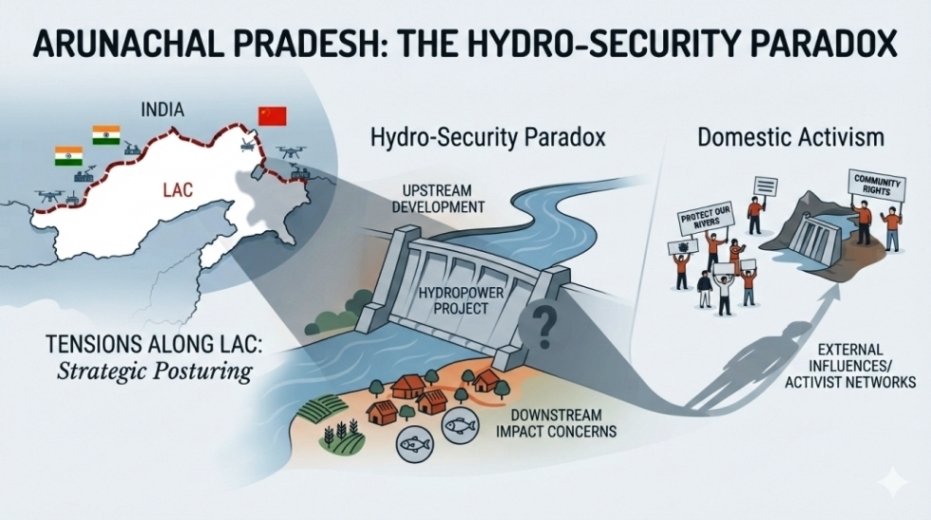
The primary epicentre of friction is the proposed Siang Upper Multipurpose Project (SUMP), a mega 11,000 to 12,000 megawatt (MW) hydro-barrier designed to create a massive cushion reservoir of nearly 9.2 billion cubic meters. Strategically, the reservoir is intended to buffer India’s lower riparian regions against prospective sudden water releases or artificial droughts caused by China’s massive upstream infrastructure on the Yarlung Tsangpo River (Brahmaputra).
However, ongoing internal agitation and road blockades by anti-dam activists in Arunachal Pradesh are severely stalling preliminary surveys, raising critical security concerns. Defence analysts point out a glaring geopolitical paradox: while Beijing systematically constructs the world’s largest super-dam in Tibet’s Medog county, directly above India, Nepal, and Bangladesh, without facing internal dissent or international civil society resistance, domestic development initiatives critical to India’s security infrastructure face disproportionate resistance.
China’s upstream mega-structures in fragile Himalayan seismic zones threaten the flow of vital silt, altering agricultural cycles across Assam, Bangladesh, and lower riparian belts, while granting Beijing asymmetric hydro-weaponization capabilities during frontline standoffs. Yet, global and regional environmental groups remained largely silent during Beijing’s aggressive damming of cross-border rivers. To any citizen, it may seem that the anti-dam activists are doing everything on their own but the situation is not as simple as it seems to be. A lot of international funding, moral support by anti- India forces and support through social media controlled by external forces have made the situation very difficult for the Indian authorities.
The complex convergence of escalating military standoffs, civil unrest, and parliamentary debate has pushed the security landscape in Arunachal Pradesh to a critical juncture. Ever since the lethal June 2020 Galwan clash and subsequent LAC standoffs, such as the December 2022 Yangtse face-off in Tawang, the Indian Armed Forces have maintained heightened border posture against persistent PLA transgressions and massive military infrastructure build-ups across Tibet. Paralleling this military standoff is New Delhi’s push for strategic counter-infrastructure, centered around the SUMP designed to cushion against potential downstream water manipulation by China’s upstream Medog mega-dam. However, anti-dam protests led by local indigenous groups and civil activists have rapidly escalated into severe unrest, marked by highway blockades, clashes with central security forces, and violent bandhs. Concurrently, opposition political parties have repeatedly raised concerns regarding Chinese border aggression and questioned the government’s strategic response, framing domestic crackdowns and hydro-defence projects within a larger national debate. This intersection of internal opposition, political friction, and external military posture creates a highly volatile environment along India’s sensitive north-eastern frontier.
At a time when Indian troops confront Chinese manoeuvres on the LAC, internal disruption of strategic counter-infrastructure undermines national security imperatives. While safeguarding indigenous heritage and addressing legitimate local ecological anxieties remains paramount, stalling strategic buffer infrastructure along a sensitive frontier inadvertently serves adversary objectives. National strategic security demands a balanced, transparent dialogue between policymakers and local communities to ensure national defence readiness is not compromised from within.

contact: drrajeshjauhri@gmail.com
Dr Rajesh Jauhri is a Journalist with an experience of over 25 years in Indian and foreign media, a Social Scientist, an Ac-complished Author, a Political & Strategic Analyst, a Marksman (Rifle & Pistol), an Orator, a Thinker and an Educationist. He holds a Ph.D. degree on “Impact of colonial heritage on Indian police”. He runs an NGO dedicated to the social and eco-nomic uplift of tribal communities in MP and two decades back, he established a school in a village of Indore district, providing education and moral values to children belonging to underprivileged and minority families. Has received multiple awards in various fields.