

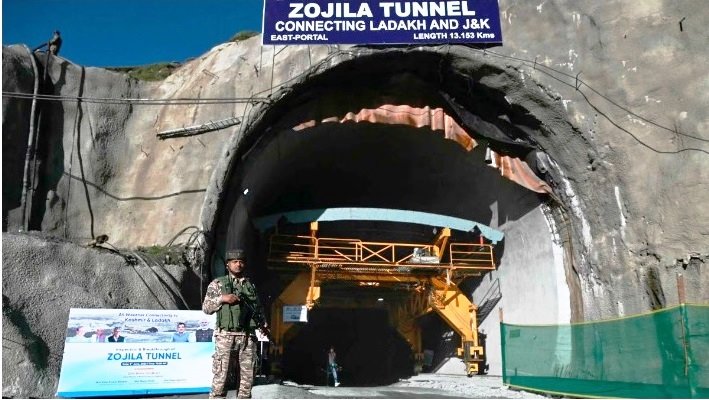
In a landmark achievement for India’s border infrastructure, the final breakthrough of the 13.153-kilometre Zojila Tunnel was accomplished on June 9, 2026, deep beneath the formidable Zojila Pass in the Western Himalayas. At an elevation of approximately 11,578 feet, this engineering marvel is set to become the world’s longest single-tube bi-directional road tunnel at the highest altitude, marking a transformative milestone in connecting the Kashmir Valley with Ladakh on National Highway-1.
Executed by Hyderabad-based Megha Engineering & Infrastructures Ltd (MEIL) using the New Austrian Tunnelling Method (NATM) to navigate the fragile Himalayan geology, the project has overcome extreme challenges including heavy snowfall, avalanches, and seismic risks. Safety features are world-class: pedestrian cross-passages every 250 metres, motorable cross-passages and lay-bys every 750 metres, advanced ventilation systems, fire-fighting infrastructure, CCTV monitoring, and emergency communication networks. Union Minister Nitin Gadkari triggered the final blast, with celebrations underscoring its significance for civilians and the military alike.
Once fully operational around February 2028, the tunnel will slash travel time between Baltal (near Sonamarg) and Meenamarg (Dras-Kargil sector) from several hours, often rendered impossible in winter, to a mere 15-30 minutes. This all-weather connectivity will serve as a vital lifeline for residents, tourism, trade, and, crucially, the Indian Armed Forces.
From a defence perspective, the implications are profound. The tunnel ensures year-round logistical support to forward deployments along the Line of Actual Control (LAC) with China. In the past, harsh winters isolated Ladakh, constraining rapid troop movements, supply of heavy weaponry, ammunition, and reinforcements. With Zojila’s completion, alongside the operational Z-Morh Tunnel, Indian forces gain unmatched operational flexibility and sustained presence in one of the world’s most contested high-altitude frontiers.
This project aligns with India’s broader strategy of enhancing border infrastructure under initiatives like the Vibrant Villages Programme and comprehensive highway development in sensitive sectors. Costing over ₹6,800 crore, it exemplifies how infrastructure development doubles as deterrence architecture, bolstering India’s ability to maintain credible posture against potential adversaries in the Himalayas.
As geopolitical dynamics in the Indo-Pacific evolve, the Zojila Tunnel stands not merely as an engineering triumph but as a testament to India’s resolve to secure its strategic frontiers. For the troops guarding the icy heights and the nation they protect, it signals a new era of resilience and readiness.

contact: drrajeshjauhri@gmail.com
Dr Rajesh Jauhri is a Journalist with an experience of over 25 years in Indian and foreign media, a Social Scientist, an Ac-complished Author, a Political & Strategic Analyst, a Marksman (Rifle & Pistol), an Orator, a Thinker and an Educationist. He holds a Ph.D. degree on “Impact of colonial heritage on Indian police”. He runs an NGO dedicated to the social and eco-nomic uplift of tribal communities in MP and two decades back, he established a school in a village of Indore district, providing education and moral values to children belonging to underprivileged and minority families. Has received multiple awards in various fields.