


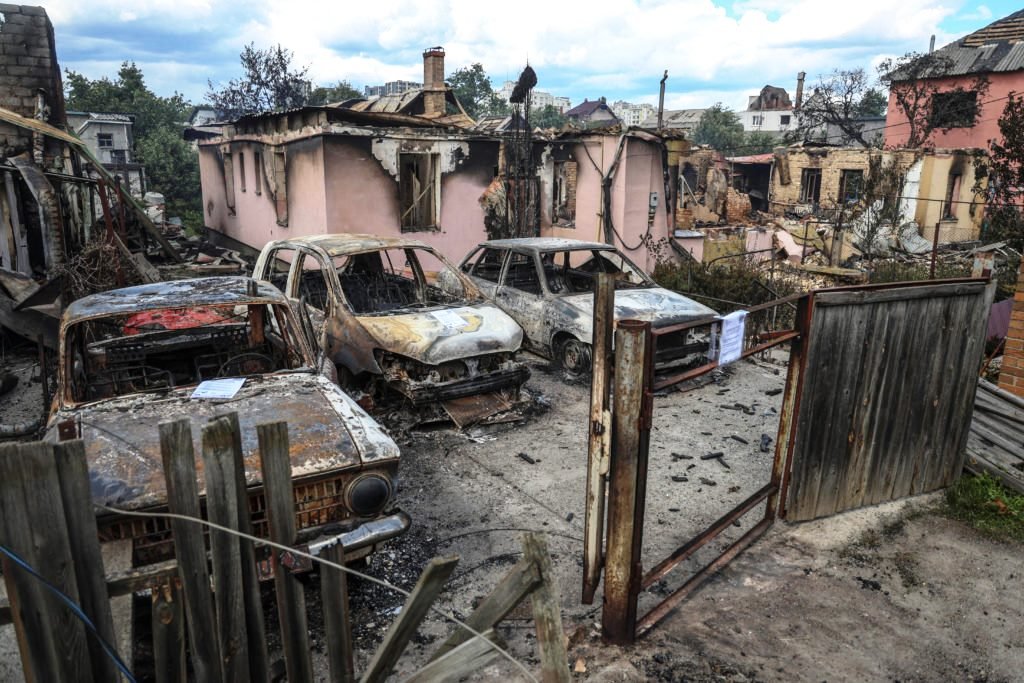
Russian forces struck a foreign-invested industrial facility in Ukraine’s Zhytomyr region on September 22, sparking a large fire at a site previously heavily damaged in early August. Regional authorities identified the target as a civilian enterprise with foreign ownership that had already suffered significant destruction, widely reported as the Kromberg & Schubert plant. No casualties or injuries were reported in the latest attack, and emergency services quickly contained the blaze amid ongoing air-raid threats.
Keywords: Russia strikes Ukraine, Kromberg & Schubert, Zhytomyr, German factory, Ukraine war, economic impact, Russia-Ukraine conflict, Zhytomyr industrial attack, civilian targets, long-range strikes
The August strike on the night of August 8-9 had already forced the German-owned facility to suspend operations indefinitely. Kromberg & Schubert’s Zhytomyr plant, employing approximately 3,500 people and operating with 100 percent German investment for 11 years, specialises in wiring harnesses and onboard electrical systems for major European automakers including Volkswagen, Audi, BMW, Mercedes-Benz, Porsche and Škoda. Production lines and infrastructure sustained extensive damage; the company confirmed no workers were hurt and stated that any restart depends on a full technical assessment. The plant ranks among the region’s key employers and taxpayers.
The repeated targeting of this civilian facility and that also German owned one, underscores a pattern of long-range strikes against industrial and infrastructure sites far from the front lines. Concurrent Russian drone and missile barrages have hit multiple regions, including the capital Kyiv, where explosions have injured civilians and Ukrainian air defences have intercepted numerous threats. Ukrainian commentator Iuliia Mendel highlighted the economic cost of such attacks, noting lost industrial capacity, tax revenue and household incomes.
Strategically, the strikes illustrate the expanding scope of the conflict beyond purely military objectives. Hitting foreign- owned civilian manufacturing that supplies Western automotive supply chains raises questions about economic pressure and potential further internationalisation of the war’s costs. Some observers draw cautious historical parallels with earlier European conflicts in which attacks on national economic interests contributed to broader escalation, though direct comparisons remain imperfect.
As both sides continue deep-strike campaigns, the destruction of productive capacity in Ukraine compounds the human and economic toll. Sustained industrial losses risk eroding the very base needed for long-term recovery, while raising the stakes for European stakeholders with direct investments on the ground. The latest fire in Zhytomyr serves as a stark reminder that the war’s trajectory continues to threaten civilian infrastructure and regional stability.

contact: drrajeshjauhri@gmail.com
Dr Rajesh Jauhri is a Journalist with an experience of over 25 years in Indian and foreign media, a Social Scientist, an Ac-complished Author, a Political & Strategic Analyst, a Marksman (Rifle & Pistol), an Orator, a Thinker and an Educationist. He holds a Ph.D. degree on “Impact of colonial heritage on Indian police”. He runs an NGO dedicated to the social and eco-nomic uplift of tribal communities in MP and two decades back, he established a school in a village of Indore district, providing education and moral values to children belonging to underprivileged and minority families. Has received multiple awards in various fields.