




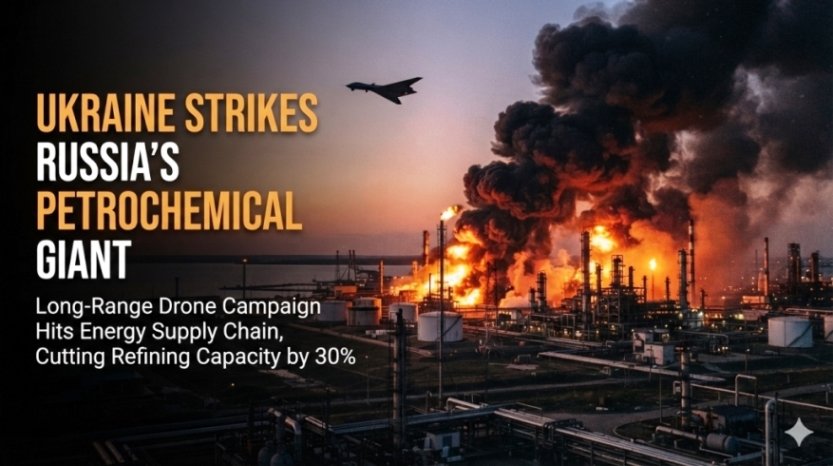
A Ukrainian long-range drone attack overnight on November 15 set parts of the SIBUR-owned Nizhnekamskneftekhim complex ablaze in Russia’s Tatarstan republic, marking another significant blow in Kyiv’s intensifying campaign against Moscow’s energy infrastructure. The facility, one of Russia’s leading producers of synthetic rubber and plastics, lies roughly 1,200 kilometres from the front lines, underscoring the growing reach of Ukrainian strike capabilities.
Keywords: Ukrainian drone strikes, Nizhnekamskneftekhim attack, Russian oil refining capacity, energy infrastructure warfare, SIBUR petrochemical plant, Ukraine Russia conflict 2026
Local monitoring channels and residents reported a large fire at the industrial zone in Nizhnekamsk, with footage showing intense flames and smoke rising over the petrochemical complex. Nizhnekamskneftekhim forms a critical node in Russia’s petrochemical sector and has been targeted in previous Ukrainian operations. The latest strike continues a coordinated wave of attacks that began in late October, which analysts describe as the largest economic operation of the war.
Since October 30, Ukrainian drones have hit multiple major refineries, including those in Novokuibyshevsk, Ufa, Kstovo, Yaroslavl, Ryazan, Omsk and Volgograd, as well as pipeline stations and the Baltic export terminal at Ust-Luga. Industry sources and reports indicate that facilities responsible for more than half of Russia’s petrol and diesel output have been affected, with overall refining capacity reduced by approximately 30 percent. OPEC and International Energy Agency data show Russian oil production has fallen by around 600,000 barrels per day over the past year.
The campaign’s design is deliberate. Striking only refineries risks pushing more crude toward export; hitting only ports can fill storage and force higher refining rates. By attacking the full supply chain simultaneously, Ukraine aims to disrupt revenue flows that finance Russia’s war effort. Export earnings remain a primary source of funding for Moscow’s military expenditure. Russian geology adds a further constraint: prolonged shutdowns of wells can make rapid restoration of production difficult.
This sustained pressure on energy infrastructure represents a calculated effort to erode the economic foundations of Russia’s military campaign. As fuel shortages and reduced processing capacity accumulate, the strategic cost of prolonged conflict for Moscow continues to rise. Ukraine’s approach demonstrates that in modern warfare, systematic economic disruption can prove as decisive as battlefield gains.

contact: drrajeshjauhri@gmail.com
Dr Rajesh Jauhri is a Journalist with an experience of over 25 years in Indian and foreign media, a Social Scientist, an Ac-complished Author, a Political & Strategic Analyst, a Marksman (Rifle & Pistol), an Orator, a Thinker and an Educationist. He holds a Ph.D. degree on “Impact of colonial heritage on Indian police”. He runs an NGO dedicated to the social and eco-nomic uplift of tribal communities in MP and two decades back, he established a school in a village of Indore district, providing education and moral values to children belonging to underprivileged and minority families. Has received multiple awards in various fields.