


Introduction
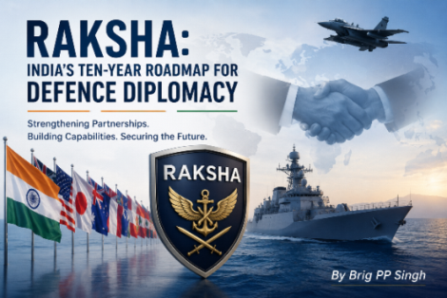
Military diplomacy as an instrument of statecraft utilises military capabilities, personnel, expertise and institutional relationships to support national foreign-policy and strategic objectives. The release of India’s ten-year strategic roadmap for defence diplomacy on 03 September 2026, marks a significant development in the India’s approach to national security and foreign policy. Titled RAKSHA and unveiled by Defence Minister Rajnath Singh, the framework provides a long-term direction to India’s international defence engagement and amalgamating military cooperation more closely with its broader diplomatic, technological and industrial objectives. India cogitates defence diplomacy as more than military-to-military engagement. Training foreign armed forces, conducting exercises, supplying defence equipment, strengthening maritime partnerships and expanding defence exports lead to durable diplomatic relationships that can enhance India’s international influence.
Relevance of Military Diplomacy
Military diplomacy uses exercises, training, exchanges, agreements, maritime cooperation, UN Peacekeeping engagements and humanitarian assistance to build trust, interoperability and long-term defence partnerships, relying on cooperation rather than force. India has long practiced military diplomacy as an essential constituent of its foreign policy, although without treating it as a separately articulated framework. Military engagements with partners like United States, France, Japan and Australia have strengthened interoperability and understanding, while defence cooperation with neighbouring countries has supported capacity building and regional confidence. India’s growing military capabilities have also unswervingly supported foreign-policy objectives through initiatives such as Operation Cactus in the Maldives in 1988, the Indian Peace Keeping Force in Sri Lanka, decades of UN peacekeeping, humanitarian assistance and disaster-relief operations, and maritime efforts against piracy and for the protection of seafarers and shipping.
These experiences validate that India’s military diplomacy has traditionally combined deterrence and security cooperation with humanitarian assistance, capacity building and regional stabilisation. Contemporary military diplomacy also intersects with public diplomacy as exercises, deployments and humanitarian operations are witnessed not only by governments but by international media and wider public audiences. Effective defence communication is therefore essential to ensure that military engagement conveys partnership and reassurance rather than coercion or threat.
Strategic Context
India’s evolving security environment, marked by global tensions and uncertainties, heightened Indo-Pacific competition, China’s growing presence and regional instability, demands resilient partnerships and stronger indigenous capabilities. RAKSHA seeks to shift defence engagement from transactional ties to long-term affiliations that deliver military, economic and diplomatic benefits, and are backed by technology, industry and secure supply chains. India’s growing heft demands greater regional security responsibility, especially in the Indian Ocean Region.
The document links diplomatic influence and defence cooperation to build partner capabilities, expand defence exports and maritime cooperation, and use these long-term relationships to enhance India’s strategic influence. The national objective is to create long-term security relations rather than one-time defence transactions. RAKSHA also provides a broader national-power dimension as defence diplomacy can create markets and partnerships for Indian industry. A stronger defence-industrial base can improve technological and military strength, further reinforcing India’s diplomatic leverage.
Four Pillars of RAKSHA
The framework of RAKSHA rests on four pillars of strategic partnerships, capacity building, indigenous defence exports and maritime security.
- Strategic Partnerships. The first pillar, strategic partnerships, seeks to deepen India’s bilateral and multilateral defence relationships. India already maintains extensive security partnerships with major powers, neighbouring countries and states across the Indo-Pacific. RAKSHA provides a framework for making these relationships more systematic and advantageously purposeful. This approach is consistent with India’s preference for strategic autonomy. Rather than becoming dependent on a single bloc or alliance system, India can develop multiple partnerships according to its specific interests. Cooperation with different countries can focus on maritime security, training, technology, logistics, defence production or other areas where interests converge. The advantage of flexibility does have limitations as India’s partners may themselves have competing geopolitical interests. Managing multiple strategic relationships therefore requires diplomatic balance and careful prioritisation.
- Capacity Building. The capacity building pillar lays emphasis on training, joint exercises, exchanges and the sharing of military expertise. Capacity building is diplomatically valuable as it creates relationships that go beyond transfer of equipment. Training foreign personnel can create professional familiarity, while joint exercises create interoperability and confidence. For developing countries and India’s immediate neighbourhood, such support can improve their ability to respond to security challenges independently. India can consequently position itself as a security partner that helps countries build their capabilities rather than simply seeking influence through military presence. This has an important diplomatic dimension as such engagements endure for decades.
- Maritime Pillar. The maritime-security pillar has strategic significance because of India’s geography and its central position in the Indian Ocean Region. RAKSHA’s emphasis on India as a “Net Security Provider” and “First Responder” reinforces an important element of India’s regional strategic outlook. The maritime dimension extends beyond conventional naval power. It can involve maritime-domain awareness, coordinated patrols, joint exercises, humanitarian assistance and disaster relief, anti-piracy cooperation and assistance to partner countries. India’s maritime-security role strengthens its position as a Net Security Provider and First Responder. Through maritime awareness, joint exercises, disaster relief, and anti-piracy cooperation, India builds regional partnerships, goodwill, and influence in the Indian Ocean and Indo-Pacific.
Geopolitical Implications
RAKSHA should not be viewed exclusively as an anti-China strategy, although China’s expanding strategic presence inevitably forms part of its geopolitical context. India’s objective appears to be the development of greater national and regional capability without forsaking strategic autonomy. Rather than relying on a formal alliance structure, India through RAKSHA can reinforce multiple partnerships while retaining freedom of strategic choice.
For the Indian Ocean neighbourhood, the implications could be even more direct. Training, capacity building, maritime cooperation and humanitarian assistance can deepen India’s relationships with smaller regional states and provide alternatives to excessive dependence on any single external power. This can enhance India’s regional influence while contributing to a more distributed and cooperative security architecture.
Strategic Autonomy and National Power
One of the deeper implications of RAKSHA is its potential contribution to India’s strategic autonomy. Strategic autonomy does not mean avoiding international partnerships. It means possessing sufficient national capability and diplomatic flexibility to cooperate with different countries while retaining independent decision-making. Indigenous defence production is directly connected to foreign policy. The more India can design, manufacture and sustain its own military systems, the greater its freedom of action. Diversified defence partnerships similarly reduce the risks associated with dependence on a single external supplier. RAKSHA can consequently be understood as an attempt to build networked strategic autonomy: multiple international partnerships supported by stronger domestic capabilities.
Its broader implication is the elevation of defence diplomacy into an instrument of national power. India is seeking to create a self-reinforcing cycle in which diplomatic engagement produces defence partnerships, defence partnerships create opportunities for Indian industry, stronger industrial capability improves military and technological strength, and greater capability enhances India’s diplomatic influence.
Whole-of-Government Approach
Another important aspect of RAKSHA is the recognition that defence diplomacy cannot be conducted by the armed forces or the defence establishment alone. Modern defence cooperation increasingly involves foreign policy, industrial policy, technology, trade, finance and logistics. A defence partnership may involve not only exercises but also manufacturing agreements, technology cooperation, training, financing and long-term maintenance.
The involvement of defence, foreign-policy and national-security institutions therefore points towards a more integrated approach. The effectiveness of this model will depend on coordination across institutions so that individual defence engagements contribute simultaneously to India’s military preparedness, industrial development and diplomatic objectives.
This whole-of-government approach could itself become an important institutional implication of RAKSHA. Defence diplomacy would increasingly function at the intersection of foreign policy, economic policy, technology policy and national security rather than as a narrowly military activity.
Opportunities and Challenges
RAKSHA provides India with significant opportunities. It can increase diplomatic influence, strengthen India’s role in the Indian Ocean, support the growth of the domestic defence industry and create new avenues for technology cooperation. It can also enable India to contribute more effectively to regional security and humanitarian assistance. Yet the blueprint’s success will ultimately depend on implementation. Strategic ambition must be matched by credible military capability, technological innovation and industrial competitiveness. Defence exports will require reliable platforms, competitive pricing, financing mechanisms and dependable after-sales support. Capacity-building initiatives will similarly require sustained resources and long-term engagement.
India will also need to manage the political expectations of multiple partners. Strategic autonomy becomes meaningful only when India possesses sufficient capability to make independent choices and sufficient diplomatic skill to manage divergent interests. There is also a risk of overextension if international commitments expand faster than India’s military, financial and institutional capacity.
Conclusion
RAKSHA’s significance lies in connecting India’s diplomatic influence, defence cooperation and defence-industrial power into a mutually reinforcing strategy. The framework seeks to transform defence relationships from transactional arrangements into enduring partnerships. Training and capacity building can create institutional trust; military exercises can generate interoperability; defence exports can create long-term industrial relationships; and maritime cooperation can strengthen India’s role as a regional security provider. The maritime emphasis, particularly the aspiration to act as a “Net Security Provider” and “First Responder”, is especially relevant to India’s geography and strategic interests in the Indian Ocean Region. At the same time, the emphasis on indigenous defence production connects national security with technological and economic capability. India does not want merely to acquire military power from other countries. It increasingly seeks to build capabilities with partners, provide security to partners, export Indian defence capabilities and use these relationships to expand its diplomatic influence. RAKSHA could help India evolve from a major defence market into a defence producer, capacity builder and regional security provider, strengthening its strategic autonomy and enabling it to play a more consequential role in shaping the regional and international security order.

Brigadier (Retd) Preet Pal Singh, AVSM, VSM is an Army veteran with over 35 years of distinguished service. After retirement, he served as a Senior Research Fellow at a leading national think tank focused on defence and strategic affairs. He currently holds a senior corporate leadership role overseeing security architecture and risk management, while also contributing regularly to defence discourse as a speaker and writer.