

“Pakistan Occupied Kashmir is part of the state of Jammu and Kashmir (J&K), and hence an integral part of India”
In international politics that states often learn the hard way that Narratives can shape perceptions, but they cannot indefinitely substitute for realities, Governments may invest decades constructing diplomatic positions, refining talking points, cultivating international constituencies, and building moral arguments.
Yet the durability of any narrative ultimately depends upon its ability to withstand scrutiny when tested against facts on the ground. The moment a Significant gap emerges between rhetoric and reality, the narrative begins to weaken. When that gap becomes too large, it transforms from a strategic asset into a strategic liability.
For nearly eight decades, Pakistan has invested heavily in constructing and promoting a particular narrative on Kashmir. Successive governments, military establishments, diplomatic missions, and information networks have consistently portrayed Pakistan as the custodian of Kashmiri aspirations, the defender of Kashmiri rights, and the principal advocate of Kashmiri self-determination.
This position has formed a central pillar of Pakistan’s foreign policy identity since 1947. It has shaped Pakistan’s engagement with the United Nations, influenced its relations with major powers, and served as a recurring theme in its domestic political discourse. Regardless of changes in governments, political parties, or military leadership, this narrative has remained remarkably consistent.
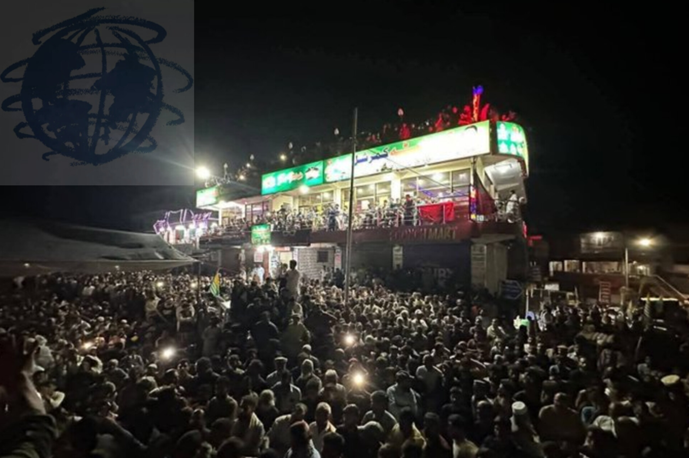
Today, however, that narrative faces one of its most significant challenges in recent memory not from India, not from the international community, and not from geopolitical developments beyond Pakistan’s control. Instead, the challenge has emerged from within Pakistan occupied Jammu and Kashmir itself.[i] The on-going unrest across Pakistan occupied Kashmir, triggered by the confrontation between the authorities and the Jammu and Kashmir Joint Awami Action Committee (JKJAAC)[ii] represents far more than a routine law-and-order issue.[iii]
It is a moment of strategic significance because it exposes deeper questions about governance, representation, legitimacy, and political accountability in a territory that Islamabad has long presented as a model of Kashmiri self-governance.[iv] But the importance of the JKJAAC movement lies not merely in the protests themselves, nor in the immediate disputes surrounding electricity tariffs, wheat subsidies, or legislative representation. Its importance lies in what these protests reveal about the evolving political consciousness of ordinary people living in Pakistan ocupied Kashmir.[v]
For years, international discussions on Kashmir have largely been framed through the prism of geopolitics, territorial disputes, military tensions, and competing national claims. The JKJAAC movement introduces a different dimension altogether.
It forces attention toward questions of governance. It asks who exercises power, who benefits from economic resources, who shapes political outcomes, and who ultimately speaks on behalf of the people. This distinction is critical.[vi]
The JKJAAC movement is not fundamentally ideological in nature. It is not a secessionist movement. It is not an armed insurgency. Nor is it a campaign demanding accession to India. At its core, it is a grassroots socio-economic and political movement driven by ordinary citizens frustrated with what they perceive as an increasingly unresponsive system.
Its participants include traders, transport operators, lawyers, students, professionals, civil society activists, and members of the local business community.
Their grievances revolve around issues that are familiar across many parts of the world, rising living costs, unequal distribution of resources, political privilege, lack of accountability, and inadequate representation. The fact that such concerns have become the basis of mass mobilization is itself revealing.
It suggests that for a growing number of residents in Pakistan occupied Kashmir, the central issue is no longer merely the unresolved territorial dispute between India and Pakistan. Rather, it is the quality of governance they experience in their daily lives.
This shift matters because it alters the nature of the debate.
Geopolitical narratives can often rally public opinion against external adversaries. Governance failures, however, are inherently domestic. They cannot easily be attributed to foreign conspiracies or external pressures. They force citizens to look inward and ask difficult questions about institutions, leadership, and accountability.
That is precisely why the current protests have created discomfort within Pakistan’s political establishment. The protesters are asking questions that go beyond economics.
Why, they ask, does a region rich in hydropower resources continue to struggle with high electricity costs? Why do local populations bear the burden of rising utility bills while electricity generated from their territory benefits others? Why do constitutional arrangements appear resistant to local demands? Why do political structures often seem more responsive to Islamabad than to the aspirations of the people they are meant to represent?
These are not radical questions.
They are the questions citizens ask when they begin to feel disconnected from decision-making processes that affect their lives. Such questions become particularly significant because they challenge a long-standing assumption embedded within Pakistan’s Kashmir policy.[vii]
Islamabad has consistently argued that it acts in the interests of Kashmiris.
Yet the JKJAAC protests raise a more fundamental issue, who determines what those interests actually are? Is it the people themselves, or institutions acting in their name? The answer to that question has implications far beyond the immediate crisis.
The controversy surrounding the twelve refugee-reserved seats in the Azad Jammu and Kashmir Legislative Assembly illustrates this tension.[viii] On the surface, the issue appears constitutional and technical. In reality, it is deeply political.
For decades, these seats have formed part of Pakistan’s broader approach to the Kashmir dispute. They symbolize Islamabad’s claim that displaced populations from Indian territories continue to possess a stake in the political future of Kashmir.[ix] From Pakistan’s perspective, the arrangement reinforces the broader narrative of an unresolved dispute. For many protesters, however, the issue looks different.
They argue that these seats dilute local representation and contribute to political outcomes that are shaped by constituencies residing outside the territory itself. Whether one agrees with this argument is ultimately secondary. What matters is that a substantial section of the local population is now openly challenging an arrangement that Islamabad has historically regarded as politically untouchable.
The significance lies not in the constitutional debate itself, but in the willingness of ordinary citizens to question the political architecture underpinning Pakistan’s administration of the territory. The official response has been equally revealing. Rather than treating the movement as a political challenge requiring political engagement, the authorities have increasingly approached it as a security problem.
Internet services have been suspended. Activists have been arrested. Protest leaders have faced legal action. Security forces have been deployed. Restrictions have been imposed on movement and communication. Human rights organizations have expressed concern regarding the scale and nature of the response.[x]
The use of such measures inevitably raises uncomfortable questions about the relationship between state authority and democratic dissent. This is where the broader strategic implications become apparent.
For years, Pakistan has criticized India on issues relating to democratic rights, civil liberties, and political freedoms in Jammu and Kashmir. Whether one agrees or disagrees with those criticisms is not the point. The point is that Pakistan has consistently sought to occupy a position of moral authority on these questions.
Yet the response to the JKJAAC movement complicates that position considerably. When a state responds to grassroots protests through communication blackouts, mass arrests, restrictions on assembly, and the criminalization of political activism, it inevitably invites scrutiny regarding the consistency of its own standards.
The issue is not hypocrisy.
International politics is replete with examples of states applying different standards in different circumstances. The real issue is credibility. Credibility is the foundation upon which diplomatic influence rests. A state may possess military power, economic resources, and political influence, but its ability to persuade others ultimately depends upon whether its actions align with its stated principles.
Once credibility begins to erode, rebuilding it becomes exceptionally difficult. Pakistan’s challenge today is therefore not simply that protests have occurred. Democracies and authoritarian systems alike experience public unrest.
The deeper challenge is that the unrest directly undermines one of the central pillars of Pakistan’s international argument on Kashmir. It exposes a growing disconnect between the image Islamabad seeks to project internationally and the realities increasingly visible within the territory under its administration.
From India’s perspective, several important lessons emerge.
First, the events reaffirm a reality that New Delhi has long emphasized[xi], the Kashmir question cannot be understood solely through the lens of territorial sovereignty. Governance matters. Economic opportunity matters. Political accountability matters. Institutional legitimacy matters.
Ultimately, populations evaluate political systems not on the basis of slogans but on the basis of outcomes. Roads, schools, employment opportunities, public services, democratic participation, and responsive governance have a far greater impact on public sentiment than abstract political rhetoric.
Second, India must resist the temptation of triumphalism. Serious states do not celebrate instability in their neighbourhood. Strategic maturity demands discipline. The objective should not be to exploit Pakistan’s difficulties through rhetorical excess. Rather, it should be to calmly and systematically expose contradictions through facts.
The most effective diplomatic argument is often the simplest one, if Pakistan claims to advocate democratic rights and political representation for Kashmiris those principles must be visibly upheld within territories under its own administration.
Third, the developments highlight an important geopolitical trend. Increasingly, populations across regions of strategic contestation are shifting their focus from grand ideological narratives toward questions of governance and accountability.
Citizens are asking who controls resources, who exercises power, and who benefits from existing arrangements. Such questions are difficult to suppress because they arise from lived experience rather than political mobilization orchestrated from above.
This trend should concern Islamabad more than any statement issued from New Delhi. External criticism can be dismissed as politically motivated. Internal dissatisfaction is far more difficult to manage because it reflects realities experienced directly by citizens. Security measures may restore temporary order. They rarely restore trust. Communication blackouts may limit information flows. They do not eliminate grievances. Arrests may remove leaders. They do not remove underlying causes.
History repeatedly demonstrates that political questions cannot be permanently resolved through administrative or security measures alone. But it would be premature to conclude that either the Pakistan Army has fundamentally reassessed its Kashmir policy or that public opinion in Pakistan occupied Kashmir has undergone a decisive transformation. Neither proposition is supported by the available evidence.
What has changed, however, is the operating environment. Questions that Islamabad once externalized are increasingly being internalized. The debate is gradually shifting from slogans to governance, from narratives to outcomes, and from rhetoric to accountability. Such shifts do not guarantee change, but they create the conditions in which change becomes possible.
When questions of representation, accountability, and legitimacy are left unanswered, they tend to re-emerge with greater intensity over time. Pakistan occupied Kashmir may be entering precisely such a phase.
For India, the lesson is straightforward. One should neither exaggerate Pakistan’s difficulties nor ignore their implications. Strategic opportunities seldom arrive in a dramatic form. More often, they emerge through the gradual accumulation of contradictions.
The objective, therefore, is not to claim that Pakistan’s Kashmir narrative has collapsed. It plainly has not. The objective is to recognize that sustaining that narrative is becoming more costly, more complex, and more demanding than before.
The prudent course for New Delhi is to remain patient, persistent, and clear-eyed. Facts should be allowed to speak for themselves. Contradictions should be exposed where they exist, and pressure should be sustained where it yields strategic advantage.
In strategy, outcomes are rarely determined by a single event. They are shaped by the cumulative effect of multiple developments moving in the same direction. The recent developments in Pakistan occupied Kashmir should be viewed not as a decisive turning point, but as part of a broader trend whose strategic implications may only become fully visible over time.
[i] https://idsa.in/system/files/book/book_PakistanOccupiedKashmir.pdf
[ii] https://x.com/IHRF_English/status/2064478926739562905?s=20
[iii] https://indianexpress.com/article/world/pakistan-pojk-clashes-joint-awami-action-committee-protests-death-toll-india-reaction-10731400/lite/
[iv] https://issi.org.pk/wp-content/uploads/2014/06/1298966502_52425797.pdf
[v] https://kashmirtimes.com/opinion/comment-articles/azad-kashmirs-awakening-assessing-two-years-of-the-joint-awami-action-committee
[vi] https://thediplomat.com/2026/06/what-the-banning-of-the-jaac-reveals-about-power-in-azad-kashmir/
[vii] https://issi.org.pk/wp-content/uploads/2014/06/1363765955_1539914.pdf
[viii] https://tribune.com.pk/story/2611876/ajk-sc-rules-refugee-seats-constitutionally-protected-cannot-be-altered
[ix] https://apnews.com/article/pakistan-kashmir-court-refugee-seats-upcoming-elections-9dafaae025057b018f3afe7b30bb96d6
[x] https://www.aninews.in/news/world/asia/human-rights-activist-tasleema-akhter-raises-alarm-over-civilian-killings-internet-shutdown-in-pojk20260609144932
[xi] https://www.mha.gov.in/sites/default/files/2022-08/J%26K-InterlocatorsRpt-0512%5B1%5D.pdf
Punit Shyam Gore (MA Defence and Strategic Studies) is an alumnus of the School of Internal Security, Defence & Strategic Studies of the Rashtriya Raksha University, Gandhinagar (an institution of national importance) under the Ministry of Home Affairs, Government of India.