


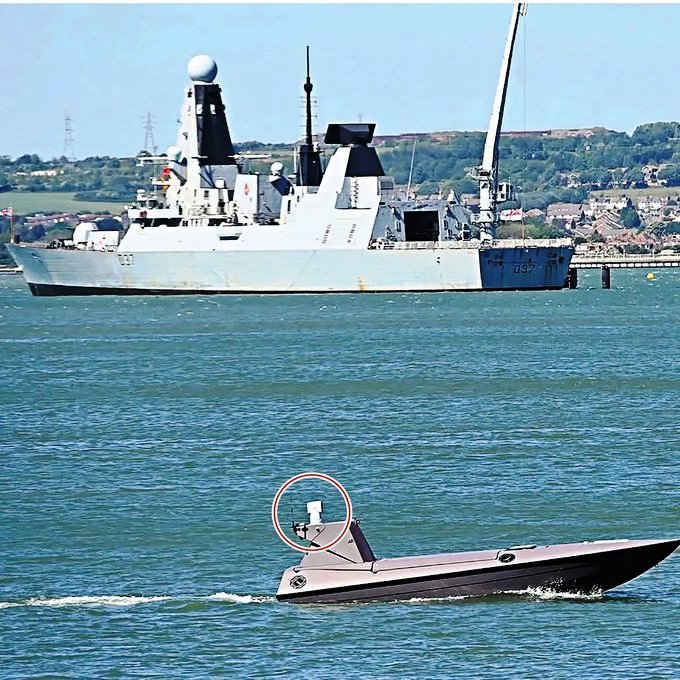
A cyber-security incident involving Britain’s K3 Scout Uncrewed Surface Vessels (USVs) has exposed a less visible but increasingly consequential vulnerability in modern defence procurement: the security of components buried deep inside ostensibly sovereign military systems.
The UK Ministry of Defence (MoD) disconnected internet connectivity from cameras fitted to K3 Scouts after a cyber assessment identified “heartbeat communications” being sent to an internet address in China, according to reporting by The Telegraph and The Times. Such communications are routine signals used by connected devices to indicate that they are online and functioning. Importantly, however, the MoD said its subsequent investigation found no evidence that MoD data or systems had been accessed, compromised or transmitted externally.
The vessels, acquired under the Royal Navy’s £12.3 million Project Beehive programme, are operated by elements including the Coastal Forces Squadron and 47 Commando Royal Marines. Built by UK-based Kraken Technology Group, the K3 Scout is an 8.4-metre autonomous USV capable of speeds up to 55 knots, carrying a payload of up to 600kg and remaining at sea for as long as 30 days, depending on mission configuration.
Kraken acknowledged that some third-party cameras contained a small number of components originating outside the UK. Following audits by Kraken and the Royal Navy, the company said it was confident that no sensitive information had been shared outside intended channels and that identified vulnerabilities had been closed.
The episode nevertheless raises a strategic question extending far beyond one camera. A military platform can be designed, assembled and integrated domestically while still depending on foreign-origin (Chinese) chips, sensors, firmware or communications modules. In an era of contested supply chains, such dependencies can create cyber and counter-intelligence risks that traditional platform-level security assessments may miss.
The K3 Scout has already featured in NATO trials in the Baltic and the wider programme has international relevance, making supply-chain assurance particularly significant.
For defence planners, the lesson is clear: sovereignty in military technology cannot end at the factory gate. It must extend down to every critical component, its software, provenance, connectivity and update pathway.

contact: drrajeshjauhri@gmail.com
Dr Rajesh Jauhri is a Journalist with an experience of over 25 years in Indian and foreign media, a Social Scientist, an Ac-complished Author, a Political & Strategic Analyst, a Marksman (Rifle & Pistol), an Orator, a Thinker and an Educationist. He holds a Ph.D. degree on “Impact of colonial heritage on Indian police”. He runs an NGO dedicated to the social and eco-nomic uplift of tribal communities in MP and two decades back, he established a school in a village of Indore district, providing education and moral values to children belonging to underprivileged and minority families. Has received multiple awards in various fields.