
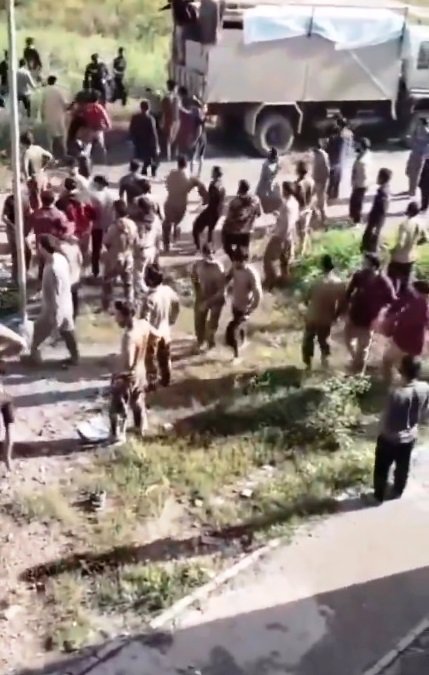
A violent internal clash among Pakistani security forces in Upper South Waziristan has once again highlighted the deep logistical and resource challenges facing the country’s military. Reports emerging from the region indicate that a severe water shortage at the ‘Asma Manza Military Brigade’ headquarters triggered a fierce confrontation involving Special Service Group (SSG) commandos, personnel from a Frontier Force (FF) regiment, Frontier Corps (FC) troops, and intelligence operatives.
Keywords: Pakistan Army water clash, South Waziristan incident, SSG FF regiment fight, Asman Manza military camp, Pakistan military logistics crisis
According to multiple accounts circulating from the area, the dispute erupted when a water tanker arrived at the camp amid prolonged scarcity. Arguments over priority access quickly escalated into a physical brawl. At least 22 security personnel were injured, with nine of them in serious condition and airlifted by helicopter for medical treatment. No external enemy was involved. The violence was entirely internal.
The incident underscores a stark reality. Pakistan’s armed forces, deployed in one of the country’s most demanding operational environments, are struggling to secure even basic necessities such as drinking water for their own ranks. Harsh terrain, limited infrastructure, and sustained operational pressure in the former tribal areas have long strained logistics. When elite units turn on one another over a tanker of water, questions inevitably arise about overall readiness, discipline, and prioritisation of resources.
While ordinary Pakistanis continue to face acute economic hardship, inflation, and shortages of essential commodities, successive governments have steadily expanded the defence budget. A significant portion of this spending is directed toward maintaining a posture of confrontation with India and sustaining networks linked to cross-border terrorism. The contrast is difficult to ignore. A military that cannot reliably supply water to its troops in Waziristan is simultaneously projected as a force capable of sustained strategic competition.
Strategic analysts note that unresolved internal weaknesses eventually undermine external ambitions. Persistent governance failures, uneven resource distribution, and neglect of basic military welfare create fractures that no amount of external posturing can conceal. History offers repeated examples of states that prioritised rivalry over internal consolidation, only to face progressive fragmentation.
Pakistan’s leadership faces a clear choice. Continued focus on external confrontation while core institutional and societal problems fester risks deepening instability. Addressing water scarcity, improving logistics, and restoring basic administrative competence within the armed forces and civilian governance structures would represent a more realistic path to long-term security. Without such course correction, the kind of internal breakdown witnessed at Asma Manza may prove less an aberration than a warning.

contact: drrajeshjauhri@gmail.com
Dr Rajesh Jauhri is a Journalist with an experience of over 25 years in Indian and foreign media, a Social Scientist, an Ac-complished Author, a Political & Strategic Analyst, a Marksman (Rifle & Pistol), an Orator, a Thinker and an Educationist. He holds a Ph.D. degree on “Impact of colonial heritage on Indian police”. He runs an NGO dedicated to the social and eco-nomic uplift of tribal communities in MP and two decades back, he established a school in a village of Indore district, providing education and moral values to children belonging to underprivileged and minority families. Has received multiple awards in various fields.