Lt Gen Rameshwar Yadav ( Retd)
The US and Iran war is in its eight month with no signs of any kind of reconciliation apparently due to mistrust and political intransigence between the warring parties. The US and Israel strategy has been to eliminate top leadership and launch massive punitive aerial strikes to destroy Iranian infrastructure and military installations to bring about a regime change. However, that has not happened. On other hand, the focus of Iranian operational art is to target US through Classical indirect approach in an asymmetrical force equation scenario. In that, Iran has been consistently and continuously reinventing ways to increase the politico-military ante so as to negotiate peace deal with US from position of strength.
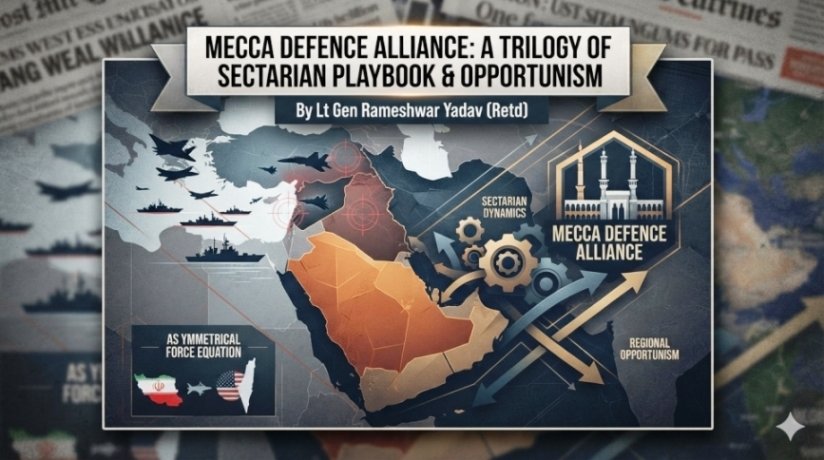
The Recent increase in Houthi aerial attacks on Saudi airports and energy infrastructure are part of this larger Iranian design. It conveys Iranian intent to show case their nuisance value and capability to impact on the economic life line of the world in general, and regional US allies in particular. In the emerging situation, Saudi Arab is known to have operationalized recently signed Mecca Accord with Turkey and Pakistan. However, there appears to be some hesitation in implementation of the accord by the partners. It warrants introspection of this accord as regards to its politico-military paradigms and effectiveness given the conceptual inconsistencies and divergent interests of partners in this convergence.
Signing of security pact between Saudi Arab, Turkey and Pakistan on 08 August 2026 in Mecca is apparently is an initiative to deal with the disturbed security order in West Asia. While defence cooperation amongst these three nations has always been there in some form or other, this accord gives it a shape of a formal commitment. Saudi Arab stands central to the accord, a nation with all the resources but has not developed requisite military capability to discharge their sovereign responsibility to defend their land and assets. They have been outsourcing their security to external forces, US being the main contributor. The US has indicated that they are not inclined to come to rescue of regional allies as they already have their hands full in the ongoing conflict.
Pakistan and Turkey are the chosen partners to fill up their military capability inadequacy. Both have substantial military structures and commonality of Sunni sectarian affinity for their political convergence. However, what stands out most is that they are both in dire need of economic bail out, hence willing to bend and open to manipulation. The Mecca Defence Alliance, though not fully structured as yet, have rough reflections of NATO concept. The statement that this ‘convergence is not against any particular country is a diplomatic camouflage to cover the actual intents of each of the partners.
The noteworthy point is that the other Sunni Gulf nations despite being roughed up by Iran are conspicuously absent from this group as of now. Infect, they should have been the natural allies to forge such a joint front against common enemy Iran. The differential probably lies in their alliance with Israel and US as part of Abraham Accord which goes against the religious sensitivities of the trio in this alliance. Moreover, historical factionalism, despite being in same sectarian camp, is the bane of most of West Asian Sunni nations.
On other hand, Shias are seen to be on the same page under leadership of Iran. Iran, on their part, has been nurturing and motivating Shia fraternity to rise as a force to defeat their ideological opponents with centrality of annihilation of Israel. It is this Iranian politico-religious investment alongside military preparedness spread over multiple fronts that has made them sustain onslaught of strongest militaries of the world.
US, apparently, seem to be under resource stress with prospects of conflict getting stretched beyond their initial assessment. They have obviously miscalculated Iranian military capabilities and their strategy to create multiple fronts, skillful use of terrain and their spirit of civilizational motivational strength. In this war, Iran chose to hit the US bases in the Gulf countries instead of taking on US directly, alongside closing strait of Hormuz and Bab el Mandeb to choke energy supply lines. Therefore, US bases which were established for the purpose of their overland and maritime security have turned out to be the biggest security threat to them.
In view of this experience, the gulf nations may well be reluctant to continue with US military presence at the present scale in future. Despite all the demonstrative bluster, even US is also seem to be looking for a way out of this war. It is assessed that in the changed geo political scenario, US may opt to reduce her military presence across the world including West Asian region once there is an amicable solution to Iran and Ukraine conflicts. A beginning has already been made in Europe and Syrian theatre in this regards. However, US would like to continue their strategic hold over energy rich region.
This probably may be the rationale of Mecca Defence Alliance, a long term military mechanism as a US proxy, albeit projected as Saudi Arab initiative. The common thread in the composition matrix in the instant case is religion with sectarian hyphenation as Iranian bogey is not going to go away. The US sponsored Sunni play book as seen earlier in Syrian episode is on the roll once again to take care of US interests in the region. Therefore, looking at the ground realities, US prompt and patronage to this accord would be a reasonable assumption.
The factual position is that Pakistanas well as Turkey enjoy amicable relations with Iran and there is no threat to them as such. Geographically, it is a triangle wherein Pakistan lies in South Asia, Saudi Arab in West Asia and Turkey in Eurasia.Hence, neither it is a West Asian regional solidarity platform, nor Pakistan as well as Turkey have a plausible reasons to join the ongoing conflict against Iran.Therefore, both would always have an inherent moral dilemma to join all out military operations against a supposedly friendly nation.
Further, Iran has accepted Pakistan as a facilitator to steer the reconciliation talks between US and Iran. It speaks of their confidence in Pakistan as a well-meaning friendly nation. It is obvious that Pakistan would also not like to let go such a diplomatic advantage that has potential to enhance their political stature. The good will, so earned, is expected to result into economic benefits in times to come.
Another major reason is that if Pakistan spoils relations with Iran, then she would be encircled by three hostile neighbours, one of them being a nuclear power and another known to have the technological capability to go nuclear. Moreover, Pakistan cannot ignore sensibilities of their own large Shia population that is unhappy over US and Israeli military campaign against Iran. Pakistan already have multiple separatist movements impacting internal security, hence they cannot afford to have another dissenting section of population.
On a larger geo political canvas, China is known to be sympathetic to Iran and views US attack unjustified. Moreover, US have imposed secondary economic sanctions on Iran that has impact on Chinese energy security. Pakistan being a vessel state of China cannot possibly go against their outlook. Pakistan has to weigh their options to be a Sunni Islamist first on US prompt, or continue to seek Chinese patronage to enhance their politico-military deterrence and economic buoyancy. Pakistan, accordingly, has to do balancing act between China and US on one hand, and Iran and Saudi Arab on other hand.
Despite all the reasons for Pakistan not to join an anti-Iran military group, they have chosen to go ahead and signed the Mecca Accord. The answer lies in changed US strategy for West Asian region and propensity of Pakistan to exploit the situation to their advantage, however unethical or immoral it may be.
It may also be noted that US has been cultivating Pakistani political and military leadership in recent past literally going out of the way. Surely, it has a reason which seems to be unfolding now, both in diplomacy and military domain. Pakistan and Iran have a common land borders that provides US a military operational contingency. Precedence exists of similar nature in case of US intervention in Afghanistan twice. Whether it is exercised, or not is a separate matter. Accordingly, the hypothesis of US manipulating Pakistan forcing her into this alliance cannot be ruled out.
Since Pakistan has always been providing military assistance to Saudi Arab, there will not be much of difference in the ground situation even if the Mecca Accord is activated. Moreover, the agreement stipulates that deployment would be restricted to defensive operations only. The ongoing Houthi strikes on civic targets are more for symbolic effect so as to pressurize Saudi Arab and in turn US to give in. Even if a missile or drone is intercepted, it would still make a headlines and convey the political message. Therefore, probability of Pakistan violating sensitivities of Iran in a major way is going to be marginal.
As per accord all signatories would help out each other in times of military threat to them. Pakistan, therefore, would have lien over Saudi and Turkish weapon and equipment during conflict situations with no major financial liabilities. US would also be more forthcoming to provide economic and military aid to Pakistan as they would be seen to do their bidding in West Asia. Saudi Arab will be indebted to Pakistan and likely to bail them out of their economic mess in return. Pakistan in turn would succeed in enhancing their deterrence against arch rival India with backing by two world powers and her partners in Accord.
Looking at such overwhelming advantages, Pakistan seem to have taken a call, albeit with utmost caution and restrictions not to cross the red lines beyond Iranian tolerance. If they do so, Pakistan would be sucked in an irretrievable military confrontation with long term dire consequences. It would have potential to destabilize Pakistan as a nation state that may relegate them into a foot note in annals of history. Iran has already issued a warning to Pakistan to refrain from any anti Iran activity. Pakistan has to take this clarion call seriously, lest it is too late.
Turkey being part of NATO enjoys well-structured security umbrella under its article 5, hence their motives to forge another security alliance for their defence does not seem to be convincing. Therefore, it is obvious that Turkey have motives other than military alliance as such. Turkish utility lies in their high tech defence industrial base, especially in the field of drones that is turning out to be the game changer in present day conflict scenario.
Turkey is looking at selling their military hardware and make money. Participation in the ongoing war would be a big advertisement for their future sales across the world. Moreover, the president of Turkey has ambitions to be the leader of Islamic world and he does not miss out any issue that may be seen to inspire and rally Muslims around him. This platform provides him such an opportunity.
Looking from purely professional point of view, conduct of joint military operations across distant lands without a structured mechanism and logistics have severe limitations. Moreover, double talk by Pakistan as well as Turkey as regards to their role in a fully blown military situation clearly reflects their reluctance and insincerity. Hence, viability of such a loosely held military grouping is a big question mark.
No nation can be secure unless they have their own forces trained, equipped and motivated to face the enemy threat. Outsiders would always be mercenaries sans accountability looking for financial benefits. They would operate as long as it does not impact on their national political interests. That happens to be reality in this instant case wherein both Pakistan as well as Turkey would be the beneficiary at the cost of Saudi Arab. The accord per se has good political optics but it is not fully convincing from professional analysis. Iran is unlikely to be smitten by this move knowing the inconsistencies and inherent fault lines as discussed in this write up. Let’s see how the situation unfolds hereafter…
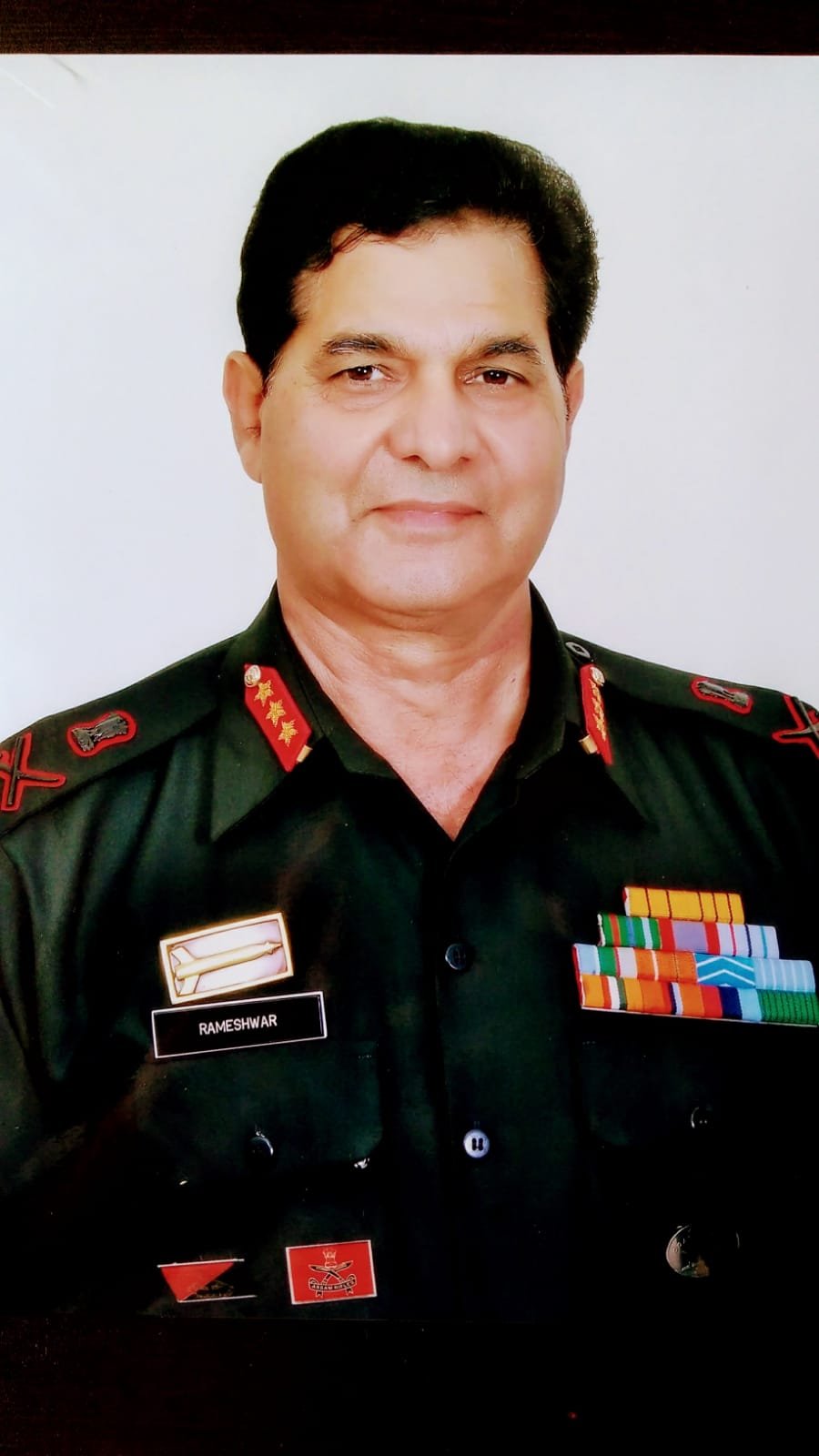
The General was commissioned into the RAJPUTANA RIFLES Regiment in December 1974. He is an ex NDA officer and an alumnus of the prestigious Defence Services Staff College, Wellington, Higher Command Course and National Defence College. He has participated in active counter insurgency operations in Jammu & Kashmir, North East and Sri Lanka. He has a distinction to have served in all corps zones including mechanized and Tri service environment as part of all three strike corps. He has been closely associated with strategic level studies, force structuring and modernization of Indian Army.
The General has been ADC to the President of India and has held Principle Staff officer and operational appointments at all levels. He was appointed as Director General of prestigious Rashtriya Rifles, a specialised force fighting insurgency in Jammu & Kashmir. Subsequently, as Director General Infantry, he has been the head of largest combat component and cutting edge of the Indian Army. The General Officer has been awarded the VSM, AVSM, and PVSM for his distinguished service and outstanding contribution to the Armed Forces and National Security.
He has been an avid sports person and has played most of troop games including riding and polo in younger days. He has switched to golf now. The General has written large number of articles on varied professional and international geo political issues. He is a regular participant in seminars and discussions on strategic and defence matters in number of think tanks, radio and visual media.