




–Dr Rajesh Jauhri
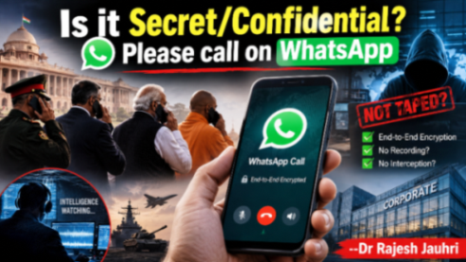
Across the corridors of power in New Delhi, the defence establishments across the nation, and the offices of corporate titans, a dangerous operational consensus has quietly taken root. Key decision-makers, ranging from defence officers and intelligence functionaries to political strategists, fulltime volunteers of the most elite and largest saffron organisation, and high-stakes business operators, increasingly share a single behavioural trait- when a conversation turns sensitive, they reach for WhatsApp calling. For anything sensitive, the preferred medium is no longer the ordinary mobile call. It is WhatsApp voice or video. The belief is near-universal: the call cannot be recorded by the network, the conversation is end-to-end encrypted, and therefore it is safer. That belief is not merely incomplete. It is strategically dangerous.
The rationale driving this pivot is simple: a widespread belief that standard cellular networks are vulnerable to local interception and recording, whereas WhatsApp calling is end-to-end encrypted and is impossible to tap. However, from the standpoint of strategic intelligence and information warfare, this collective retreat into commercial encrypted channels has created a severe structural vulnerability.
Illusion of Secrecy
In strategic deception, the most effective trap is one, where the target willingly walks into under the belief that it offers absolute sanctuary. This dynamic mirrors the plot of Robert Arthur’s classic narrative The Midnight Visitor (often remembered in academic curricula as the tale of the elusive agent Fowler and Ausable). In that story, the adversary is subtly driven to jump through a high-altitude window because he was repeatedly assured it was a safe exit.
When a commercial platform continuously reminds users on every screen that “messages and calls are end-to-end encrypted,” it functions as a psychological beacon. It reassures high-value targets that the platform is their safe exit.
By convincing an entire nation’s political, military, social and financial leadership to centralize their sensitive discussions on a handful of foreign-hosted messaging applications, India’s strategic elite has done the heavy lifting for foreign signals intelligence agencies.
Surveillance made easy by us
Consider the operational burden placed on foreign intelligence apparatuses, whether the CIA, Mossad, or the SVR (the modern successor to the KGB). Monitoring over a billion daily cellular connections across India’s traditional telecom architecture presents a formidable signals-intelligence challenge requiring vast data processing resources.
However, when key personnel voluntarily cluster their sensitive communications onto a localized internet-based platform, the intelligence grid shrinks dramatically. Foreign intelligence platforms do not need to break AES-256 encryption across the entire network to harvest high-value intelligence. Instead, they leverage traffic analysis, social graph mapping, and endpoint telemetry:
- Metadata Mapping: Even when payload contents are encrypted, call timing, duration, device IDs, and IP routing betray organizational structures and operational tempos.
- Target Isolation: The systemic migration of decision-makers to WhatsApp calling allows foreign intelligence agencies to filter out ambient noise and isolate high-value clusters with minimal operational overhead.
- Meta Can’t be Left Undoubted: Looking at the recent sharp increase of Cockroach Janta Party (CJP) in terms of fake followers’ numbers and views to derail the democratically elected government in India, Indian authorities must rethink on the use of WhatsApp calling and messaging for confidential conversations in all critical sectors in India.
Conversely, radical non-state actors, extreme leftist factions, and seasoned insurgent networks consistently demonstrate a deep institutional distrust of mainstream Silicon Valley infrastructure. Their operational secrecy relies on fragmented, multi-layered, and self-hosted communication vectors.
The fallibility of this false sense of security was vividly demonstrated in the public domain when audio-visual recordings of high-profile political figures engaging in sensitive financial deals were broadcast across national media, captured effortlessly via secondary recording devices operating in the same room.
Urdu Shayri may throw light on WhatsApp’s continuous messages about end to end encryption
There is a classic Urdu couplet that captures the paradox of deliberate silence and misplaced trust:
“Qatil ke gharane se unka bhi taluq hai,
Bhoole se bhi unka jo naam nahi lete.”
(They too share a bond with the killer’s team, those who, even by mistake, never utter their name)
Same can be felt when WhatsApp continuously and tirelessly tells us, “messages and calls are end-to-end encrypted”. So, in the domain of national security and institutional intelligence, avoiding open scrutiny of foreign-controlled communication platforms is equivalent to tacit compliance. Relying on commercial messaging infrastructure designed in foreign jurisdictions for strategic operations, statecraft, or sensitive business deals is not an administrative convenience, it is an information security gamble.
Until India’s key policy-makers, defence leadership, and institutional figures recognize that commercial encryption is a user feature rather than a state-grade defence shield, strategic conversations will remain exposed to those who monitor the network from afar.

contact: drrajeshjauhri@gmail.com
Dr Rajesh Jauhri is a Journalist with an experience of over 25 years in Indian and foreign media, a Social Scientist, an Ac-complished Author, a Political & Strategic Analyst, a Marksman (Rifle & Pistol), an Orator, a Thinker and an Educationist. He holds a Ph.D. degree on “Impact of colonial heritage on Indian police”. He runs an NGO dedicated to the social and eco-nomic uplift of tribal communities in MP and two decades back, he established a school in a village of Indore district, providing education and moral values to children belonging to underprivileged and minority families. Has received multiple awards in various fields.