


Dr Rajesh Jauhri, Senior Journalist
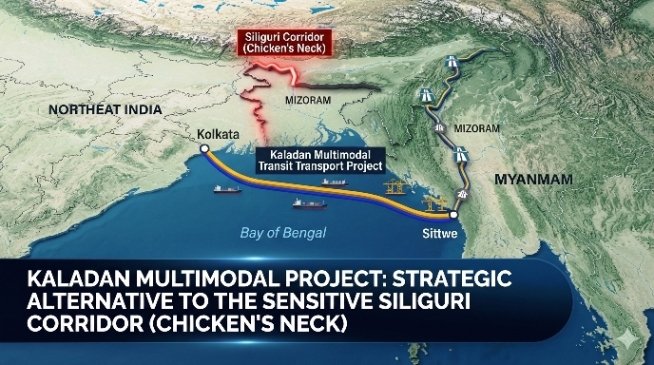
India’s narrow Siliguri Corridor, popularly known as the Chicken’s Neck, has long been recognised as a critical strategic vulnerability linking the mainland to the eight north-eastern states. Any disruption here could sever vital military and civilian supply lines. To address this risk, New Delhi is advancing the Kaladan Multimodal Transit Transport Project (KMMTTP), a multi-mode alternative route through Myanmar that promises both enhanced security and significantly shorter logistics distances between Kolkata and the Northeast.
Keywords: Kaladan Multimodal Transit Transport Project, Siliguri Corridor, Chicken’s Neck, Act East Policy, Sittwe Port, Northeast connectivity, Paletwa–Zorinpui highway
The project begins at Kolkata Port, from where cargo vessels cross the Bay of Bengal, a distance of approximately 539 km, to reach the Indian-built and operated Sittwe deep-water port in Myanmar’s Rakhine State. From Sittwe, goods are transferred to smaller barges for a 158 km journey northward along the Kaladan River to the inland port of Paletwa. The most challenging segment follows a 109 km highway through the rugged terrain of Myanmar’s Chin State that connects Paletwa to the Zorinpui border point in Mizoram.
Once inside Indian territory, the corridor links via National Highway-54 to Aizawl and further to Silchar in Assam, the principal gateway for the southern Northeast. To complete the high-speed network, the government is constructing a ₹22,864-crore, 167 km four-lane expressway between Silchar and Shillong featuring 34 viaducts and 19 major bridges. This stretch is expected to cut travel time from eight hours to five and provide seamless connectivity onward to Guwahati.
When fully operational, the corridor is projected to reduce the Kolkata- Aizawl/Silchar distance by nearly 700 km and will halve the logistics costs, thereby ending heavy dependence on both the Siliguri Corridor and transit routes through Bangladesh. The sea and river components are already functional, the final bottleneck remains the secure completion of the Paletwa- Zorinpui road amid Myanmar’s internal conflict.
Defence planners view the project as a decisive step under the Act East Policy. The day the remaining 109 km stretch is secured and opened, the Bay of Bengal will gain a direct logistical doorway to Guwahati, transforming both the geography and the security architecture of India’s Northeast.

contact: drrajeshjauhri@gmail.com
Dr Rajesh Jauhri is a Journalist with an experience of over 25 years in Indian and foreign media, a Social Scientist, an Ac-complished Author, a Political & Strategic Analyst, a Marksman (Rifle & Pistol), an Orator, a Thinker and an Educationist. He holds a Ph.D. degree on “Impact of colonial heritage on Indian police”. He runs an NGO dedicated to the social and eco-nomic uplift of tribal communities in MP and two decades back, he established a school in a village of Indore district, providing education and moral values to children belonging to underprivileged and minority families. Has received multiple awards in various fields.