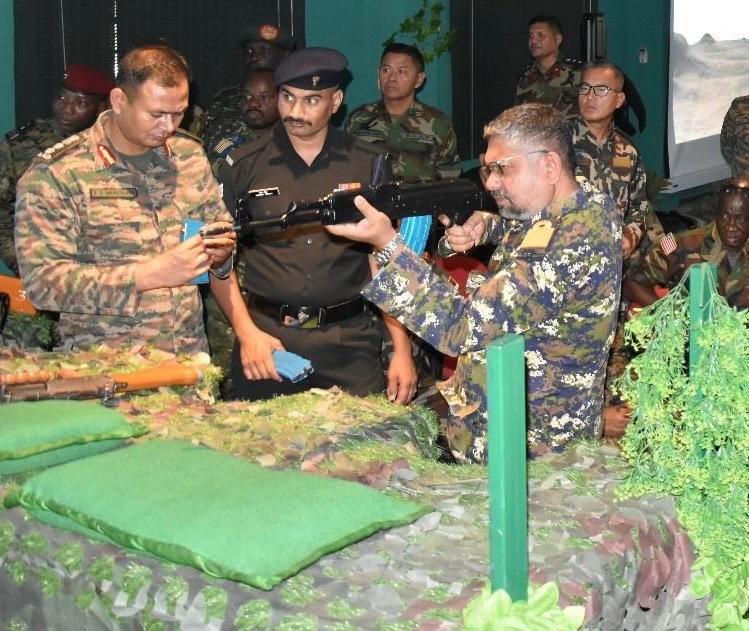
Secunderabad/Hakimpet: A delegation from the Higher Defence Orientation Course (HDOC) at the Army War College (AWC), Mhow, visited the Indian Army’s Simulator Development Division (SDD) in Secunderabad and Air Force Station Hakimpet on April 13, gaining first-hand exposure to the latest advancements in military simulation technology. The visit underscored the growing emphasis across the Indian Armed Forces on leveraging artificial intelligence (AI), augmented reality (AR), virtual reality (VR), robotics, and high-fidelity simulators to enhance training realism while optimising operational costs and safety.
The HDOC, a prestigious tri-service programme designed to orient senior officers on higher defence management, strategic leadership, and joint operational perspectives, regularly incorporates exposure visits to key establishments. This particular leg of the course allowed participants to interact directly with indigenous simulator solutions developed to address contemporary training challenges in a rapidly evolving threat environment.At the Simulator Development Division in Secunderabad, the Indian Army’s nodal facility for designing and producing training simulators since its establishment in the early 1990s, the delegation received detailed briefings on ongoing projects. SDD has increasingly integrated emerging technologies such as AI-driven scenario generation, AR/VR immersive environments, and robotic systems to create realistic, repeatable, and cost-effective training modules for diverse platforms, from armoured vehicles and artillery to drones and infantry tactics. Recent collaborations, including a Centre of Excellence with IIT Hyderabad, reflect the push towards indigenisation and academic-industry synergy in defence R&D.
The group then proceeded to Air Force Station Hakimpet, a premier IAF training base located on the outskirts of Hyderabad that serves as a hub for Stage-II flying training for fighter pilots, helicopter crews, and technical personnel. Participants witnessed operational simulators that replicate complex flying scenarios, including emergency procedures, mission profiles, and tactical engagements, without the risks and expenses associated with live aircraft sorties.Hakimpet has been at the forefront of the IAF’s adoption of immersive technologies. The station has deployed indigenous VR-based simulators that provide 360-degree immersive experiences, significantly augmenting traditional flight training. These systems allow trainees to practise critical manoeuvres, engine failures, and combat situations in a safe, controlled environment, thereby conserving valuable flying hours on actual aircraft while accelerating skill development. Briefings highlighted how AI elements are being woven into these platforms for adaptive learning, real-time performance analysis, and intelligent scenario customisation.
Senior defence officials accompanying the visit emphasised that such simulator-based training is not merely supplementary but a strategic necessity. In an era of contested airspaces, networked warfare, and high-intensity operations, the ability to rehearse complex joint manoeuvres, blending air power with ground and maritime elements, assumes critical importance.
Simulators enable forces to train for high-risk scenarios that would otherwise be prohibitively expensive or dangerous in live settings.The integration of robotics and AI further enhances fidelity. Robotic adversaries or support elements can respond dynamically, while AI algorithms generate unpredictable threat behaviours, forcing trainees to exercise superior decision-making under pressure. These capabilities align with the broader “Atmanirbhar Bharat” initiative in defence, reducing reliance on imported systems and fostering indigenous innovation.For the HDOC participants, comprising senior officers from the Army, Navy, and Air Force, along with select international partners, the visit offered valuable insights into how technology is reshaping professional military education. It also reinforced the importance of jointness: understanding the simulation ecosystem across services is essential for effective theatre-level planning and integrated battle management.As the Indian Armed Forces modernise amid regional security challenges, investments in simulation infrastructure are expected to grow. Facilities like SDD and Hakimpet exemplify a mature approach, combining domain expertise with cutting-edge technology to produce combat-ready personnel at lower risk and cost.
The Army War College and Indian Air Force have not issued detailed public statements beyond the official social media post confirming the visit, consistent with standard protocol for such professional military education activities. Nevertheless, the demonstrated capabilities point to a clear trajectory: future Indian military training will increasingly occur in synthetic environments that closely mirror the complexities of modern conflict.
This visit by the HDOC cohort is yet another marker of the quiet but determined transformation underway in India’s defence training architecture, one that prioritises technological edge, operational efficiency, and joint warfighting readiness.

contact: drrajeshjauhri@gmail.com
Dr Rajesh Jauhri is a Journalist with an experience of over 25 years in Indian and foreign media, a Social Scientist, an Ac-complished Author, a Political & Strategic Analyst, a Marksman (Rifle & Pistol), an Orator, a Thinker and an Educationist. He holds a Ph.D. degree on “Impact of colonial heritage on Indian police”. He runs an NGO dedicated to the social and eco-nomic uplift of tribal communities in MP and two decades back, he established a school in a village of Indore district, providing education and moral values to children belonging to underprivileged and minority families. Has received multiple awards in various fields.