


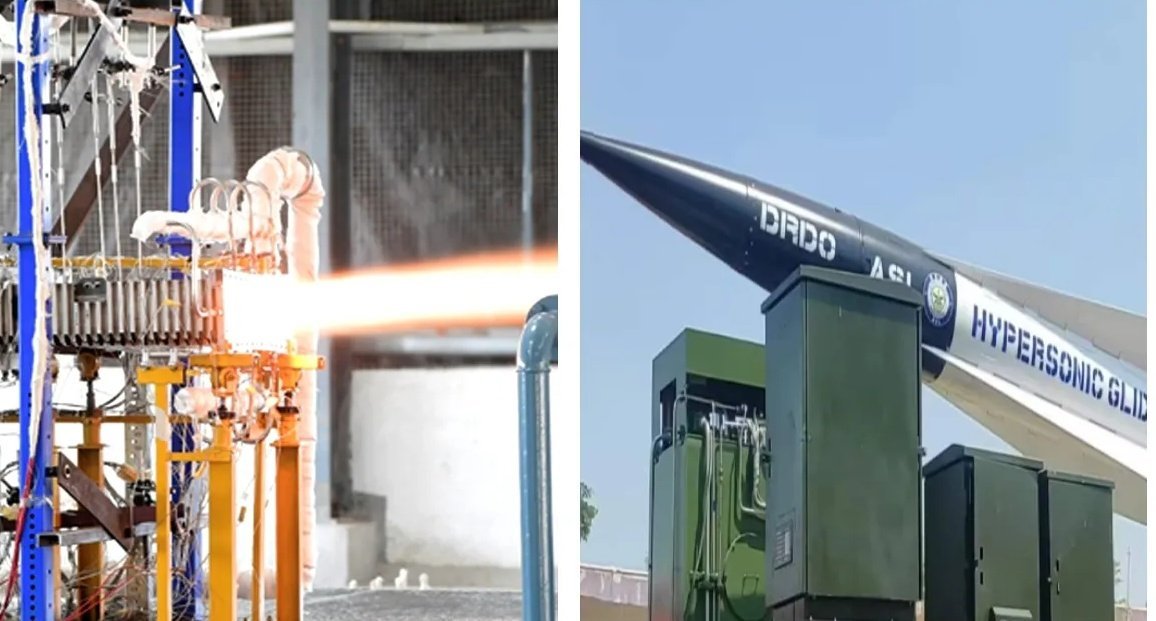
New Delhi: In a milestone that fundamentally alters the balance of power in the Indo-Pacific, India has successfully conducted a ground test of a full-scale, actively cooled, long-duration Scramjet engine. This breakthrough, announced by the Defence Research and Development Organisation (DRDO), propels India into an ultra-exclusive club of nations possessing the ‘holy grail’ of modern aerospace engineering: operational hypersonic air-breathing technology.
A Scramjet, or Supersonic Combustion Ramjet, differs from traditional jet engines by lacking rotating parts. Instead, it relies on the vehicle’s high speed to compress incoming air. However, the true challenge lies in maintaining combustion while air moves through the engine at supersonic speeds, a feat often compared to ‘lighting a match in a hurricane.’ By successfully testing a long-duration, actively cooled version, India has solved the two greatest hurdles of hypersonic flight: sustained combustion and thermal management.
The engine utilizes an advanced cooling system where the fuel itself likely acts as a coolant before being injected into the combustor. This is critical because, at speeds exceeding Mach 5, friction generates temperatures soaring above 1500°C, which would melt conventional aerospace materials. This transition from experimental research to a ‘weapon-grade’ system marks India’s shift toward developing long-range hypersonic cruise missiles that are virtually immune to current missile Defence shields.
To appreciate the magnitude of this achievement, one must look at how India’s progress compares to the only three other nations that have successfully flight-tested similar technology.
The U.S. has led scramjet research for decades, most notably with the X-51A Waverider. American technology focuses heavily on precision and miniaturization, aiming to integrate hypersonic missiles onto standard fighter jets. While the U.S. possesses highly sophisticated computational fluid dynamics, it has faced recent setbacks in consistent flight testing. India’s successful long-duration ground test suggests it is pursuing a ‘steady-state’ reliability that rivals the American approach to sustained hypersonic cruise.
Russia currently leads the world in deploying hypersonic weapons, such as the Zircon cruise missile. Russian scramjet technology is characterized by its ruggedness and immediate operational integration. While Russia focused on rapid deployment, India’s approach appears more focused on the indigenous development of the ‘actively cooled’ aspect, which ensures the engine can run for longer periods without structural failure, a key requirement for trans-continental hypersonic platforms.
China has invested heavily in the Starry Sky-2 and various high-speed wind tunnels to perfect its air-breathing systems. China’s strength lies in its ability to conduct frequent, iterative tests. By achieving this milestone, India has effectively neutralized a significant technological gap with Beijing, ensuring that its strategic deterrence remains credible. India’s engine, developed under the ‘Atmanirbhar Bharat’ initiative, ensures that its future hypersonic arsenal will be free from foreign supply chain vulnerabilities.
For the Indian Ministry of Defence, this test is not merely a laboratory success but a declaration of strategic autonomy. As India moves toward a ‘weapon-grade’ system, it secures a future where its strike capabilities are faster than the speed of sound, leaving adversaries with almost zero reaction time. This achievement ensures that India remains a primary architect of global security rather than a mere spectator in the hypersonic arms race.

contact: drrajeshjauhri@gmail.com
Dr Rajesh Jauhri is a Journalist with an experience of over 25 years in Indian and foreign media, a Social Scientist, an Ac-complished Author, a Political & Strategic Analyst, a Marksman (Rifle & Pistol), an Orator, a Thinker and an Educationist. He holds a Ph.D. degree on “Impact of colonial heritage on Indian police”. He runs an NGO dedicated to the social and eco-nomic uplift of tribal communities in MP and two decades back, he established a school in a village of Indore district, providing education and moral values to children belonging to underprivileged and minority families. Has received multiple awards in various fields.