
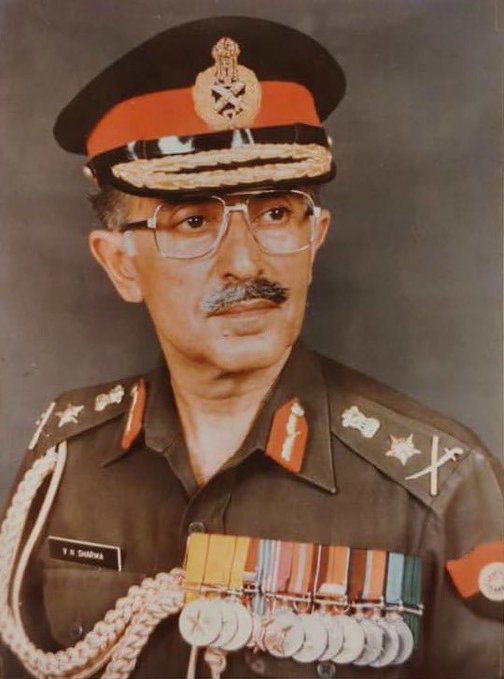
General Vishwa Nath Sharma, the 14th Chief of the Army Staff who led the Indian Army from 1988 to 1990 and stood firm during the tense 1987 Wangdung (Sumdorong Chu) standoff with China, passed away in New Delhi yesterday. He was 96.
Known affectionately in Army circles as ‘Tich’, Gen Sharma was the first officer commissioned after Independence to rise to the apex of the Indian Army. Commissioned into the 16th Light Cavalry in June 1950 from the fifth Regular Course at the Indian Military Academy, Dehradun, he embodied the cavalry ethos of speed, resolve and unflinching nerve under pressure throughout a career spanning four decades.
Keywords: Gen VN Sharma, Chief of Army Staff, Wangdung standoff, Sumdorong Chu, Indian Army, Param Vir Chakra family, Rajnath Singh tribute
Born in London on June 4, 1930 into a distinguished military family from Dadh village in Kangra district of Himachal Pradesh, Sharma carried forward an extraordinary legacy of service. His father, Major General Amar Nath Sharma, served in the Army Medical Corps. His elder brother, Major Som Nath Sharma, became Independent India’s first Param Vir Chakra recipient for gallantry at Badgam in 1947. Another brother, Lt Gen Surendra Nath Sharma, served as Engineer-in-Chief of the Indian Army and remains active at 103. The family’s roots in the Dogra heartland of Himachal continued to inspire generations of soldiers from the region.
As a Major, Sharma saw action in the Lahore sector during the 1965 Indo-Pak War. He later commanded the 66th Armoured Regiment, served as an instructor at the Defence Services Staff College, Wellington, and held key staff appointments, including as Colonel General Staff (Operations) of an armoured division during the 1971 war. His successive commands included a mountain brigade in an insurgency-affected area (for which he received the Ati Vishisht Seva Medal), an armoured brigade in Rajasthan, a mountain division, and a corps. In June 1987 he took over as GOC-in-C, Eastern Command.
It was in this role that he faced one of the most serious India-China confrontations since 1962. When Chinese forces occupied positions in the Wangdung area of the Sumdorong Chu valley in Arunachal Pradesh, Sharma, drawing on prior war-gaming of Chinese plans and personal aerial reconnaissance, refused orders for a tactical withdrawal that would have ceded critical ridgelines. His firm stance — that lawful defence of the border could not yield to limited-patrolling restrictions when the adversary was advancing — contributed to a robust Indian military response involving substantial troop and air deployments. The standoff eventually de-escalated through mutual pull-back, preserving India’s position.
Elevated as Chief of the Army Staff on June 1, 1988, Gen Sharma led the force through a demanding period marked by the Punjab insurgency, challenges in Kashmir and the Northeast, and the Indian Peace Keeping Force (IPKF) operations in Sri Lanka. He oversaw the orderly withdrawal of the IPKF and maintained operational readiness amid external posturing. Decorated with the Param Vishisht Seva Medal for distinguished service of the most exceptional order, he retired on June 30, 1990.
In the years that followed, Sharma remained connected to national security discourse as a member of the Institute for Defence Studies and Analysis and the National Security Advisory Board, while quietly supporting a free tuberculosis and medical centre in his ancestral village of Dadh.
Tributes poured in from the highest levels. Defence Minister Rajnath Singh wrote: “Deeply saddened by the passing of former Chief of the Army Staff, General Vishwa Nath Sharma. A distinguished military leader, General Sharma served the Nation with unwavering dedication, courage and honour. He carried forward the illustrious legacy of his family, including that of his elder brother, Major Som Nath Sharma, PVC, with great distinction. His contribution to the Indian Army and his exemplary life of service will continue to inspire generations. My heartfelt condolences to his family and loved ones. Om Shanti!”
Indian Army, under Chief of the Army Staff General Dhiraj Seth, stated: “General Dhiraj Seth, COAS, and All Ranks of the Indian Army express profound grief on the passing of General Vishwa Nath Sharma, former Chief of the Army Staff. The Indian Army extends its heartfelt condolences to his bereaved family and loved ones.” The Army further remembered him as “a distinguished soldier and visionary military leader” who upheld his family’s legacy of courage and selfless service, noting that his leadership and commitment would continue to inspire future generations.
Himachal Pradesh Governor Kavinder Gupta described the demise as the end of an era, observing that the state had lost one of its finest soldier-statesmen whose distinguished career and unwavering commitment earned lasting respect. Chief Minister Sukhvinder Singh Sukhu paid homage to General Sharma’s exemplary military leadership, sense of duty and lifelong dedication, stating that the nation would remain indebted for his contributions and that his example would continue to elevate the Army’s glorious traditions.
On August 1, Gen Sharma was cremated with full military honours at Brar Square Crematorium in Delhi Cantonment. COAS Gen Dhiraj Seth laid a wreath on behalf of all ranks. The three service chiefs, several former Army Chiefs including Gen (Retd) VK Singh (Governor of Mizoram), former Chief of Defence Staff Gen (Retd) Anil Chauhan, serving and retired officers, and family members paid their final respects. His daughters performed the last rites amid a 17-gun salute.
Gen Vishwa Nath Sharma’s life bridged the early years of the independent Indian Army and its modern challenges. From the battlefields of 1965 and 1971 to the high Himalayas of Arunachal and the complex operational environment of the late 1980s, he exemplified professional resolve, institutional loyalty and quiet integrity. The Indian Army and the nation mourn a soldier who never wavered when the defence of the border demanded firmness.
contact: drrajeshjauhri@gmail.com
Dr Rajesh Jauhri is a Journalist with an experience of over 25 years in Indian and foreign media, a Social Scientist, an Ac-complished Author, a Political & Strategic Analyst, a Marksman (Rifle & Pistol), an Orator, a Thinker and an Educationist. He holds a Ph.D. degree on “Impact of colonial heritage on Indian police”. He runs an NGO dedicated to the social and eco-nomic uplift of tribal communities in MP and two decades back, he established a school in a village of Indore district, providing education and moral values to children belonging to underprivileged and minority families. Has received multiple awards in various fields.