
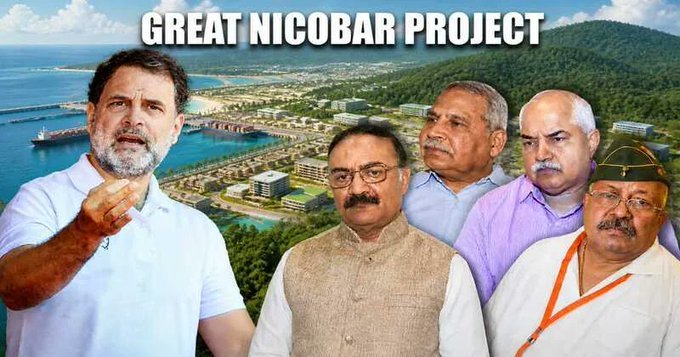
New Delhi: Congress leader Rahul Gandhi has sharply criticised the ambitious Great Nicobar Island Development Project, describing it as a ‘Scam’ that threatens pristine rainforests and indigenous communities, following his two-day visit to the Andaman and Nicobar Islands on April 28-29.
The ₹92,000 crore infrastructure initiative, approved in 2022, envisages the development of a major transhipment port, an international airport, power plants, and a township on the southern tip of Great Nicobar. Located near the vital Malacca Strait, the project is viewed by strategic planners as a critical asset to bolster India’s maritime posture in the Indo-Pacific, particularly in response to growing Chinese naval activity in the region.
Defence veterans have pushed back strongly against Gandhi’s assessment. Major General Arvind Bhatiya (Retd) and Air Vice Marshal PK Srivastava (Retd) highlighted that the project will impact less than 1.8% of the island’s forest cover while incorporating robust ecological safeguards. They emphasised that no forced displacement of tribal populations is envisaged, with relocation planned only on a voluntary and consensual basis where necessary.
Senior government officials pointed to comprehensive environmental impact assessments and mitigation measures, including compensatory afforestation and biodiversity conservation programmes. They argue the development will enhance maritime domain awareness, improve surveillance capabilities, and provide dual-use infrastructure vital for both commercial shipping and national security.
The Great Nicobar project forms a key component of India’s broader strategy to strengthen its eastern seaboard and island territories. Proponents see it as essential for countering potential chokepoint vulnerabilities in the Indian Ocean and supporting logistics for the Indian Armed Forces in a contested maritime environment.
Gandhi’s remarks have reignited debate over the balance between ecological preservation, tribal rights, and strategic necessities in India’s remote island territories. As the project moves forward, its implementation will likely remain under close scrutiny from both environmental stakeholders and the strategic community.

contact: drrajeshjauhri@gmail.com
Dr Rajesh Jauhri is a Journalist with an experience of over 25 years in Indian and foreign media, a Social Scientist, an Ac-complished Author, a Political & Strategic Analyst, a Marksman (Rifle & Pistol), an Orator, a Thinker and an Educationist. He holds a Ph.D. degree on “Impact of colonial heritage on Indian police”. He runs an NGO dedicated to the social and eco-nomic uplift of tribal communities in MP and two decades back, he established a school in a village of Indore district, providing education and moral values to children belonging to underprivileged and minority families. Has received multiple awards in various fields.