

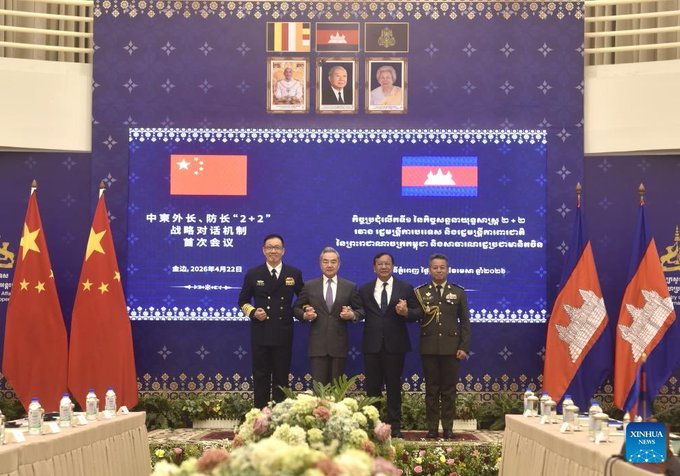
The inaugural “2+2” strategic dialogue between China and Cambodia, held in Phnom Penh, marks a significant development in the evolving geopolitical landscape of Southeast Asia, particularly against the backdrop of rising tensions in the South China Sea. Co-chaired by Chinese Foreign Minister Wang Yi and Defence Minister Dong Jun alongside their Cambodian counterparts Prak Sokhonn and Tea Seiha, the meeting underscores Beijing’s intent to institutionalise its strategic footprint in the region.
The dialogue focused on deepening bilateral cooperation across political, defence, and security domains while addressing broader regional and global challenges. Both sides reached a broad consensus on strengthening ties, with an emphasis on military cooperation, cybersecurity, and coordinated responses to transnational threats such as telecom fraud and online gambling.
Cambodian Prime Minister Hun Manet reinforced this trajectory by affirming Phnom Penh’s commitment to further consolidating relations with Beijing. Cambodia reiterated its adherence to the “One China” policy and expressed strong support for China’s national objectives, highlighting the asymmetry in the partnership, where Beijing continues to emerge as Phnom Penh’s principal strategic benefactor.
From an Indian perspective, the institutionalisation of the China–Cambodia strategic dialogue raises important security considerations. Cambodia’s geographic proximity to critical maritime routes and its growing defence alignment with China could enhance Beijing’s ability to project influence closer to the Indian Ocean region. This is particularly relevant as India seeks to safeguard its interests under its Indo-Pacific vision and maintain a rules-based order in the South China Sea.
China’s emphasis on building an “Asian security model” based on shared security and dialogue may appear cooperative in tone, but it also aligns with Beijing’s broader objective of reshaping regional governance structures in ways that could dilute the influence of external powers, including India and its partners.
Furthermore, China’s offer to mediate or facilitate dialogue between Cambodia and Thailand reflects its expanding diplomatic role in regional conflict management, an area where India has traditionally maintained a more restrained approach.
For New Delhi, the developments signal the need to recalibrate its engagement with Southeast Asia. Strengthening bilateral ties with ASEAN members, enhancing maritime cooperation, and accelerating defence diplomacy will be critical to counterbalance China’s growing strategic consolidation.
As the South China Sea continues to be a theatre of geopolitical contestation, the China-Cambodia “2+2” dialogue represents not merely a bilateral milestone, but a broader shift with implications that extend well beyond Southeast Asia, directly intersecting with India’s strategic calculus.

contact: drrajeshjauhri@gmail.com
Dr Rajesh Jauhri is a Journalist with an experience of over 25 years in Indian and foreign media, a Social Scientist, an Ac-complished Author, a Political & Strategic Analyst, a Marksman (Rifle & Pistol), an Orator, a Thinker and an Educationist. He holds a Ph.D. degree on “Impact of colonial heritage on Indian police”. He runs an NGO dedicated to the social and eco-nomic uplift of tribal communities in MP and two decades back, he established a school in a village of Indore district, providing education and moral values to children belonging to underprivileged and minority families. Has received multiple awards in various fields.