

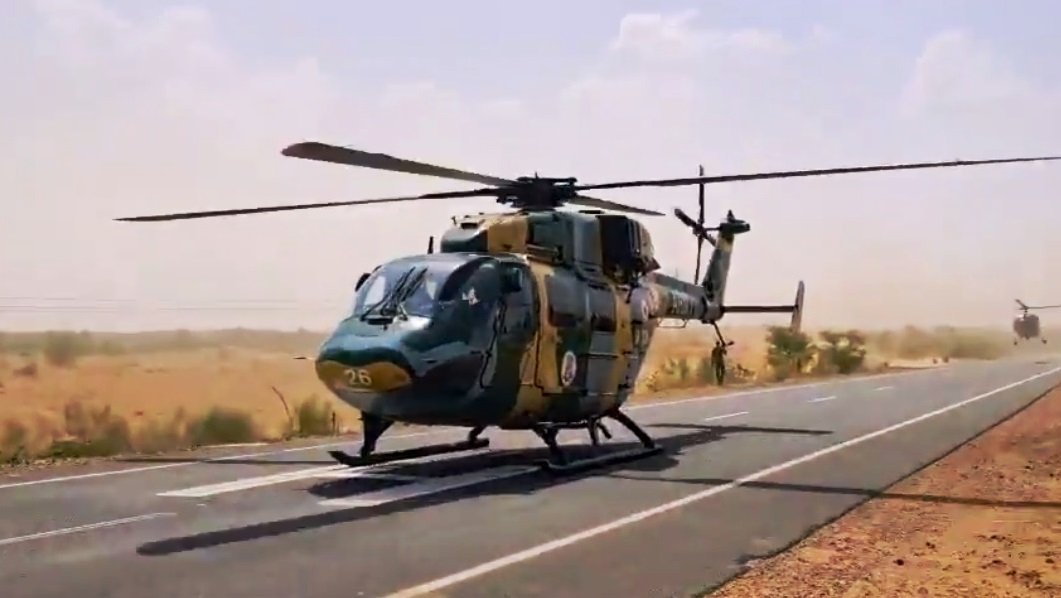
On Tuesday, September 29, 2026, helicopters of the Indian Army’s Sapta Shakti Command transformed a stretch of National Highway-911 near Dantour in Rajasthan’s Bikaner district into a temporary operating surface. Rudra, Dhruv and Chetak aircraft conducted controlled approaches, landings and take-offs on the designated section of the Bharatmala highway, located roughly 80 km from the India-Pakistan international border.
Keywords: Indian Army, Sapta Shakti Command, NH-911 highway landing, Rudra Dhruv Chetak, dual-use infrastructure, western border readiness, Army Aviation, Dhruv Helicopter, Rudra Helicopter, Chetak Helicopter, Pakistan Border
The short drill, which lasted for about half an hour, required traffic to be halted in both directions for safety. Pilots practised precision flying over the desert terrain while ground teams managed coordination at the site. The exercise specifically tested the ability to sustain helicopter operations from unconventional locations when conventional airfields, airbases or dedicated helipads are unavailable or restricted, conditions that could arise in a high-intensity conflict or during rapid deployment in the vast western desert.
Rudra, the armed variant of the indigenous Advanced Light Helicopter, provides reconnaissance, escort and fire-support capability. The twin-engine Dhruv, designed and built by Hindustan Aeronautics Limited, serves multi-role utility functions including troop movement and logistics. The Chetak, produced under licence in India, remains a reliable workhorse for lighter tasks. Together they demonstrated the versatility of Army Aviation assets operating as an integrated package.
Officials and Experts on Defence & Strategy described the activity as tangible proof of operational agility and the practical value of dual-use infrastructure. By converting a civilian national highway into a temporary aviation facility, the Army highlighted rapid-response potential, enhanced situational awareness and the capacity to maintain mobility even when fixed aviation infrastructure is compromised. The timing of the exercise, coinciding with the tenth anniversary of the 2016 surgical strikes, underscored a continuing emphasis on readiness along the western front.
In an official statement, the Army framed the drill under the motto “Mission Ready, Future Ready,” noting that it showcased “rapid response, situational awareness and versatility of dual-use infrastructure for enhanced operational readiness.” The guiding principles, “Adapt. Innovate. Transform”, reflect a deliberate institutional shift toward greater flexibility in contested environments.
Such training strengthens the Army’s ability to support logistics, surveillance and combat operations across the expansive Rajasthan sector, where distances are long and permanent aviation facilities remain limited. The NH-911 exercise therefore stands as a measured demonstration of preparedness rather than mere spectacle, reinforcing the force’s capacity to operate beyond traditional airfields when operational necessity demands it.

contact: drrajeshjauhri@gmail.com
Dr Rajesh Jauhri is a Journalist with an experience of over 25 years in Indian and foreign media, a Social Scientist, an Ac-complished Author, a Political & Strategic Analyst, a Marksman (Rifle & Pistol), an Orator, a Thinker and an Educationist. He holds a Ph.D. degree on “Impact of colonial heritage on Indian police”. He runs an NGO dedicated to the social and eco-nomic uplift of tribal communities in MP and two decades back, he established a school in a village of Indore district, providing education and moral values to children belonging to underprivileged and minority families. Has received multiple awards in various fields.