


In a significant maritime interdiction, the Indonesian Navy has seized a Comoros-flagged cargo vessel carrying 405 tonnes of sodium perchlorate, a dual-use chemical oxidiser with applications in rocket and missile propellants, while it was en route from China to Bangladesh.
The MV Star Line (IMO 8356962) was intercepted on November 7, 2026 in waters off Belawan, North Sumatra, by the patrol ship KRI Sigalu-857. The vessel had made an unscheduled stop, reportedly to refuel, when naval personnel noted irregular movements and a lack of response to radio communications. Subsequent boarding and inspection of its 36 containers revealed that 15 held the chemical, amounting to 405 tonnes net. Authorities also recovered millions of blank 4G LTE SIM cards packed on 54 pallets.
Keywords: MV Star Line seizure, sodium perchlorate, Indonesian Navy interdiction, China-Bangladesh cargo, missile propellant chemical, dual-use oxidiser, Belawan maritime security
Rear Admiral Deny Septiana, Commander of Naval Regional Command I (Kodaeral I), detailed the operation at a press conference in Belawan on November 20. He noted that sodium perchlorate is a strong oxidiser that, while used in legitimate industrial processes, can serve as a key component in solid-fuel rocket propellants when combined with other materials. Officials estimated that roughly four tonnes of the substance could support the propellant for one missile, meaning the seized quantity could theoretically fuel around 100 missiles. Document irregularities were also flagged, including a suspended registration status despite papers listing validity into 2027.
The vessel was travelling from a Chinese port toward Mongla in Bangladesh. Indonesian authorities have not named any specific buyer or end-user, and the investigation continues jointly with customs, police, immigration and other agencies. Sodium perchlorate itself is not an explosive but requires careful handling under dangerous-goods regulations; the scale of the consignment, the documentation anomalies and the parallel discovery of unregistered SIM cards have prompted closer scrutiny of the shipment’s purpose.
The incident has drawn regional attention given the chemical’s dual-use nature and the route involved. While legitimate commercial trade remains possible, the volume and circumstances have raised questions among defence observers about proliferation risks in the Indo-Pacific. Officials emphasise that the priority remains maritime safety, regulatory compliance and determining the precise intended use. Further findings from the ongoing probe are expected to clarify the full picture.
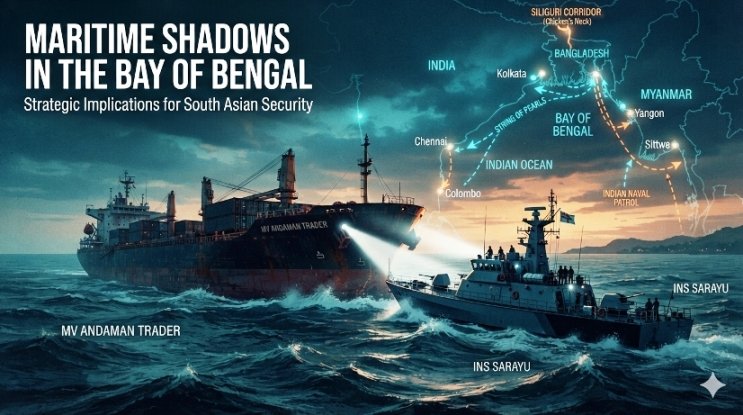
The world knows that China has been working on its ‘String of Pearls’ theory aimed at its dominance over Indian Ocean Region along with surrounding India, which China sees a major challenge in the near future. India should remain awake on the issue because both China, Bangladesh and several anti- national forces inside India are hell bent to cut the ‘Chicken’s Neck’ (Siliguri Corridor), a crucial and only link between the Indian main land to its north-eastern states.

contact: drrajeshjauhri@gmail.com
Dr Rajesh Jauhri is a Journalist with an experience of over 25 years in Indian and foreign media, a Social Scientist, an Ac-complished Author, a Political & Strategic Analyst, a Marksman (Rifle & Pistol), an Orator, a Thinker and an Educationist. He holds a Ph.D. degree on “Impact of colonial heritage on Indian police”. He runs an NGO dedicated to the social and eco-nomic uplift of tribal communities in MP and two decades back, he established a school in a village of Indore district, providing education and moral values to children belonging to underprivileged and minority families. Has received multiple awards in various fields.