


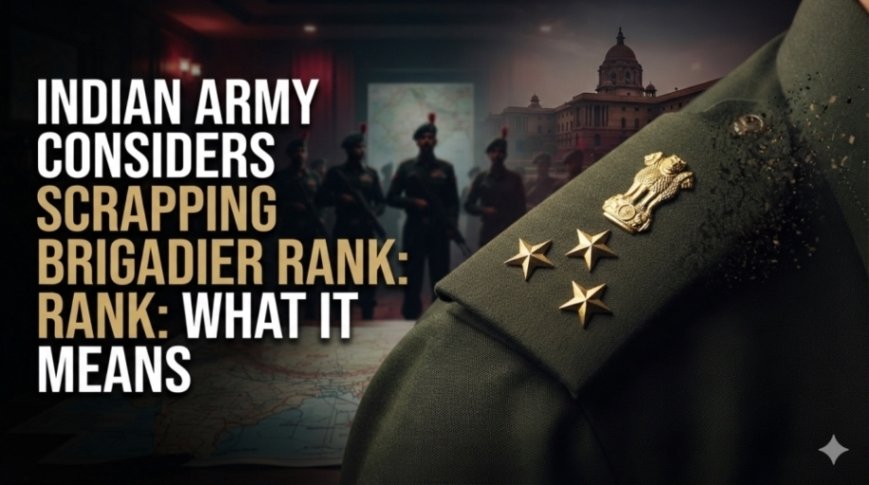
The Indian Army is preparing to formally recommend the abolition of the Brigadier rank, a significant restructuring of its officer hierarchy aimed at easing chronic promotion bottlenecks and narrowing the career-progression gap with civilian services. Under the proposal, Colonels would be promoted directly to Major General. The recommendation is expected to be routed through the Ministry of Defence to the 8th Central Pay Commission, with final submissions to the Centre targeted by May 2027 and possible implementation as early as November 2027.
Keywords: Indian Army Brigadier rank abolition, Army officer promotion restructuring, 8th Central Pay Commission Army proposal, Major General minimum retirement rank, Integrated Battle Groups command structure
The move addresses the Army’s steeply pyramidal rank structure. Approximately 86% of officer posts remain at Lieutenant Colonel level or below, while Colonels account for 10.5% percent, Brigadiers 2.5% and Major Generals just 0.8%. An Army officer currently requires 32-33 years of service to reach Pay Level 14, the grade associated with Major General. In contrast, officers of the IAS, IPS and Indian Forest Service typically attain the equivalent level in 16-18 years. By comparison, over 26% of IPS officers serve in the Senior Administrative Grade and above, against roughly 1 percent at comparable seniority in the Army.
If accepted, Major Generals would command both brigades and divisions, and the rank of Major General would become the minimum retirement rank for regular officers. The idea first surfaced in 2018 during a cadre study ordered by then Army Chief General Bipin Rawat, but is now being advanced as a formal Army recommendation. The change could also carry implications for the Navy and Air Force, where Commodore and Air Commodore hold equivalent ranks.
The proposal coincides with broader organisational reforms. In July, the Army operationalised its first five Integrated Battle Groups and a Fire Support Group, each commanded by a Major General and comprising around 5,000 troops, larger than a traditional brigade yet smaller than a division. Supporters view the rank rationalisation as a means to unclog the promotion pipeline and align military timelines more closely with civilian counterparts. Critics caution that removing an intermediate command rank risks diluting command effectiveness and operational clarity.
The Army’s existing rank structure remains in force pending government approval. The outcome will determine whether this long-discussed reform finally reshapes the service’s promotion architecture and senior command hierarchy.

contact: drrajeshjauhri@gmail.com
Dr Rajesh Jauhri is a Journalist with an experience of over 25 years in Indian and foreign media, a Social Scientist, an Ac-complished Author, a Political & Strategic Analyst, a Marksman (Rifle & Pistol), an Orator, a Thinker and an Educationist. He holds a Ph.D. degree on “Impact of colonial heritage on Indian police”. He runs an NGO dedicated to the social and eco-nomic uplift of tribal communities in MP and two decades back, he established a school in a village of Indore district, providing education and moral values to children belonging to underprivileged and minority families. Has received multiple awards in various fields.