


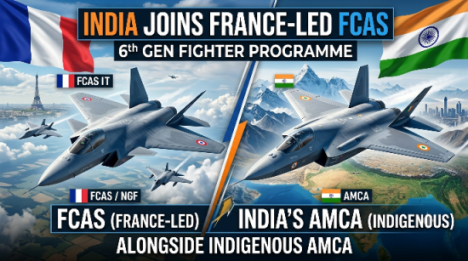
India’s Ministry of Defence has formally informed a parliamentary panel that it has initiated concerted efforts to join France’s Future Combat Air System (FCAS), the European sixth-generation combat aircraft programme. The disclosure was made in the government’s action-taken report to the Parliamentary Standing Committee on Defence, tabled in Parliament on Friday.
Keywords: India FCAS programme, sixth-generation fighter India, France FCAS India, AMCA and FCAS, Indian Air Force next-gen aircraft
According to the ministry, steps have been taken “in a concerted manner to co-join the sixth-generation Fighter Aircraft Development Programme viz. FCAS, spearheaded by the French Government.” The move is intended to run in parallel with India’s own Advanced Medium Combat Aircraft (AMCA) programme, a fifth-generation stealth fighter whose design has been finalised and whose prototype phase is approaching.
The committee noted that two major international consortia are developing sixth-generation aircraft, one involving the United Kingdom, Italy and Japan (GCAP), and the other originally centred on France and Germany (FCAS). It urged the Indian Air Force to engage with one of these programmes at an early stage so that India does not lag in acquiring advanced air combat capabilities amid increasingly air-centric modern warfare. The panel has now directed the ministry to submit a detailed status report, a clear roadmap and a tentative acquisition timeline for sixth-generation aircraft, along with an update on AMCA progress.
Observers point to recent strains within the original Franco-German FCAS partnership, including differences over work-share, requirements and intellectual property, which have led France to explore alternative collaborations. For India, participation offers potential access to advanced technologies such as manned-unmanned teaming, combat cloud networking and next-generation propulsion and stealth features, while the indigenous AMCA continues to prioritise self-reliance.
The development underscores New Delhi’s dual-track approach: accelerating domestic fifth-generation capabilities while seeking selective international partnerships to bridge technological gaps without undue delay. Success will depend on the terms of technology transfer, industrial participation and alignment with India’s long-term force structure needs.

contact: drrajeshjauhri@gmail.com
Dr Rajesh Jauhri is a Journalist with an experience of over 25 years in Indian and foreign media, a Social Scientist, an Ac-complished Author, a Political & Strategic Analyst, a Marksman (Rifle & Pistol), an Orator, a Thinker and an Educationist. He holds a Ph.D. degree on “Impact of colonial heritage on Indian police”. He runs an NGO dedicated to the social and eco-nomic uplift of tribal communities in MP and two decades back, he established a school in a village of Indore district, providing education and moral values to children belonging to underprivileged and minority families. Has received multiple awards in various fields.