

A heart-warming marriage proposal by a young Indian Army aviator following his passing-out parade at the Combat Army Aviation Training School (CAATS) in Nashik has ignited a wider debate on military decorum, personal expression, and the amplifying power of social media.
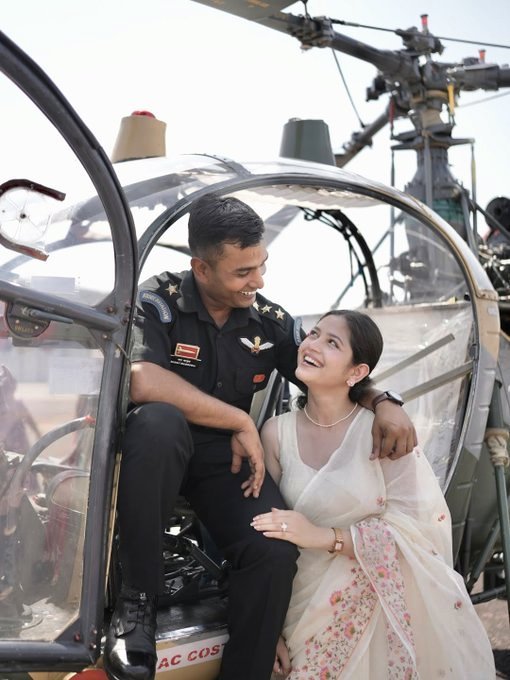
The incident occurred on June 2 after Captain Bharat Bhardwaj successfully completed his aviation training at CAATS, one of the Indian Army’s premier aviation institutions. Moments after the ceremonial parade concluded, the newly qualified officer knelt before his long-time partner and proposed marriage in the presence of fellow officers, instructors, family members and invited guests. The proposal was accepted amid applause and celebrations, with videos of the moment rapidly circulating across social media platforms.
While many viewers described the gesture as a touching and inspirational display of commitment, others questioned whether such personal acts should take place in uniform and within the setting of an official military event. The discussion subsequently evolved into a broader conversation on the boundaries between military professionalism and individual expression in an era where every moment can be instantly shared online.
Reports indicate that the Indian Army has sought an explanation through the chain of command regarding the circumstances surrounding the proposal and adherence to established protocol. However, defence sources suggest that the matter is likely to be addressed through guidance rather than formal disciplinary action, reflecting the institution’s preference for mentoring young officers while preserving standards of conduct.
The controversy has also drawn responses from veterans. Lt Gen (Retd) KJS Dhillon publicly defended the officer, arguing that a soldier expected to make the ultimate sacrifice for the nation should not be criticised for expressing affection towards his fiancée during a landmark moment in his life. He further rejected suggestions that the presence of military equipment in photographs raised security concerns, noting that Army platforms are routinely displayed during public outreach and “Know Your Army” events.
The episode highlights a contemporary challenge confronting armed forces worldwide: maintaining cherished traditions of discipline and professionalism while adapting to a digitally connected generation, the ‘GenZ’. As military institutions continue to engage with a social-media-driven society, the Nashik proposal may well be remembered as a case study in balancing protocol with the human dimension of military service.

contact: drrajeshjauhri@gmail.com
Dr Rajesh Jauhri is a Journalist with an experience of over 25 years in Indian and foreign media, a Social Scientist, an Ac-complished Author, a Political & Strategic Analyst, a Marksman (Rifle & Pistol), an Orator, a Thinker and an Educationist. He holds a Ph.D. degree on “Impact of colonial heritage on Indian police”. He runs an NGO dedicated to the social and eco-nomic uplift of tribal communities in MP and two decades back, he established a school in a village of Indore district, providing education and moral values to children belonging to underprivileged and minority families. Has received multiple awards in various fields.