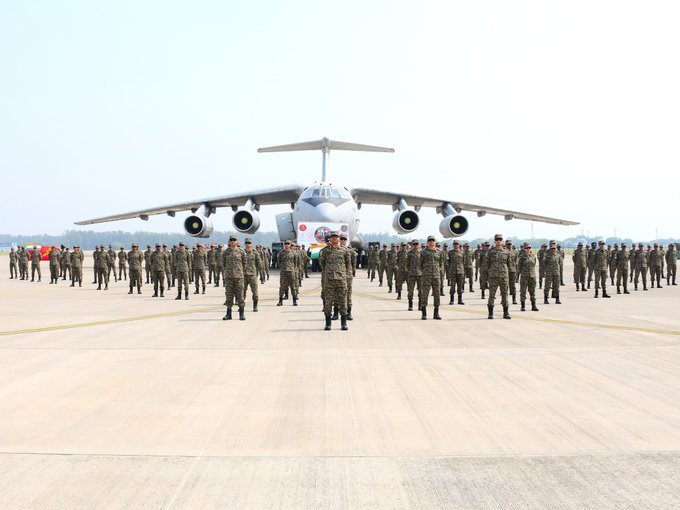
New Delhi: The Indian Army contingent has departed for Cambodia to participate in the second edition of the India-Cambodia Bilateral Military Exercise CINBAX-II 2026, marking another important step in deepening defence cooperation between the two nations.
According to the Additional Directorate General of Public Information (ADGPI) of the Indian Army, the joint exercise will be held from May 4 to May 17, 2026, at the Techo Sen Phnom Thom Mreas Prov Royal Cambodian Air Force Training Centre, also known as Camp Basil, in Kampong Speu Province, Cambodia.
The exercise will focus on company-level joint training for operations in a sub-conventional environment, a term generally used for counter-insurgency, counter-terrorism, peacekeeping and other conflict scenarios that fall below the threshold of conventional warfare.
Military analysts say such bilateral drills have become increasingly significant in today’s security landscape, where armed forces must prepare not only for traditional combat but also for asymmetric threats, humanitarian emergencies and transnational security challenges.
For India, CINBAX-II aligns with its broader strategic outreach in Southeast Asia under the Act East Policy, which seeks stronger economic, diplomatic and security engagement with the ASEAN region. Cambodia occupies an important place in that framework, both geographically and politically, as the Indo-Pacific continues to emerge as a key theatre of global strategic interest.
For Cambodia, cooperation with India offers opportunities in military training, professional exchanges, tactical learning and capacity building. India has steadily expanded defence partnerships with friendly foreign nations by sharing operational expertise, training standards and institutional knowledge developed through decades of diverse military experience.
Exercises such as CINBAX-II also help participating forces build interoperability, the ability to operate together smoothly during joint missions, peacekeeping deployments or humanitarian assistance operations. Troops train in common procedures, communication systems, battlefield drills and decision-making processes, reducing friction during real-world contingencies.
Beyond immediate military value, these engagements foster trust between partner nations and contribute to regional stability. In an era shaped by natural disasters, maritime security concerns, terrorism and evolving geopolitical competition, collaborative preparedness has become an essential pillar of national security.
The second edition of CINBAX demonstrates that India and Cambodia are committed to strengthening long-term defence ties through practical cooperation. As the exercise begins in Kampong Speu, it signals a shared intention to build readiness, resilience and mutual confidence in an increasingly Uncertain World.

contact: drrajeshjauhri@gmail.com
Dr Rajesh Jauhri is a Journalist with an experience of over 25 years in Indian and foreign media, a Social Scientist, an Ac-complished Author, a Political & Strategic Analyst, a Marksman (Rifle & Pistol), an Orator, a Thinker and an Educationist. He holds a Ph.D. degree on “Impact of colonial heritage on Indian police”. He runs an NGO dedicated to the social and eco-nomic uplift of tribal communities in MP and two decades back, he established a school in a village of Indore district, providing education and moral values to children belonging to underprivileged and minority families. Has received multiple awards in various fields.