
Lucknow: In a period marked by intensified command-level scrutiny across the Indian Armed Forces, senior military leaders are conducting extensive inspections of key installations to assess and enhance operational readiness amid a fluid geopolitical environment. These high-level visits, spanning Army, Navy, and Air Force establishments nationwide, underscore a strategic emphasis on maintaining peak combat effectiveness, infrastructure resilience, and personnel preparedness in response to evolving regional security dynamics.
Air Marshal Balakrishnan Manikantan, Air Officer Commanding-in-Chief (AOC-in-C) of the Central Air Command, recently visited Air Force Station Darbhanga in Bihar as part of this broader initiative. Upon arrival, the senior officer was received with full military honours by the Station Commander. The visit provided a comprehensive platform for evaluating the station’s operational capabilities and ongoing infrastructure enhancements critical to supporting both military flying operations and civil aviation requirements in the eastern sector.
Air Force Station Darbhanga, a dual-use facility that serves the Indian Air Force while facilitating civilian air traffic through Darbhanga Airport, plays a vital role in the region’s air power projection and rapid response capabilities. Its strategic location enhances the IAF’s ability to maintain air dominance and logistical support across eastern and central India.
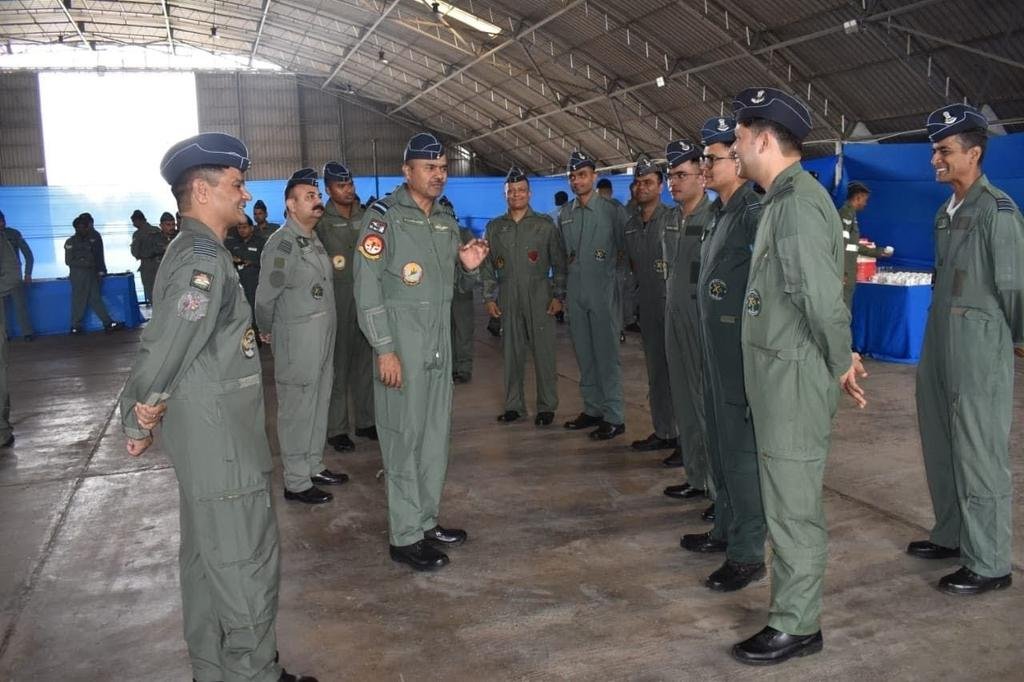
During the inspection, Air Marshal Manikantan conducted a detailed review of operational readiness parameters, including aircrew proficiency, maintenance standards, and mission sustainment protocols. He paid particular attention to infrastructure development projects aimed at improving quality of life and operational efficiency for station personnel. The AOC-in-C formally inaugurated several newly constructed facilities: a Medical Inspection (MI) Room equipped with modern diagnostic and treatment capabilities, an upgraded Mess for officers and airmen, additional Transit Accommodation to support rotational deployments and visiting aircrew, and a state-of-the-art Indoor Sports Complex designed to bolster physical fitness and morale.
These additions reflect the Indian Air Force’s ongoing commitment to holistic welfare measures that directly contribute to sustained operational effectiveness. Modern medical infrastructure ensures rapid response to health needs in a high-tempo environment, while improved accommodation and recreational facilities help mitigate the stresses associated with demanding flying and ground duties.
Air Marshal Manikantan commended the station’s personnel for their “unwavering dedication and professionalism.” In interactions with officers, airmen, and support staff, he highlighted the station’s pivotal contribution to robust flying operations in the sector and its seamless assistance to civil aviation activities. He stressed the importance of maintaining high standards of training, maintenance discipline, and inter-agency coordination, particularly as India navigates complex security challenges along its borders and in the broader Indo-Pacific region.
The visit comes against the backdrop of concerted efforts by the Indian Armed Forces to adapt to contemporary warfare paradigms. Recent Army Commanders’ Conferences have designated 2026 as the year of “Networking and Data Centricity,” focusing on technology infusion, drone integration, and network-centric operations to build a more agile “Future Ready Force.” Similarly, the Indian Navy’s Commanders’ Conference has prioritised maritime domain awareness, long-duration sustainment, and capability development. The IAF’s parallel command-level engagements, including those led by Air Marshal Manikantan at Central Air Command, align with this national push toward enhanced jointness, indigenisation, and rapid technological absorption.
A seasoned helicopter combat leader and Qualified Flying Instructor with over 5,500 flying hours, Air Marshal Manikantan assumed charge of Central Air Command on 1 May 2025 after commanding Southern Air Command. His extensive operational experience brings a pragmatic, mission-oriented perspective to these readiness assessments.
Inspections of this nature serve multiple strategic purposes. They enable senior commanders to gain first-hand insights into ground realities, identify bottlenecks in real time, and accelerate decision-making on resource allocation. In an era of hybrid threats, multi-domain operations, and contested airspace, such engagements reinforce doctrinal alignment, validate training outcomes, and signal unwavering resolve to both domestic and external audiences.
For Air Force Station Darbhanga, the high-level endorsement and infrastructural boost are expected to further elevate its role as a key node in Central Air Command’s operational matrix. As India continues to modernise its air power capabilities, with emphasis on advanced platforms, integrated air defence, and seamless civil-military synergy, stations like Darbhanga will remain instrumental in translating strategic intent into tactical proficiency.
The Indian Air Force’s proactive approach to readiness, exemplified by Air Marshal Manikantan’s visit, reaffirms its position as a cornerstone of national defence. In a changing geopolitical landscape characterised by assertive posturing and technological disruption, sustained command attention to operational stations ensures that India’s air warriors remain prepared to safeguard sovereignty and contribute effectively to regional stability.
As these command-level inspections continue across the services, defence analysts anticipate further momentum in capability development, infrastructure rationalisation, and human capital optimisation, essential pillars for a credible and future-ready military posture.

contact: drrajeshjauhri@gmail.com
Dr Rajesh Jauhri is a Journalist with an experience of over 25 years in Indian and foreign media, a Social Scientist, an Ac-complished Author, a Political & Strategic Analyst, a Marksman (Rifle & Pistol), an Orator, a Thinker and an Educationist. He holds a Ph.D. degree on “Impact of colonial heritage on Indian police”. He runs an NGO dedicated to the social and eco-nomic uplift of tribal communities in MP and two decades back, he established a school in a village of Indore district, providing education and moral values to children belonging to underprivileged and minority families. Has received multiple awards in various fields.