

New Delhi: China has displaced the United States as India’s single largest trading partner in the financial year 2025-26, official commerce data confirm, with the bilateral merchandise trade deficit swelling to an unprecedented $112 billion.
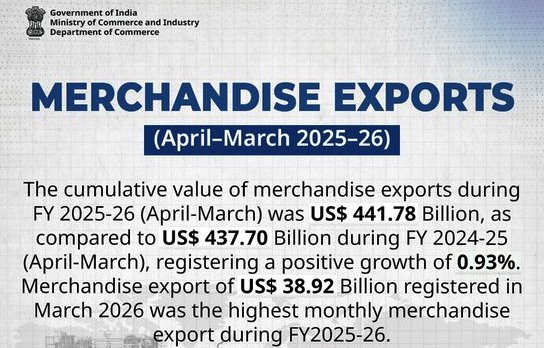
The development underscores the resilience of India-China commercial ties even as New Delhi continues to deepen strategic and defence cooperation with Washington and its Quad partners. It also arrives against the backdrop of steady, albeit modest, growth in India’s overall merchandise exports, which reached $441.78 billion for the full fiscal year, a 0.93 per cent increase over the $437.70 billion recorded in FY 2024-25.
March 2026 proved the strongest month of the year, with outbound shipments touching $38.92 billion, the highest monthly figure in FY 2025-26 and a clear sign of sustained momentum in the final quarter.
Widening Deficit Despite Policy Push for Diversification
The $112 billion deficit with China reflects a familiar pattern: robust Indian imports of electronics, machinery, active pharmaceutical ingredients, and intermediate goods continue to outpace exports to the Chinese market. While successive Indian governments have promoted “Atmanirbhar Bharat” and production-linked incentive schemes to reduce strategic dependencies, China remains the dominant supplier in several critical sectors, including components that feed into India’s burgeoning defence electronics and aerospace supply chains.
Defence analysts note that certain dual-use items sourced from China, ranging from specialised alloys to sub-systems in radar and communication equipment, still feature in the inventory of both public and private Indian defence manufacturers. The scale of the overall trade imbalance therefore carries implications beyond economics, touching upon supply-chain resilience at a time when the Indian armed forces are accelerating indigenisation under the “Make in India” and “Make II” initiatives.
Exports Show Resilience
The modest 0.93 per cent year-on-year rise in merchandise exports nevertheless indicates underlying stability. Engineering goods, pharmaceuticals, gems and jewellery, and petroleum products remained key drivers, with the strong March performance suggesting that global demand for Indian manufactures held firm despite protectionist headwinds in several Western markets.
Commerce ministry officials, speaking on condition of anonymity, described the export outturn as “encouraging” given the challenging global trade environment. They pointed to the successful implementation of free-trade agreements with Australia, the UAE and the United Kingdom, as well as the operationalisation of the India-EFTA pact, as factors helping to offset any softening in traditional markets.
Strategic Context: Balancing Beijing and Washington
The return of China to the top trading-partner slot comes at a delicate geopolitical juncture. India and China remain locked in a military standoff along the Line of Actual Control in eastern Ladakh, now in its sixth year, even as disengagement talks continue at the corps-commander level. Simultaneously, defence and technology ties with the United States have reached new heights through the Initiative on Critical and Emerging Technologies (ICET), the Quad’s supply-chain working group, and expanded joint military exercises.
Senior officials in the Ministry of Defence and the National Security Council have repeatedly emphasised the need to “de-risk” rather than “de-couple” from Chinese supply chains. The latest trade figures are expected to intensify internal debates on accelerating the production of strategic minerals, semiconductors, and defence-grade electronics within India and friendly partner nations.
Industry observers believe the government may use the forthcoming Budget and subsequent policy announcements to further incentivise domestic manufacturing in sectors where Chinese dominance remains pronounced. Whether such measures can meaningfully narrow the $112 billion gap in the near term remains an open question.
Outlook
For now, the data paint a picture of pragmatic economic engagement with Beijing alongside a clear strategic tilt towards Washington and its allies. India’s defence planners will be watching closely to ensure that expanding commercial interdependence does not compromise the country’s ability to maintain technological edge and operational readiness in an increasingly contested Indo-Pacific theatre.
The coming months are likely to see heightened scrutiny of import patterns in dual-use categories, even as Indian exporters seek fresh markets to sustain the modest but steady growth trajectory established in FY 2025-26.

contact: drrajeshjauhri@gmail.com
Dr Rajesh Jauhri is a Journalist with an experience of over 25 years in Indian and foreign media, a Social Scientist, an Ac-complished Author, a Political & Strategic Analyst, a Marksman (Rifle & Pistol), an Orator, a Thinker and an Educationist. He holds a Ph.D. degree on “Impact of colonial heritage on Indian police”. He runs an NGO dedicated to the social and eco-nomic uplift of tribal communities in MP and two decades back, he established a school in a village of Indore district, providing education and moral values to children belonging to underprivileged and minority families. Has received multiple awards in various fields.