

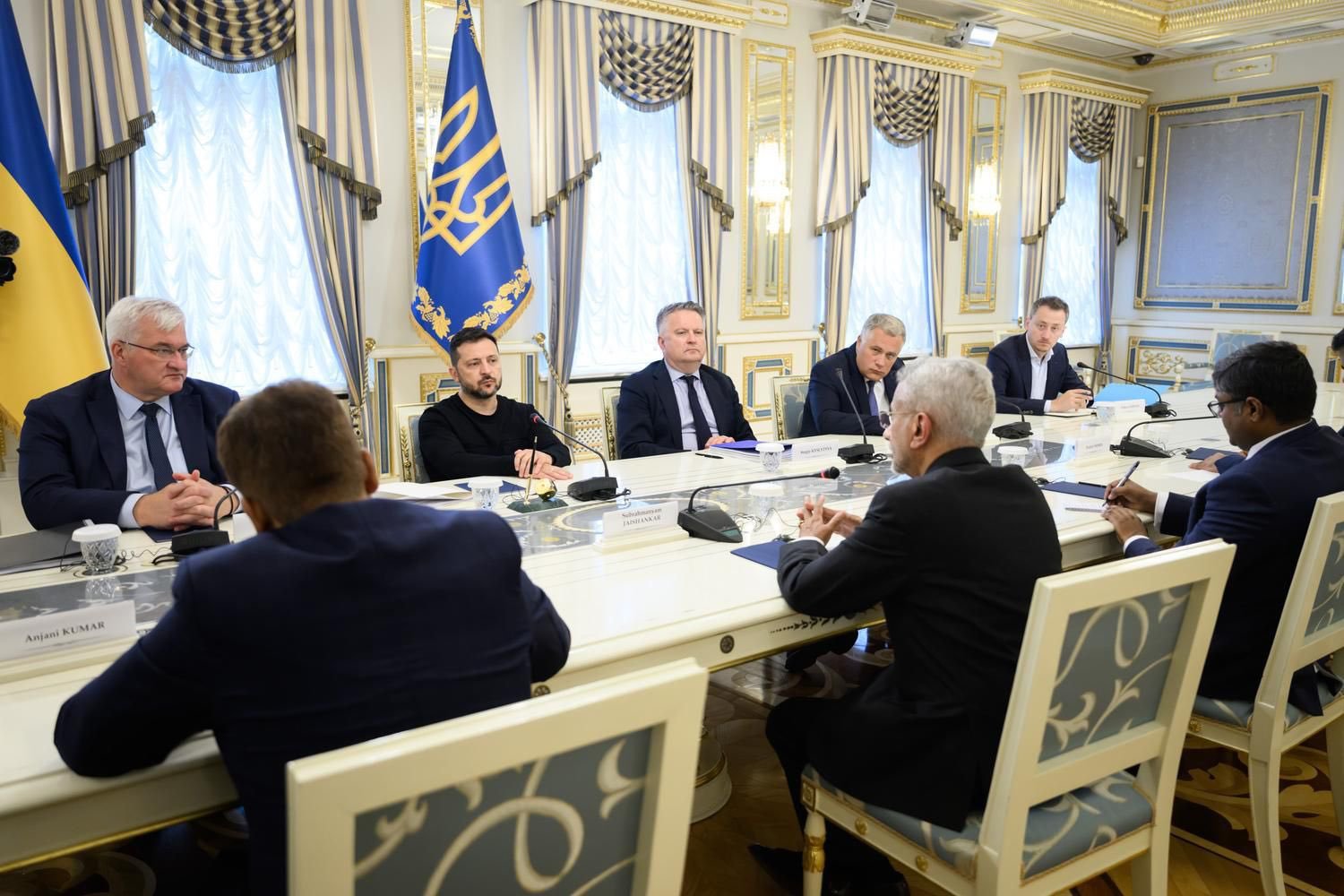
In a landmark diplomatic engagement, External Affairs Minister Dr S Jaishankar conducted his first dedicated bilateral visit to Ukraine on September 3, 2026, holding high-level discussions with President Volodymyr Zelenskyy and Foreign Minister Andrii Sybiha. Set against a tense security backdrop marked by Black Sea maritime disruptions and fresh drone strikes on Kyiv, the talks centred on resolving the protracted conflict while expanding bilateral cooperation across key domains.
Keywords: S Jaishankar Ukraine Visit 2026, India Energy Security Russian Oil, Volodymyr Zelenskyy Dialogue Diplomacy, India Ukraine Bilateral Relations, Defence Chronicle Geopolitics Peace
During a press conference in Kyiv, Dr Jaishankar addressed global scrutiny regarding India’s energy purchases from Russia, articulating a stance rooted in realpolitik and national interest. Responding directly to criticism over crude oil imports, he underscored the imperative of securing energy for India’s massive population amid tight global markets.
“It is important for all of you to understand the challenges of providing energy for 1.4 billion people. Ukraine has its perspective, which we respect. India has its own perspective, which I expect you to respect,” Jaishankar asserted.
He further noted that global conflict resolution cannot be achieved through resource boycotts or trade restrictions, stating that lasting peace requires sustained dialogue, negotiation, and diplomacy.
President Zelenskyy acknowledged New Delhi’s principled stance and expressed gratitude for India’s commitment to facilitating peaceful resolution mechanisms. While briefing the Indian delegation on maritime security threats affecting Black Sea shipping routes, Zelenskyy highlighted the shared goal of protecting global supply chains and regional stability. Beyond crisis diplomacy, both nations reaffirmed plans to broaden bilateral engagement in core growth sectors, including education, healthcare, digital technology, and agriculture.
Dr. Jaishankar’s Kyiv visit reinforces India’s strategic posture on the world stage: maintaining principled strategic autonomy, safeguarding national energy security, and promoting dialogue as the primary vehicle for geopolitical resolution.
From a defence and strategic affairs perspective, Dr S Jaishankar’s Kyiv engagement illustrates New Delhi’s operationalization of multi-alignment and realpolitik in a fragmented international order. Defence analysts highlight that India’s refusal to weaponise energy trade while simultaneously engaging directly with a warring nation reflects a mature strategic autonomy, one that decoupled humanitarian crisis diplomacy from Western pressure and secondary market restrictions. Strategic experts view this high-stakes diplomacy as a calculated assertion of India’s role as an indispensable regional power and a credible mediator; by framing energy security for 1.4 billion citizens as a non-negotiable national interest, New Delhi firmly established that strategic decision-making in the Indo-Pacific and Global South will not be dictated by Eurocentric security priorities. Furthermore, by leveraging the platform to address critical regional vulnerabilities, such as Black Sea maritime trade lines and seafarer safety, India demonstrated that its non-aligned posture is not passive neutrality, but an active, pragmatism-driven framework aimed at safeguarding global supply chains and expanding its economic and technical footprint even amidst conflict.
contact: drrajeshjauhri@gmail.com
Dr Rajesh Jauhri is a Journalist with an experience of over 25 years in Indian and foreign media, a Social Scientist, an Ac-complished Author, a Political & Strategic Analyst, a Marksman (Rifle & Pistol), an Orator, a Thinker and an Educationist. He holds a Ph.D. degree on “Impact of colonial heritage on Indian police”. He runs an NGO dedicated to the social and eco-nomic uplift of tribal communities in MP and two decades back, he established a school in a village of Indore district, providing education and moral values to children belonging to underprivileged and minority families. Has received multiple awards in various fields.