

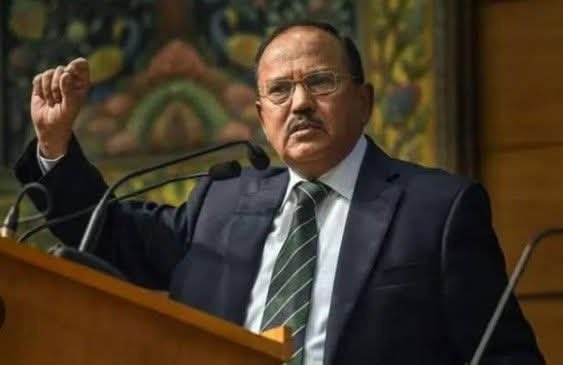
New Delhi: India’s National Security Adviser, , has offered one of the most detailed public accounts yet of Operation Sindoor, describing it as a landmark demonstration of India’s precision-strike capability, intelligence-driven warfare, and indigenous defence technology.Speaking as the chief guest at the 62nd Convocation of IIT Madras, Doval asserted that the operation showcased the growing effectiveness of India’s home-grown military systems and the seamless integration of intelligence, surveillance, and strike capabilities.According to Doval, Indian forces identified nine terrorist targets located deep inside Pakistani territory and executed a highly coordinated operation that lasted just 23 minutes. He stated that the mission commenced at 1:05 a.m. and concluded at 1:28 a.m., with all designated targets successfully engaged.“The operation was based on pin-point intelligence and every intended target was struck,” Doval told the graduating students, describing the mission as an example of modern precision warfare.In a strong rebuttal to claims circulated by Pakistan and sections of the foreign media regarding alleged Indian losses, Doval challenged critics to produce verifiable satellite imagery showing damage on the Indian side. Referring to the widespread availability of commercial satellite technology, he argued that any significant damage would be easily visible and documented.He further alleged that Pakistan had resorted to misinformation campaigns to mask the failure of its response, while emphasizing that no credible evidence had emerged to substantiate claims of major Indian losses.A significant part of Doval’s address focused on India’s indigenous defence ecosystem. He highlighted the role of domestically developed military technologies and command-and-control networks in ensuring mission success. Among the systems he praised were the BrahMos missile system, India’s Integrated Air Command and Control System (IACCS), and advanced radar networks that, according to him, provided uninterrupted situational awareness and targeting precision throughout the operation.For defence observers, Doval’s remarks reinforce the growing emphasis on self-reliance in military technology under India’s indigenous defence modernisation efforts. The operation, as described by the NSA, reflects a maturing capability to combine intelligence gathering, network-centric warfare, precision-guided weapons, and real-time command systems into a unified operational framework.Addressing the students, Doval also linked national security with technological innovation. He urged India’s youth to contribute to emerging fields such as artificial intelligence, quantum computing, and advanced defence technologies, arguing that technological leadership would be central to India’s ambition of becoming a fully developed nation by 2047.If Doval’s account is taken at face value, Operation Sindoor may be remembered not only as a counter-terror operation but also as a significant demonstration of India’s increasingly sophisticated indigenous defence architecture and its ability to conduct rapid, precision military actions with strategic effect.

contact: drrajeshjauhri@gmail.com
Dr Rajesh Jauhri is a Journalist with an experience of over 25 years in Indian and foreign media, a Social Scientist, an Ac-complished Author, a Political & Strategic Analyst, a Marksman (Rifle & Pistol), an Orator, a Thinker and an Educationist. He holds a Ph.D. degree on “Impact of colonial heritage on Indian police”. He runs an NGO dedicated to the social and eco-nomic uplift of tribal communities in MP and two decades back, he established a school in a village of Indore district, providing education and moral values to children belonging to underprivileged and minority families. Has received multiple awards in various fields.