

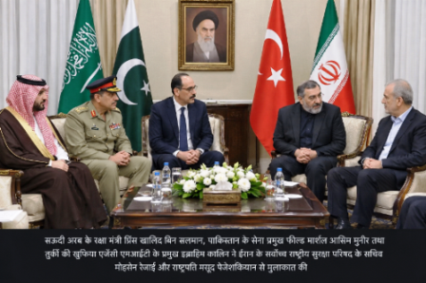
In a significant diplomatic development amid heightened regional tensions, all three stakeholders of the Mecca Joint Defense Agreement countries met Iranian leaders in Tehran on 26 October 2026. Saudi Arabia’s Defence Minister Prince Khalid bin Salman, Pakistan’s Field Marshal Asim Munir, and Türkiye’s National Intelligence Organization (MIT) chief Ibrahim Kalin held discussions with Iranian President Masoud Pezeshkian and the Secretary of Iran’s Supreme National Security Council, Mohsen Rezaei.
Keywords: Mecca Joint Defense Agreement, Tehran security talks, Khalid bin Salman Iran visit, Asim Munir Tehran meeting, Middle East de-escalation, regional security dialogue
The Saudi Foreign Ministry described the visit as part of ongoing efforts by Mecca Pact members to de-escalate the current crisis, encourage dialogue and diplomatic solutions, and support mediation initiatives led by Qatar and Pakistan. Iranian officials characterised the talks as a practical step toward building “endogenous security” in West Asia through cooperation among regional states. Both sides agreed to continue discussions aimed at strengthening collaboration on peace and security.
This marked the first joint high-level engagement between the Mecca Pact countries and Iran since the formation of the defence arrangement. The meeting comes against the backdrop of recent Houthi attacks on Saudi targets and concerns over possible renewed military escalation involving the United States and Israel. Field Marshal Munir, who has visited Tehran multiple times in recent months as part of Pakistan’s mediation efforts, played a notable role in facilitating the gathering.
Strategic analysts view the talks as an attempt to manage regional flashpoints through direct dialogue rather than confrontation. While the Mecca Pact was originally conceived as a mutual defence framework among Saudi Arabia, Pakistan and Türkiye, the Tehran meeting signals a pragmatic outreach to Iran. Officials have emphasised de-escalation and diplomatic channels over any shift toward confrontation with external powers.
The outcome remains limited to an agreement on continued engagement. No concrete security arrangements or joint statements on broader geopolitical alignments were announced. Observers note that deep-seated differences on regional issues, including the situation in Yemen, Lebanon and the wider Israeli-Palestinian conflict, continue to pose challenges.
For defence watchers, the Tehran meeting underscores the fluid nature of Middle Eastern alignments and the growing preference among regional actors for intra-regional diplomacy. Whether this initiative yields lasting de-escalation or remains a temporary diplomatic gesture will depend on follow-up actions in the coming weeks.
contact: drrajeshjauhri@gmail.com
Dr Rajesh Jauhri is a Journalist with an experience of over 25 years in Indian and foreign media, a Social Scientist, an Ac-complished Author, a Political & Strategic Analyst, a Marksman (Rifle & Pistol), an Orator, a Thinker and an Educationist. He holds a Ph.D. degree on “Impact of colonial heritage on Indian police”. He runs an NGO dedicated to the social and eco-nomic uplift of tribal communities in MP and two decades back, he established a school in a village of Indore district, providing education and moral values to children belonging to underprivileged and minority families. Has received multiple awards in various fields.