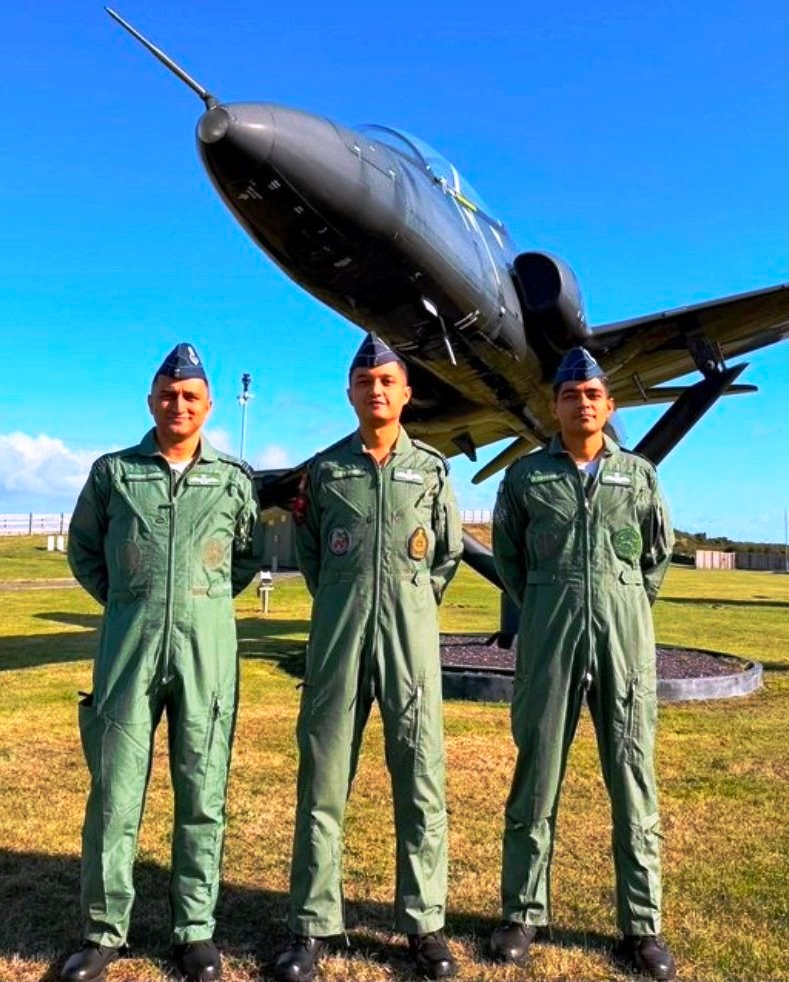
In a landmark first for India-UK defence cooperation, three Qualified Flying Instructors from the Indian Air Force (IAF) have taken up duties at British Royal Air Force (RAF) Valley in Wales to train RAF pilots. The deployment, confirmed in recent weeks, marks the first time Indian QFIs are instructing British aircrew on the Hawk-T2 and Texan-T1 aircraft at the RAF’s premier fast-jet training base. It is to be noted that despite getting independence, India had two British Generals as Army Chiefs, three British Air Marshals as Air Chiefs and four British Admirals as Naval Chiefs. Thereafter, Indian officers started taking over as Service Chiefs in all three forces in India.
Keywords: Indian Air Force QFIs RAF Valley, India UK defence cooperation, Hawk T2 training RAF, IAF instructors British pilots, UK-India Air Staff Talks 2026, East India Company, Colonial Rule, Commonwealth, British Crown, Indian Independence, 1947
The arrangement was finalised during the 19th UK-India Air Staff Talks held in New Delhi on February 12, 2026. It builds on a broader military training cooperation agreement signed during British Prime Minister Keir Starmer’s visit to Mumbai in October 2025. The instructors will serve initial two-year tenure. While remaining under Indian Air Force command, they will work under RAF leadership for day-to-day instructional duties, integrating seamlessly into No. 4 Flying Training School.
This development carries striking historical resonance. In 1932, the Royal Air Force played a foundational role in training India’s earliest military pilots. Nearly a century later, the dynamic has reversed: Indian expertise is now helping prepare the next generation of British fast-jet aviators destined for Typhoon and F-35 cockpits. The move also completes a notable milestone, Indian service personnel now serve as instructors across all three major British military academies, following earlier deployments to RAF College Cranwell, Britannia Royal Naval College Dartmouth, and the Royal Military Academy Sandhurst.
Beyond symbolism, the deployment addresses practical needs. The RAF has faced shortages of qualified instructors, while the Indian Air Force brings extensive experience operating the Hawk advanced jet trainer. The exchange enhances mutual understanding of procedures, strengthens interoperability, and deepens professional bonds that will endure beyond the posting.
Observers view the initiative as a concrete expression of growing strategic trust between New Delhi and London. As both air forces invest in shared standards of excellence, this quiet but significant step underscores a maturing defence partnership rooted in professional respect rather than hierarchy.

contact: drrajeshjauhri@gmail.com
Dr Rajesh Jauhri is a Journalist with an experience of over 25 years in Indian and foreign media, a Social Scientist, an Ac-complished Author, a Political & Strategic Analyst, a Marksman (Rifle & Pistol), an Orator, a Thinker and an Educationist. He holds a Ph.D. degree on “Impact of colonial heritage on Indian police”. He runs an NGO dedicated to the social and eco-nomic uplift of tribal communities in MP and two decades back, he established a school in a village of Indore district, providing education and moral values to children belonging to underprivileged and minority families. Has received multiple awards in various fields.