

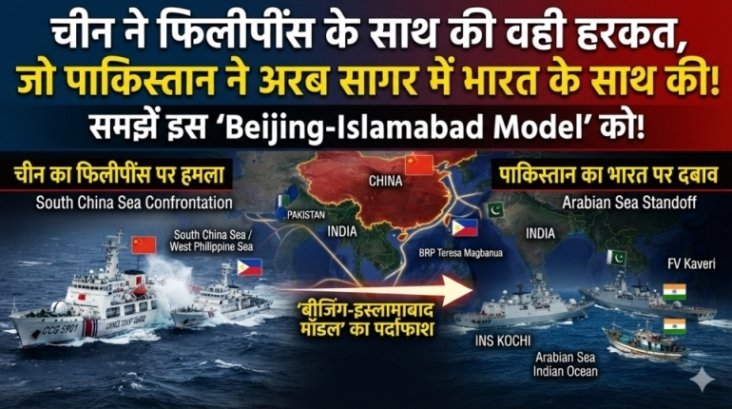
In a troubling escalation across key Indo-Pacific chokepoints, recent incidents in the North Arabian Sea and the South China Sea reveal an aligned operational playbook between Beijing and Islamabad. On September 15, Pakistan Navy’s Yarmook-class corvette PNS Hunain executed high-speed, unprofessional manoeuvres against a frontline Indian Navy warship (INS Kolkata) conducting routine surveillance in international waters. The reckless interception resulted in a collision. While the Indian warship’s captain exercised maximum restraint to avoid a major catastrophe, leaving the vessel undamaged, PNS Hunain suffered severe structural damage and was forced to return to harbour.
Keywords: Beijing, Islamabad, maritime alliance, PNS Hunain collision, Indian Navy, China Coast Guard ramming Philippines, Indo-Pacific grey zone, warfare tactics, South China Sea, Arabian Sea, naval security
Barely days later, a China Coast Guard (CCG) vessel deployed a near-identical tactic, intentionally ramming a Philippine Bureau of Fisheries and Aquatic Resources boat (BRP Datu Magat Salamat) near Abad Santos Shoal, roughly 54 nautical miles off Palawan. Replicating its established diplomatic script, Beijing immediately blamed Manila, alleging infringement and provocative course changes.
These synchronized maritime provocations demonstrate that Pakistan and China are not merely strategic partners, but coordinated actors employing identical grey-zone tactics. By intentionally provoking collisions and subsequently weaponising diplomatic disinformation, accusing the victim nation of non-compliance, both countries actively violate the International Regulations for Preventing Collisions at Sea (COLREGs) and UNCLOS frameworks.
The ‘Beijing-Islamabad axis’ relies on escalating tension below the threshold of open kinetic warfare. By manoeuvring dangerously close to naval assets operating within legitimate exclusive economic zones and international waters, both regimes aim to erode neighbouring nations’ sovereign maritime rights.
As the naval forces of China and Pakistan deepen joint exercises and interoperability, this shared doctrine of aggressive manoeuvrability presents a dangerous threat to global maritime trade routes and rules-based international order. The international community must recognize this dual-front coercion and enforce stricter accountability against such reckless naval conduct.

contact: drrajeshjauhri@gmail.com
Dr Rajesh Jauhri is a Journalist with an experience of over 25 years in Indian and foreign media, a Social Scientist, an Ac-complished Author, a Political & Strategic Analyst, a Marksman (Rifle & Pistol), an Orator, a Thinker and an Educationist. He holds a Ph.D. degree on “Impact of colonial heritage on Indian police”. He runs an NGO dedicated to the social and eco-nomic uplift of tribal communities in MP and two decades back, he established a school in a village of Indore district, providing education and moral values to children belonging to underprivileged and minority families. Has received multiple awards in various fields.