



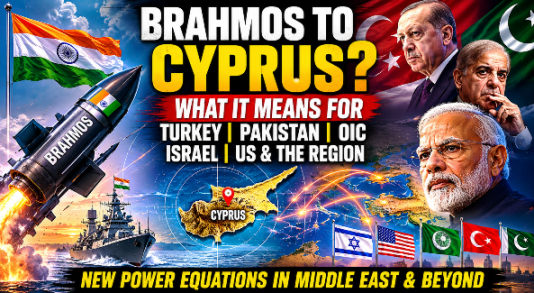
Reports and speculation surrounding a potential Indian BrahMos missile sale to Cyprus have triggered considerable debate in strategic circles across Europe, West Asia and South Asia. While no official confirmation of such a deal has been announced, the possibility itself has generated interest because of the broader geopolitical context in which it would occur.
A BrahMos acquisition by Cyprus would represent far more than conventional defence procurement. It would be viewed as a strategic signal reflecting India’s growing role as a defence exporter, its expanding geopolitical footprint in the Mediterranean, and the evolving nature of its relationships with Turkey, Pakistan and other regional actors.
Why Cyprus Matters
Cyprus occupies a strategically significant location in the Eastern Mediterranean. The island sits at the intersection of Europe, West Asia and North Africa, making it an important geopolitical node for maritime security, energy infrastructure and regional military balance.
For decades, tensions between Cyprus and Turkey have remained a defining feature of Eastern Mediterranean politics. Turkey maintains military forces in Northern Cyprus and does not recognize the internationally recognized Republic of Cyprus as the sole authority over the island. Consequently, any major enhancement of Cypriot military capabilities inevitably attracts attention in Ankara.
In such a context, the introduction of a highly capable precision-strike missile system like BrahMos would be interpreted not merely as an arms purchase but as a strategic shift in deterrence capabilities.
The BrahMos Factor
The BrahMos supersonic cruise missile has emerged as one of India’s most successful defence exports and a symbol of the country’s growing indigenous military-industrial capability.
Its speed, precision and versatility have made it attractive to nations seeking credible deterrence without investing in significantly larger military structures. The missile’s successful export to Southeast Asia has already demonstrated that New Delhi is increasingly willing to use defence exports as a component of strategic diplomacy.
A potential Cyprus deal would therefore fit into a broader pattern of India’s effort to establish itself as a reliable supplier of advanced defence systems to friendly nations.
Implications for India-Turkey Relations
Relations between India and Turkey have experienced periods of strain over several years. Ankara has frequently voiced support for Pakistan’s position on Kashmir on international forums, while India has viewed such interventions as interference in its internal affairs.
Turkey’s political leadership has also periodically criticized Indian policies in relation to Jammu and Kashmir and constitutional changes associated with Article 370.
Against this backdrop, a BrahMos sale to Cyprus would likely be interpreted by Turkish policymakers as a strategic message. Although India would officially characterize any such deal as a legitimate defence export to a sovereign nation, Turkish observers may perceive it as a response to Ankara’s persistent alignment with Pakistan on issues sensitive to New Delhi.
However, it would be inaccurate to view the matter solely through the prism of retaliation. India’s defence export policy increasingly reflects commercial, strategic and diplomatic considerations rather than ideological alignments alone.
Pakistan’s Perspective
Pakistan would closely monitor any BrahMos deployment in Cyprus, even though the geographical distance limits direct military implications.
Islamabad’s concern would be more political than operational. Pakistan has traditionally benefited from diplomatic support from Turkey in multilateral forums. If India deepens defence cooperation with countries that have longstanding disagreements with Ankara, Pakistan could interpret it as evidence of New Delhi’s expanding geopolitical influence.
Such developments would reinforce perceptions within Pakistan that India is gradually building strategic partnerships across multiple regions, including Europe, Southeast Asia, the Gulf and the Mediterranean.
The OIC Dimension
The impact on members of the Organization of Islamic Cooperation (OIC) would likely be mixed rather than uniform.
Many OIC countries today pursue foreign policies based on national interests rather than bloc politics. Several Gulf states have significantly expanded economic and strategic engagement with India despite differences on certain political issues.
As a result, a hypothetical BrahMos sale to Cyprus is unlikely to generate a collective OIC response. Individual states would assess the development through the lens of their own security interests and bilateral relations.
The growing strategic partnerships between India and several Gulf nations suggest that New Delhi’s ties with key Arab capitals would probably remain unaffected.
Israel and the Strategic Convergence
Israel would likely view expanded Indian defence engagement in the Mediterranean with interest.
Over the past two decades, India and Israel have developed a robust defence and technology partnership. Both countries share concerns regarding regional instability, maritime security and emerging strategic competition.
A stronger Indian presence in the Eastern Mediterranean could complement broader efforts aimed at enhancing security cooperation among democratic and strategically aligned states operating across the Mediterranean and West Asian theatres.
The United States and NATO Considerations
Washington’s reaction would likely depend on the broader strategic environment. Cyprus has become increasingly important in discussions related to Mediterranean security, energy routes and regional stability. The United States has gradually expanded engagement with Cyprus in recent years while simultaneously maintaining Turkey’s importance within NATO.
American policymakers would therefore seek to balance competing interests. A BrahMos acquisition by Cyprus could be viewed positively from the perspective of strengthening a partner’s deterrence capabilities, but it could also add another layer of complexity to already sensitive Turkey-Cyprus relations.
Impact on West Asia and the Eastern Mediterranean
The Eastern Mediterranean is undergoing significant transformation driven by energy exploration, maritime disputes and shifting alliances.
Advanced missile systems have become important instruments of deterrence in this environment. If Cyprus were to acquire BrahMos, regional actors would reassess existing military balances and contingency planning.
Such a development could encourage other countries to accelerate modernization programs, potentially increasing demand for advanced missile systems across the wider region.
Signals for Southeast Asia and the South China Sea
Perhaps the most significant long-term implication would be the message sent to countries in Southeast Asia.
Several nations facing maritime security challenges are already evaluating advanced coastal defence systems. The successful export of BrahMos to one region strengthens confidence among prospective customers elsewhere.
For countries concerned about maintaining credible deterrence in contested maritime environments, India’s missile export record could become an increasingly important factor in procurement decisions.
A Cyprus deal, if realized, would therefore extend beyond Europe and influence perceptions of Indian defence technology across the Indo-Pacific.
Faith Angle
Cyprus is predominantly Christian, while Turkey has a Muslim-majority population. However, reducing the strategic significance of a potential BrahMos transaction to religious identities would oversimplify a far more complex reality.
Modern defence relationships are driven primarily by security calculations, strategic geography, economic interests and diplomatic priorities. Experts believe that the nations purchase advanced military systems not on the basis of religious affiliation but because of operational requirements and geopolitical considerations but the case of Turkey is different from that perspective. It is a known and established fact that Turkey is believed to be the Throne of Khalifa since the advent of Islam and the grand Khilafat movement was witnessed not only in Islamic nations but also in far-off countries like India in early years of 20th century. The core idea of ISIS like organisations is based on the Khilafat of Turkey, which has been shown in blockbuster films like Kerala Story (India), Profie (England), Layla M (Netherlands), Heaven Will wait (France), Road to Istambul (France), Caliphate (Sweden), Rabia (France), The Return: Life after ISIS (Spain), ISIS: Women Unveiled (England), Return from ISIS (United States) and many more. So, the faith or religious angle cannot be overlooked when BrahMos sale issue to Cyprus is discussed.
Conclusion
Whether or not a BrahMos sale to Cyprus ultimately materializes, the discussion itself highlights India’s growing stature as a defence exporter and strategic actor.
A potential deal would carry implications extending far beyond a single arms transaction. It would affect perceptions in Ankara and Islamabad, attract attention in Washington and Brussels, reinforce India’s expanding defence diplomacy, and potentially influence procurement calculations from the Mediterranean to the Indo-Pacific.
Most importantly, it would underscore a broader reality of twenty-first century geopolitics: India’s strategic choices are increasingly shaping regional equations well beyond its immediate neighbourhood.

contact: drrajeshjauhri@gmail.com
Dr Rajesh Jauhri is a Journalist with an experience of over 25 years in Indian and foreign media, a Social Scientist, an Ac-complished Author, a Political & Strategic Analyst, a Marksman (Rifle & Pistol), an Orator, a Thinker and an Educationist. He holds a Ph.D. degree on “Impact of colonial heritage on Indian police”. He runs an NGO dedicated to the social and eco-nomic uplift of tribal communities in MP and two decades back, he established a school in a village of Indore district, providing education and moral values to children belonging to underprivileged and minority families. Has received multiple awards in various fields.