
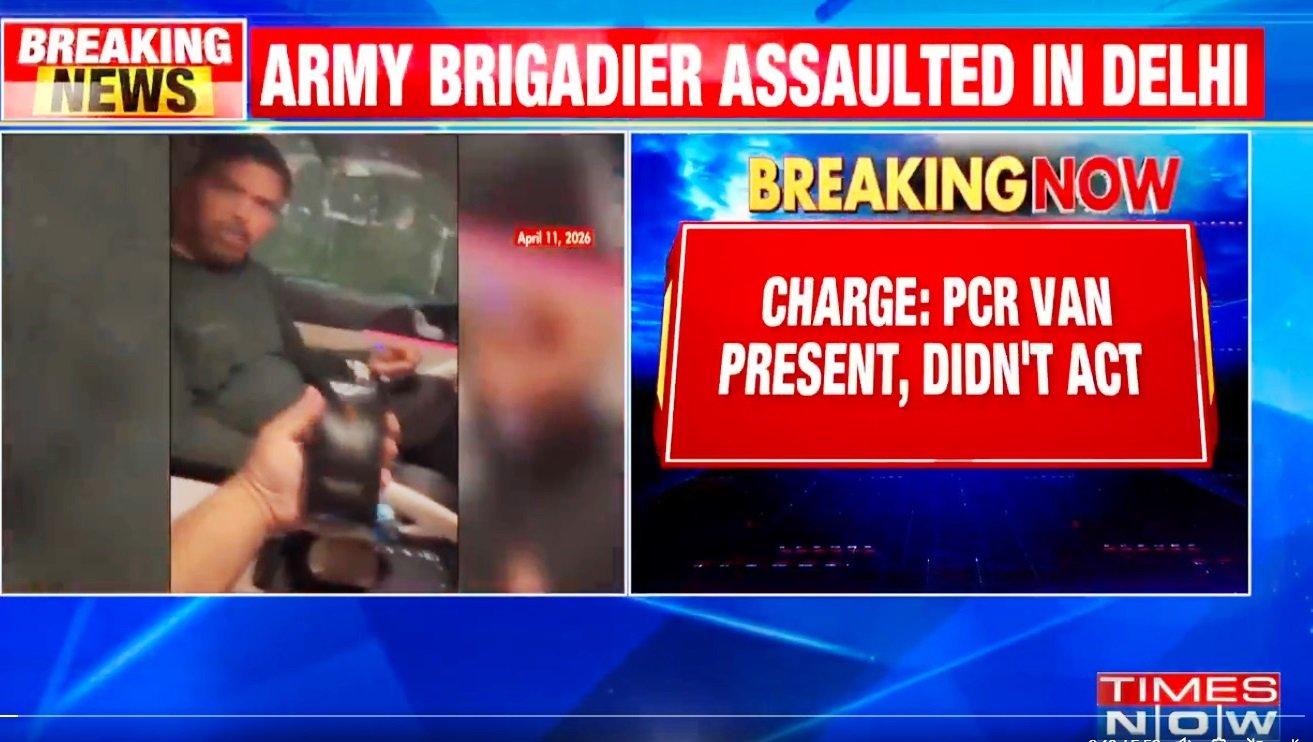
New Delhi: In a disturbing incident that has sent ripples through India’s defence community, an Indian Army Brigadier and his son were physically assaulted in the upscale Vasant Enclave neighbourhood of south Delhi late on April 11, 2026 after they objected to public drinking by a group of men inside a parked luxury vehicle.
According to preliminary police and military sources, Brigadier Parminder Singh Arora, accompanied by his son, confronted occupants of a Mercedes SUV, who were consuming alcohol in a public area. What began as a verbal objection quickly escalated when seven to eight additional individuals arrived at the scene and turned violent, assaulting both the officer and his son.
Eyewitness accounts and family statements indicate that Delhi Police personnel who reached the spot initially took no decisive action to intervene or apprehend the assailants. The victims reportedly faced significant delays in registering a formal complaint and obtaining immediate medical assistance from civilian facilities. In response, the family sought treatment at a military hospital, a move that itself underscores the institutional trust deficit that has since become central to the narrative.
The episode might have remained a local law-and-order matter had it not involved a serving senior Army officer. Outrage within military circles, including veterans’ groups and active-duty forums, prompted swift intervention by Army authorities. Senior military officials are understood to have engaged directly with the Delhi Police leadership, leading to accelerated action.
Within hours, Delhi Police registered a First Information Report (FIR). Two primary suspects have been identified through CCTV footage, while an inspector at the local police station has been removed from duty and a sub-inspector suspended pending inquiry. Police officials have described the moves as part of an internal review to address “lapses in initial response.”
Defence analysts view the incident as symptomatic of a deeper malaise. “Uniformed personnel expect the same respect and protection from the state that they are sworn to provide it,” said a retired Major-General who requested anonymity. “When an officer in civilian clothes cannot ensure safety for himself and his family in the national capital, it raises serious questions about the rule of law and the societal premium placed on those who wear the uniform.”
The episode has reignited long-standing debates about public safety in Delhi, particularly in affluent residential pockets where enforcement of liquor consumption laws has often been perceived as lax. It also comes at a time when the armed forces continue to grapple with post-pandemic recruitment challenges and heightened operational commitments along the northern and western borders. Any perception that the state is failing to safeguard its own defenders risks eroding the moral contract between the military and civil society.
As investigations proceed, both the Army and the Delhi Police have pledged transparency and swift justice. The incident, however, has already become a litmus test for how seriously the capital’s administration treats threats to the dignity and physical security of India’s serving military personnel. For many in the defence fraternity, the real measure of accountability will not lie in the suspension of a few junior officers but in whether such assaults are treated as attacks on the institution itself.
contact: drrajeshjauhri@gmail.com
Dr Rajesh Jauhri is a Journalist with an experience of over 25 years in Indian and foreign media, a Social Scientist, an Ac-complished Author, a Political & Strategic Analyst, a Marksman (Rifle & Pistol), an Orator, a Thinker and an Educationist. He holds a Ph.D. degree on “Impact of colonial heritage on Indian police”. He runs an NGO dedicated to the social and eco-nomic uplift of tribal communities in MP and two decades back, he established a school in a village of Indore district, providing education and moral values to children belonging to underprivileged and minority families. Has received multiple awards in various fields.