
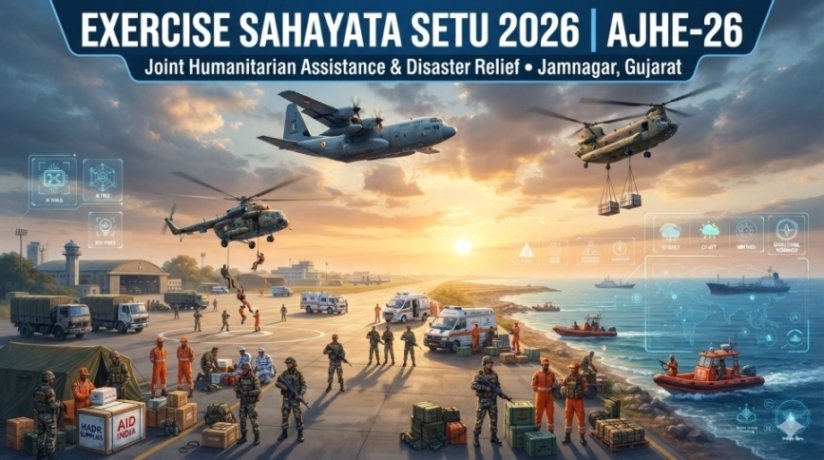
India has reinforced its strategic standing as the primary humanitarian first responder in the Indo-Pacific following the conclusion of Exercise Sahayata Setu 2026 (AJHE-26), a three-day multinational Humanitarian Assistance and Disaster Relief (HADR) drill held from November 17 to 19 at Air Force Station Jamnagar, Gujarat. Hosted by the Indian Air Force under the aegis of Headquarters Integrated Defence Staff and South Western Air Command, the exercise integrated India’s Army, Navy, Air Force, Coast Guard, National Disaster Response Force (NDRF), and state agencies alongside representatives from two dozen friendly nations affiliated with the Indian Ocean Rim Association (IORA), BIMSTEC, and the Quadrilateral Security Dialogue (QUAD).
Keywords: Exercise Sahayata Setu 2026, Annual Joint HADR Exercise AJHE-26, Indian Air Force Jamnagar HADR Drill, CDS General N. S. Raja Subramani, Indo-Pacific Disaster Relief IORA BIMSTEC QUAD, India First Responder Indian Ocean Region
Addressing the closing Multi-Agency Capability Demonstration, Chief of Defence Staff General N. S. Raja Subramani underscored that modern crises demand a cohesive “whole-of-nation” framework rather than siloed institutional efforts. Aligning the drill with New Delhi’s Neighbourhood First policy, he emphasized that rapid aerial reconnaissance and interoperable command structures are vital to saving lives during complex emergencies such as cyclones, earthquakes, floods, and chemical hazards. The curriculum also drew lessons from India’s recent overseas relief missions, including Operation Brahma in Myanmar and Operation Sagar Bandhu in Sri Lanka.
Broadcast live nationwide on Doordarshan, the culminating operational display showcased seamless civil-military synergy under simulated severe cyclonic conditions. The exercise commenced with remotely piloted quadcopters conducting real-time damage assessments before heavy-lift assets intervened. C-130J Super Hercules transport aircraft executed rapid tactical insertions, while CH-47F Chinook helicopters airlifted critical medical crates and modular bridge structures into inaccessible zones. Simultaneously, Mi-17 helicopters deployed Bambi buckets supported by firefighting robots, and specialized rapid-response troops performed precision rappelling and combat free-fall rescues from AN-32 aircraft.
Beyond field maneuvers, expert seminars examined artificial intelligence-driven predictive analytics, marine hazard forecasting, and unified command protocols. By bridging military capability with regional diplomacy, Sahayata Setu 2026 has established a robust operational blueprint for collective disaster resilience across the Indian Ocean Region.
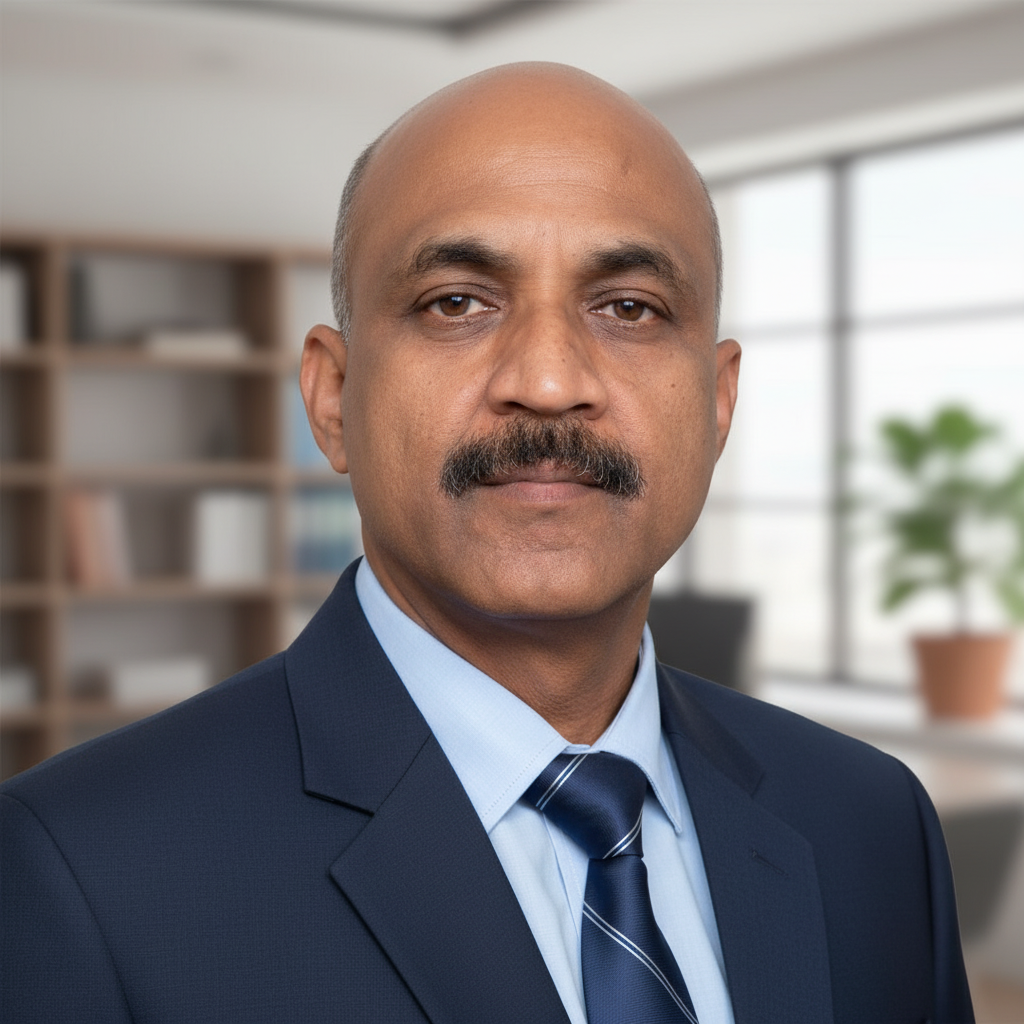
contact: drrajeshjauhri@gmail.com
Dr Rajesh Jauhri is a Journalist with an experience of over 25 years in Indian and foreign media, a Social Scientist, an Ac-complished Author, a Political & Strategic Analyst, a Marksman (Rifle & Pistol), an Orator, a Thinker and an Educationist. He holds a Ph.D. degree on “Impact of colonial heritage on Indian police”. He runs an NGO dedicated to the social and eco-nomic uplift of tribal communities in MP and two decades back, he established a school in a village of Indore district, providing education and moral values to children belonging to underprivileged and minority families. Has received multiple awards in various fields.