



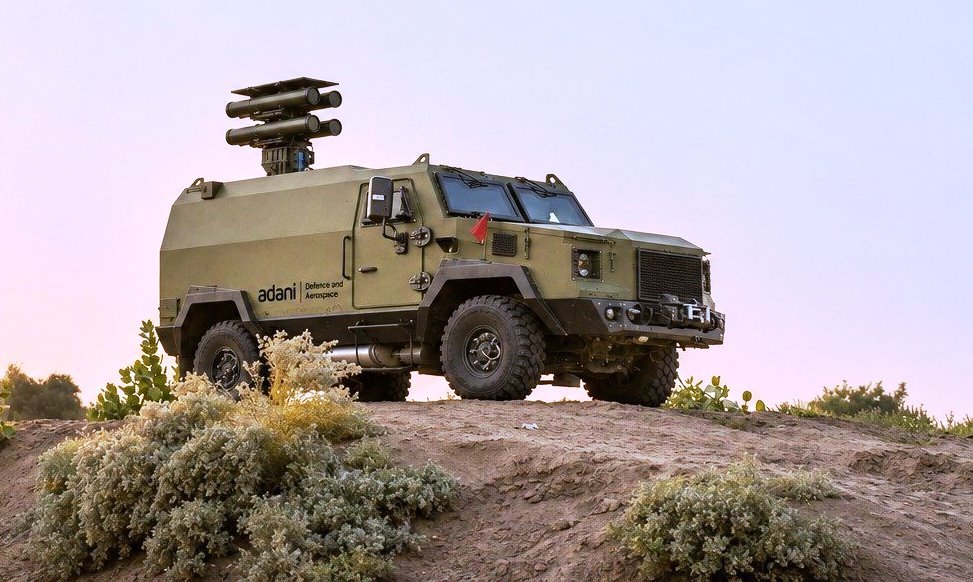

The Defence Research and Development Organisation’s Long Range Anti-Ship Missile (LR-AShM) is rapidly emerging as a transformative asset for the Indian Navy, significantly enhancing its ability to project power and deny sea control across the Indian Ocean Region. Mounted on a heavy multi-axle Transporter Erector Launcher, the system is designed to engage high-value surface targets at extended ranges with minimal warning time.
Keywords: LR-AShM, DRDO, hypersonic missile, Indian Navy, anti-ship, Long Range Anti-Ship Missile, hypersonic glide vehicle India, Indian Ocean, Bay of Bengal, Malaca Strait, Gulf of Eden
A boost-glide hypersonic weapon, the LR-AShM reaches peak speeds of approximately Mach 10 during the boost phase and sustains an average of over Mach 5 in the unpowered glide phase. It follows a quasi-ballistic trajectory featuring multiple atmospheric skips and high-g manoeuvres, rendering it extremely difficult for enemy radars and missile defence systems to track or intercept. Demonstrated range exceeds 1,500 km, enabling engagement of both stationary and manoeuvring warships deep into the maritime domain. Flight time to maximum range is roughly 15 minutes, sharply compressing an adversary’s reaction window.
Propulsion comes from a two-stage solid-fuel rocket motor derived from proven technologies. After booster burnout, the glide vehicle performs complex mid-course and terminal manoeuvres guided by indigenous inertial navigation, multi-GNSS, and active radar homing seekers. The missile carries conventional warheads in multiple configurations, combining kinetic impact with explosive effect capable of critically damaging or destroying large surface combatants. It is weather- and terrain-independent and currently configured for coastal battery operations, with a ship-launched variant under development.
Successful flight trials, including a Phase-II test striking a simulated seaborne target at 1,500 km, have validated terminal accuracy, mid-course agility and sustained hypersonic performance. DRDO is now working on software and trajectory upgrades to extend the operational range towards 3,500 km without major hardware redesign, potentially using the inherent capability of the K-4-derived booster stages. Production clearance is targeted for the late 2020s, with interest also expressed by the Army and Air Force for land-attack variants.
The LR-AShM represents a concrete step in India’s drive for self-reliant defence technology. By providing a credible, long-range, high-speed anti-ship capability, it strengthens deterrence in the Indian Ocean, complicates adversary planning, and positions India among the limited group of nations fielding operational hypersonic maritime strike systems. As induction proceeds, the missile is expected to serve as a multi-service platform, reinforcing the broader strategic balance in the region.

contact: drrajeshjauhri@gmail.com
Dr Rajesh Jauhri is a Journalist with an experience of over 25 years in Indian and foreign media, a Social Scientist, an Ac-complished Author, a Political & Strategic Analyst, a Marksman (Rifle & Pistol), an Orator, a Thinker and an Educationist. He holds a Ph.D. degree on “Impact of colonial heritage on Indian police”. He runs an NGO dedicated to the social and eco-nomic uplift of tribal communities in MP and two decades back, he established a school in a village of Indore district, providing education and moral values to children belonging to underprivileged and minority families. Has received multiple awards in various fields.