



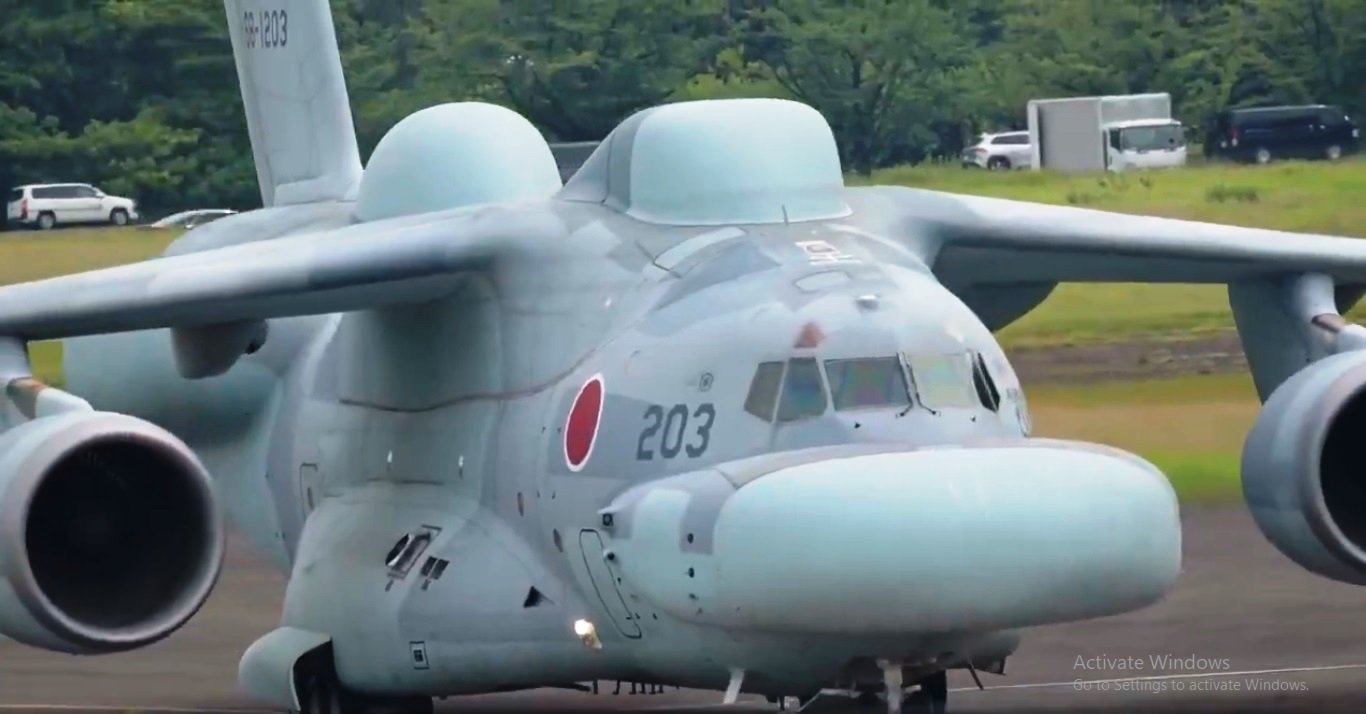
Gifu Air Base, Japan
The Japan Air Self-Defence Force (JASDF) has taken a significant step forward in bolstering its electronic warfare capabilities with the XEC-2 Stand-Off Jammer aircraft, affectionately yet aptly nicknamed the “Platypus” or “Shin Kamonohashi,” now undergoing operational flight testing.
Keywords: XEC-2 Platypus, Japanese electronic warfare aircraft, Kawasaki EC-2 Stand-Off Jammer, JASDF electromagnetic spectrum operations, Japan Air Self-Defense Force new aircraft.
A modified variant of Kawasaki’s proven C-2 transport platform, the XEC-2 made its maiden flight in March 2026 and officially commenced operational test and evaluation on July 15 at Gifu Air Base. Spotters and official imagery captured the aircraft, bearing tail number 68-1203 and the Air Development and Test Wing (ADTW) markings, conducting flights accompanied by an F-2 chase plane. Its distinctive, almost otherworldly profile, featuring a prominent bulbous nose radome and large, protruding side and dorsal pods, has drawn widespread attention, evoking comparisons to science-fiction designs while underscoring its lethal functionality.
Designed as a successor to the aging EC-1 electronic warfare aircraft in service since 1986, the XEC-2 is engineered for stand-off electromagnetic operations. From safe distances, it will detect, disrupt, and jam enemy radars, communications, and integrated air defence systems, providing critical support to JASDF strike packages without exposing itself to direct threats. The aircraft incorporates advanced Electronic Support Measures (ESM), Electronic Countermeasures (ECM), and SATCOM arrays housed within its unconventional bulges, with some systems inherited from its predecessor, including the J/ALQ-5 suite. Japan plans to field up to four of these platforms by the early 2030s as part of a broader push for indigenous expertise in the electromagnetic spectrum.
Analysts view the program as a pragmatic response to evolving regional security dynamics, where control of the electromagnetic domain is increasingly decisive. The XEC-2’s development, initiated around 2021 with substantial investment, reflects Tokyo’s commitment to modernizing its defensive posture amid heightened tensions in the Indo-Pacific.
While its aesthetics may polarize observers, described by enthusiasts as both “terrifying” and “cool”, the aircraft’s true measure lies in its mission effectiveness. As testing progresses, the Platypus promises to become a cornerstone of Japan’s next-generation airpower, blending proven airframe reliability with cutting-edge electronic attack prowess.

contact: drrajeshjauhri@gmail.com
Dr Rajesh Jauhri is a Journalist with an experience of over 25 years in Indian and foreign media, a Social Scientist, an Ac-complished Author, a Political & Strategic Analyst, a Marksman (Rifle & Pistol), an Orator, a Thinker and an Educationist. He holds a Ph.D. degree on “Impact of colonial heritage on Indian police”. He runs an NGO dedicated to the social and eco-nomic uplift of tribal communities in MP and two decades back, he established a school in a village of Indore district, providing education and moral values to children belonging to underprivileged and minority families. Has received multiple awards in various fields.