
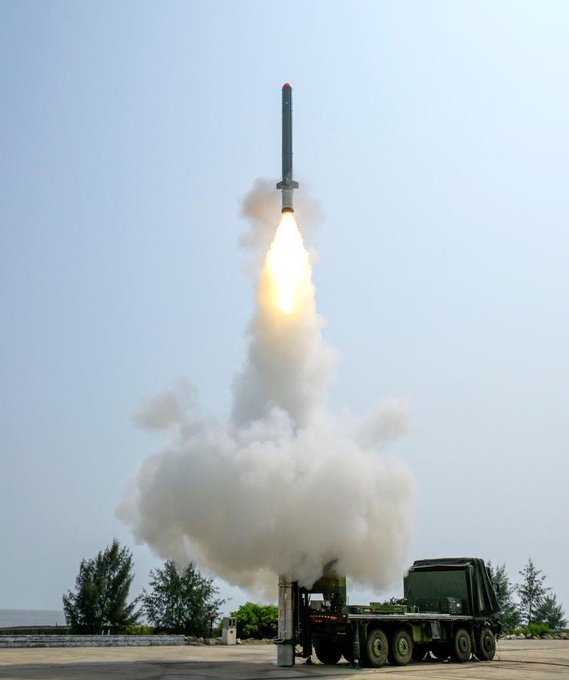
In a significant boost to India’s indigenous precision-strike capabilities, the Defence Research and Development Organisation (DRDO) successfully conducted the flight test of the indigenously developed Long Range Land Attack Cruise Missile (LRLACM) on Monday from Dr APJ Abdul Kalam Island off the Odisha coast. The missile, launched from a mobile platform, met all mission objectives, validating critical technologies in propulsion, guidance, navigation, control systems, and warhead delivery.
Tracked comprehensively by sensors at the Integrated Test Range (ITR) in Chandipur, the subsonic LRLACM demonstrated robust performance across varying altitudes and speeds, including terrain-hugging flight profiles designed to evade radar detection. Officials confirmed that the missile followed its designated path using waypoint navigation and executed complex manoeuvres as planned.
Developed primarily by the Aeronautical Development Establishment (ADE) in Bengaluru, with substantial contributions from other DRDO laboratories and Indian industry partners, the LRLACM represents a mature evolution of the Nirbhay programme. With an extended operational range of 1,000 to 1,500 kilometres, it fills a vital gap in India’s standoff weaponry arsenal, complementing supersonic systems like BrahMos and providing versatile deployment options for the Army, Navy, and Air Force across land, sea, and air platforms.
Defence Minister Rajnath Singh congratulated the DRDO team, describing the test as a major stride towards *Aatmanirbhar Bharat* and the strengthening of India’s defence ecosystem. The successful trial underscores the growing self-reliance in advanced subsystems, including a homegrown turbofan engine, advanced avionics, and software for enhanced reliability.
In the current geopolitical context, marked by persistent regional tensions, the LRLACM enhances India’s deterrent posture by enabling deep strikes without exposing launch platforms to immediate risk. Its mobile launch capability further improves survivability and operational flexibility. This achievement paves the way for further integration, user trials, and eventual induction, aligning with broader modernisation goals of the armed forces.
The test not only highlights DRDO’s maturing expertise in cruise missile technology but also signals India’s emergence as a credible player in long-range precision munitions. As development progresses, the LRLACM is expected to play a pivotal role in shaping the future battlefield dynamics for India’s tri-services.

contact: drrajeshjauhri@gmail.com
Dr Rajesh Jauhri is a Journalist with an experience of over 25 years in Indian and foreign media, a Social Scientist, an Ac-complished Author, a Political & Strategic Analyst, a Marksman (Rifle & Pistol), an Orator, a Thinker and an Educationist. He holds a Ph.D. degree on “Impact of colonial heritage on Indian police”. He runs an NGO dedicated to the social and eco-nomic uplift of tribal communities in MP and two decades back, he established a school in a village of Indore district, providing education and moral values to children belonging to underprivileged and minority families. Has received multiple awards in various fields.