

Tyndall Air Force Base, Florida
Once considered a peripheral concern, the threat posed by small unmanned aircraft systems (sUAS) has become central to how the US Air Force trains its defenders. A recent demonstration by the 325th Security Forces Squadron (SFS) at Tyndall Air Force Base highlights a fundamental shift in air base defence doctrine, driven by lessons from contemporary conflicts and the proliferation of affordable drone technology.
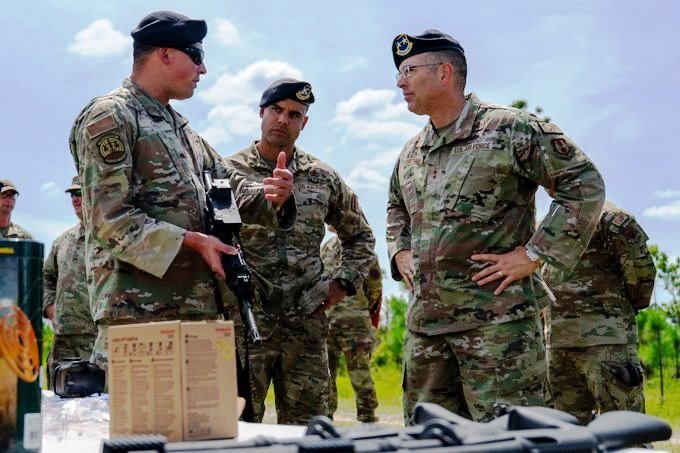
On June 3, 2026, Airmen from the 325th SFS showcased kinetic counter-sUAS capabilities to Air Force Installation and Mission Support Center Commander Maj Gen Thomas P Sherman. The event featured live-fire engagements using the M870 shotgun against simulated drone targets, alongside briefings on the SMASH 2000 electro-optical fire control system mounted on M4A1 carbines. This initiative aims to qualify approximately 210 defenders in specialized skills to establish robust point-defence against low-altitude, high-speed aerial threats.
Senior Master Sgt Reginald Walters, 325th SFS future operations superintendent, emphasized the transformation: “The drone domain is a transformational mechanism that will continue to evolve. It’s important that every single defender is capable of integrating current systems and capabilities to deter, detect, delay, deny and defeat.” The training draws heavily from after-action reports in Ukraine, where small drones have demonstrated their ability to disrupt operations and overwhelm traditional defences.
The program operates under Title 10 US Code, Section 130i, authorizing installations to counter unmanned threats while adhering to FAA guidelines. Defenders will arrive pre-certified on basic weapons, allowing focused training on aerial engagement. The SMASH 2000 system enhances accuracy by automatically calculating ballistic solutions and locking onto moving targets, significantly boosting first-round hit probability.
This evolution reflects broader US military adaptations. The proliferation of commercial and military-grade drones has compressed decision timelines and expanded the threat spectrum, from state actors like China and Russia to non-state groups. Conflicts in Ukraine and the Middle East have shown how inexpensive sUAS can target high-value assets, prompting investments in layered defences that combine kinetic solutions, electronic warfare, and advanced sensors.
For the Air Force, securing fixed and expeditionary bases is critical to maintaining air superiority in potential peer conflicts. Initiatives like the Point Defence Battle Lab and joint task forces underscore a commitment to rapid capability development. As one training leader noted, arming patrols with shotguns and smart optics “drastically expands our defeat bubble” for drones entering airspace.
The changing playbook signals a more proactive, integrated approach to base defence. What was once niche is now mission-essential training, ensuring Airmen can protect installations that serve as launch points for global power projection. As threats continue to evolve, such innovations will be vital to preserving operational resilience in an era of contested skies.

contact: drrajeshjauhri@gmail.com
Dr Rajesh Jauhri is a Journalist with an experience of over 25 years in Indian and foreign media, a Social Scientist, an Ac-complished Author, a Political & Strategic Analyst, a Marksman (Rifle & Pistol), an Orator, a Thinker and an Educationist. He holds a Ph.D. degree on “Impact of colonial heritage on Indian police”. He runs an NGO dedicated to the social and eco-nomic uplift of tribal communities in MP and two decades back, he established a school in a village of Indore district, providing education and moral values to children belonging to underprivileged and minority families. Has received multiple awards in various fields.